War and the Process of State-making

As we discussed in class on Thursday, there is a close relationship between the war, the state, and state-making.  Thus, violence is at the root of the idea of the modern state, as Weber’s famous definition of the state aptly demonstrates.  Norbert Elias suggested that the state-formation process in Europe was “an elimination contest.”  In addition, Charles Tilly famously wrote* “war made the state and the state made war.”  In a much-read paper** on the topic, Tilly wrote:

What distinguished the violence produced by states from the violence delivered by anyone else? In the long run, enough to make the division between “legitimate” and “illegitimate” force credible. Eventually, the personnel of states purveyed violence on a larger scale, more effectively, more efficiently, with wider assent from their subject populations, and with readier collaboration from neighboring authorities than did the personnel of other organizations.  But it took a long time for that series of distinctions to become established. Early in the state-making process, many parties shared the right to use violence, the practice of using it routinely to accomplish their ends, or both at once. The continuum ran from bandits and pirates to kings via tax collectors, regional power holders, and professional soldiers.

The uncertain, elastic line between “legitimate” and “illegitimate” violence appeared in the upper reaches of power. Early in the state-making process, many parties shared the right to use violence, its actual employment, or both at once. The long love-hate affair between aspiring state makers and pirates or bandits illustrates the division. “Behind piracy on the seas acted cities and city-states,” writes Fernand Braudel of the sixteenth century. “Behind banditry, that terrestrial piracy, appeared the continual aid of lords.”‘ In times of war, indeed, the managers of full-fledged states often commissioned privateers, hired sometime bandits to raid their enemies, and encouraged their regular troops to take booty. In royal service, soldiers and sailors were often expected to provide for themselves by preying on the civilian population: commandeering, raping, looting, taking prizes. When demobilized, they commonly continued the same practices, but without the same royal protection; demobilized ships became pirate vessels, demobilized troops bandits.

It also worked the other way: A king’s best source of armed supporters was sometimes the world of outlaws. Robin Hood’s conversion to royal archer may be a myth, but the myth records a practice. The distinctions between “legitimate” and “illegitimate” users of violence came clear only very slowly, in the process during which the state’s armed forces became relatively unified and permanent.

The process of legitimation of state violence came, as Tilly argues above, slowly.  What, according to Weber, are the different types of legitimacy that attended to this process?

*Charles Tilly, “Reflections on the History of European State-Making,” in Charles Tilly, ed.,  The Formation of National States in Western Europe (Princeton, N.J.: Princeton Univ. Press, 1975), p. 42.

**Tilly, Charles. “War Making and State Making as Organized Crime, ” in Evans, Rueschemeyer and Skocpol, ed., Brining the State Back in (Cambridge: Cambridge University Press, 1985), p.172-173.

***Elias, Norbert. The Civilizing Process  (Oxford: Blackwell), 1993.
Human Security Resources

A general trend has developed, amongst governments, academics, and (especially) activists working in IGOs and NGOs worldwide that has moved the focus of security away from traditional concepts–such as protecting borders from external threat–to a new approach that focuses specifically on human security. What is “human security?” Well, the Human Security Report Project, at Vancouver, Canada’s Simon Fraser University, defines human security in this way:

Unlike traditional concepts of security, which focus on defending borders from external military threats, human security is concerned with the security of individuals…

For some proponents of human security, the key threat is violence; for others the threat agenda is much broader, embracing hunger, disease and natural disasters. Largely for pragmatic reasons, the Human Security Report Project has adopted the narrower concept of human security that focuses on protecting individuals and communities from violence.

Traditional security policy emphasizes military means for reducing the risks of war and for prevailing if deterrence fails. Human security’s proponents, while not eschewing the use of force, have focused to a much greater degree on non-coercive approaches. These range from preventive diplomacy, conflict management and post–conflict peacebuilding, to addressing the root causes of conflict by building state capacity and promoting equitable economic development.

The website has an informative and very useful set of links to various organizations, governmental institutions, research institutes, etc., that focus on issues of human security.

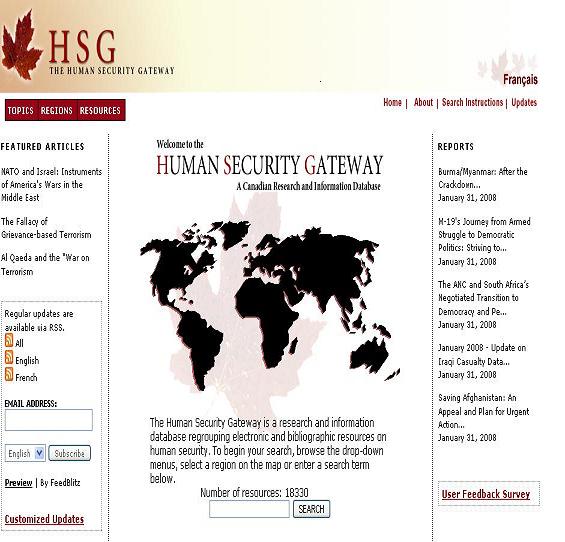
Another excellent source for information related to human security is the Human Security Gateway. Below is a thumbnails which will take you to a screen shot of their home page. (Notice the RSS feed icons in the left sidebar.)

human_security_gateway_homepage1.jpg

The History of Warfare since World War II–via Foods Fighting

We spent much of last Friday’s session understanding various realist approaches to international relations and the importance therein of concepts like anarchy, survival, power and war. Here’s a clear–and highly original–attempt to demonstrate the history of world warfare since WWII. For a menu of the foods and which countries they are meant to represent, click here. Before doing so, which foods do you think represent Great Britain, Germany, France, China, and the United States, respectively?  You can view the film here.

UCDP/PRIO Armed Conflict Dataset


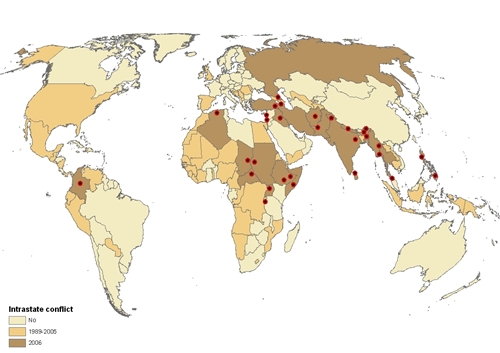
konfliktkart_8908.jpg

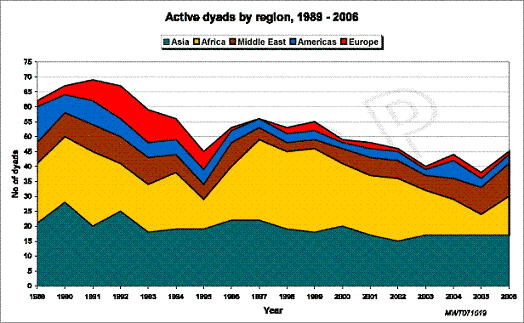
The Centre for the Study of Civil War at the International Peace Research Institute, Oslo (PRIO) and Uppsala Conflict Data Program (UCDP) at the Department of Peace and Conflict Research, Uppsala University, are the home for the Armed Conflict Dataset.  The dataset allows users access to information on such variables as name of conflict, antagonists, whether/not there was third-party intervention, etc., for all global conflicts between 1946 and 2002.  The website also has other data sources and illuminating charts and graphs, an example of which is reproduced below.

dyads_year_reg1.gif

This chart shows the number of conflicts in various regions of the world over time.

NATO–Preemptive Nuclear Strike a Key Option?

We discussed in class today the use of preemptive force to respond to potential security threats and how this was a central component of President Bush’s National Security Strategy (NSS) of the United States (2002). Now, according to the Guardian newspaper, it seems that “five of the west’s most senior military officers and strategists” have insisted that NATO (the North Atlantic Treaty Organization) and the

west must be ready to resort to a preemptive nuclear attack to try to halt the “imminent” spread of nuclear and other weapons of mass destruction.

Calling for root-and-branch reform of Nato and a new pact drawing the US, Nato and the European Union together in a “grand strategy” to tackle the challenges of an increasingly brutal world, the former armed forces chiefs from the US, Britain, Germany, France and the Netherlands insist that a “first strike” nuclear option remains an “indispensable instrument” since there is “simply no realistic prospect of a nuclear-free world”.

The manifesto has been written following discussions with active commanders and policymakers, many of whom are unable or unwilling to publicly air their views. It has been presented to the Pentagon in Washington and to Nato’s secretary general, Jaap de Hoop Scheffer, over the past 10 days. The proposals are likely to be discussed at a Nato summit in Bucharest in April.

“The risk of further [nuclear] proliferation is imminent and, with it, the danger that nuclear war fighting, albeit limited in scope, might become possible,” the authors argued in the 150-page blueprint for urgent reform of western military strategy and structures. “The first use of nuclear weapons must remain in the quiver of escalation as the ultimate instrument to prevent the use of weapons of mass destruction.”

Remember that in one of our earlier sessions we wondered aloud if there were any institutionalized norms in international relations and we thought that maybe there was a normative injunction against the use of nuclear weapons. Nina Tannenwald has written about the “nuclear taboo” but suggests that in the aftermath of WWII, officials in the US and Europe thought that nuclear weapons would come to be seen as another type of conventional weapon.

Continue reading “NATO–Preemptive Nuclear Strike a Key Option?”

Congo Civil War Kills 45,000 Persons Monthly

We’ll be covering war and strife later in the semester and we’ll note that the nature of warfare has changed over the years. Whereas most wars in the past were of the inter-state variety, contemporary wars are mostly intra-state (i.e, wars resulting from civil and ethnic conflict). A worrisome characteristic of these contemporary wars is that the vast majority of victims are civilians and they generally succumb to factors, such as disease and hunger, not related to direct conflict. In a new report by the International Red Cross, we learn that 45,000 persons have died (and continue to die) monthly from civil war in Congo.

25congo600.jpg

The effects of one of the bloodiest wars in modern history continue to unfold in relative obscurity in the Democratic Republic of Congo, where 5.4 million lives have been lost as a result of conflict since 1998, according to a nationwide mortality survey that will be released today.

While the conflict in the Darfur region of neighbouring Sudan has begun to draw substantial international attention, the humanitarian crisis resulting from conflict in the Congo has received almost none. About 200,000 people have been killed in Darfur, and two million displaced.

“People aren’t dying dramatically in Congo,” said Richard Brennan, a lead researcher with the U.S.-based International Rescue Committee, which conducted the survey. “It’s not like a Rwandan genocide where people die in a very dramatic and acute manner. They are dying quietly and anonymously.”

In fact, very few of the recorded deaths were caused directly by violence, roughly 0.4 per cent nationwide, the report says. Instead, the principal causes of death across Congo, a largely undeveloped country the size of Western Europe, were malnutrition, preventable diseases and pregnancy-related conditions.
“Our experience in poorly developed countries over the last 20 years is that in most conflicts, the majority of deaths, frequently over 90 per cent, are due to the indirect consequences of that conflict,” Dr. Brennan said. “They are no less devastating, but they are very much below our radar screen in the West.”

How do you Affect International Relations in your Daily Life?

In Mingst’s first chapter, she asks “How does international relations affect you in your daily life?” More potentially meaningful information may be garnered by turning that question over on its head: “how do you affect international relations in your daily life?” Are you thinking of buying a new cell phone? What will you do with your old one? You may want to think twice about your decision, as it could have an effect on people thousands of miles away.

…did you know that throwing your old cell phone in the garbage helps support civil war in central Africa, driving endangered gorillas closer to extinction in the process? A little explanation: A used cell phone’s value lies mainly in small amounts of minerals in its circuits — gold, nickel and especially tantalum, a high-melting-point metal sometimes referred to as coltan. Like something from a Clive Cussler thriller, tantalum is vital to manufacturing cell phones and many other electronic devices, but 80 percent of the world’s reserves are in the DRC (Democratic Republic of the Congo). There, it is mined under frequently appalling conditions and fought over during the DRC’s ongoing civil and international wars. Tantalum-mining revenues help fuel these wars, along with the associated destruction of human lives and gorilla habitat.

Tantalum and other minerals command a premium, so cell-phone manufacturers have turned to recycling because it’s easier (and more ethical) than dealing with warlords — or commodities brokers who buy from them. An entire tantalum-recycling economy has sprung up, and now accounts for 20 to 25 percent of manufacturing input per year.

In addition, cell phones and their electronic cousins may also contain potentially toxic compounds of lead and arsenic, so it behooves us to keep them from winding up in landfills and afterward, the water supply.

Here are some of the ways that you can keep your old phone’s minerals and plastics in circulation while easing your conscience about making calls using the equivalent of a conflict diamond.

Your next blog entry will be dedicated to documenting either how international relations affects you or how you affect international relations, or both.

Here is a compelling documentary.

Design a site like this with WordPress.com
Get started