
Here’s a fascinating debate from the 1960s between two American intellectual giants–William Buckely and Noam Chomsky–on the morality of military intervention. Chomsky makes a very strong claim: in the history of humankind never has a state intervened military on the basis of disinterested (i.e., altruistic) motives. Military intervention is always about the furthering of self-interest, but is often dressed up in garb of humanitarianism. Chomsky notes, of course, the few exceptions; exceptions, that is, in the sense that some states didn’t even bother trying to put a veneer of humanitarianism on their naked power grabs–think Belgian in the Congo.
Category: War and Strife
List of All UN Peacekeeping Operations
Here’s an exhaustive list of the peacekeeping operations established by the UN since its inception.Notice how long some of the operations have lasted (and continue to last). The longest continuing peacekeeping operation is UNMOGIP, which continues to the present and was established in 1949! For the complete list, click here.
| Acronym | Mission name | Start date | Closing date |
|---|---|---|---|
| UNTSO | United Nations Truce Supervision Organization | May 1948 | Present |
| UNMOGIP | United Nations Military Observer Group in India and Pakistan | January 1949 | Present |
| UNEF I | First United Nations Emergency Force | November 1956 | June 1967 |
| UNOGIL | United Nations Observation Group in Lebanon | June 1958 | December 1958 |
| ONUC | United Nations Operation in the Congo | July 1960 | June 1964 |
| UNSF | United Nations Security Force in West New Guinea | October 1962 | April 1963 |
| UNYOM | United Nations Yemen Observation Mission | July 1963 | September 1964 |
| UNFICYP | United Nations Peacekeeping Force in Cyprus | March 1964 | Present |
| DOMREP | Mission of the Representative of the Secretary-General in the Dominican Republic | May 1965 | October 1966 |
Michael Ignatieff and Humanitarian Intervention
Current leader of the Canadian Federal Liberal Party, Michael Ignatieff has long been involved in the issue of human rights–as a historian, journalist, public intellectual, and as the former Carr Professor and Director of the Carr Center for Human Rights Policy at the Kennedy School of Government.
In the aftermath of the contentious NATO military intervention in Kosovo (1999), Ignatieff sat down with WBUR’s Chris Lydon to assess what had gone right (and wrong) during the intervention. A self-identified member of the “something must be done [to stop alleged Serbian war crimes against the Kosovar Albanians]”, Ignatieff stands by his support for the intervention, claiming that, on the whole, the benefits outweighed the costs.
External Threat and State Capacity
We addressed the history of state-formation in continental Europe and learned that, as Charles Tilly has noted, war and state-making were interconnected. The stronger the nascent state, the better it was able to wage war and vice versa. War-making, of course, required strong coercive and extractive (in the form of taxes and other renumerations) of the state vis-a-vis its domicile population. Mix in a little bit of nationalism and you’ve got the perfect recipe for a strong state.
A recent article in the Journal of Peace Research [subscription only] by David Lektzian and Brandon Pine, demonstrates the empirical validity of the state-making/war-making nexus. The argue that the larger the perception of “external threat” the more latitiude do leaders have in increasing the capacity of the state. Here is the abstract to the paper:
Taming the Leviathan: Examining the Impact of External Threat on State Capacity
This article argues that the systemic security environment influences the structure of domestic political and economic institutions. If states have been primarily created to protect one group from predation by another, then the state may visibly change as external threats rise and fall. The authors argue that political elites respond to threatening environments by enhancing the ability of the state to extract resources from society in order to protect itself. Using data from the Armed Conflict Dataset, Banks’s Cross National Data Archive, and COW data from 1975 to 1995, the authors find evidence that supports the conjectured relationship between threat and state strength. As a response to a more threatening environment, the authors find that states significantly increase their capacity in terms of revenue, government spending, and military spending, but they do not easily relinquish these gains. The authors also observe that nation-state security is heavily influenced by regional regime-type patterns. State capacity increases as the regional neighborhood becomes increasingly autocratic. This suggests political elites not only regard violent conflict in the region as a serious concern to national security, but also appear to consider political change a threat as well.
Japanese American Internment During World War II
Students in my Intro to IR class have turned in papers dealing with ethics in international relations. One of the papers has an interesting quote by a Lieutenant General John L. DeWitt (who [my student claims] ultimately ordered the internment).
According to my student (AA), this is what Lt-Gen. DeWitt said to members of a Congressional panel:
“I don’t want any of them [persons of Japanese ancestry] here. They are a dangerous element. There is no way to determine their loyalty… It makes no difference whether he is an American citizen, he is still Japanese. American citizenship does not necessarily determine loyalty… But we must worry about the Japanese all the time until he is wiped off the map” (Mullen)*.

*Here is the source: Fred Mullen, “DeWitt Attitude on Japs Upsets Plans,” Watsonville Register- Pajaronian, April 16, 1943. Reproduced by Santa Cruz Public Library, accessed April 6, 2008.
Israel and Syria once again Negotiating over Golan Heights
In intro to IR on Wednesday we addressed global environmental issues and we went over this chart outlining Thomas Homer-Dixon’s overview regarding the link between environmental scarcity and security. According to Homer-Dixon, environmental degradation is not only an important economic, social, and health issue, it is crucially an issue of importance for global security.

We see the important link between increased environmental scarcity and social effects (like ethnic conflicts, deprivation conflicts and coups d’etat), facilitated indirectly at times by the conditions of weakened states.
Homer-Dixon argues that these environmentally-driven conflicts will increase the more the environment degrades. Moreover, it is just those places in the world that have the least capacity to deal with the potentially negative effects of environmental degradation whose environments will be most likely to suffer.
In the far left column is “unequal resource access”. One of the most important resources to humankind is water. The conflict between Syria and Israel over the Golan Heights is crucially linked to water. As we learn from the New York Times:
JERUSALEM — Peace overtures between Israel and Syria moved up a gear on Wednesday when a Syrian cabinet minister said that Prime Minister Ehud Olmert of Israel had sent a message to President Bashar al-Assad to the effect that Israel would be willing to withdraw from all the Golan Heights in return for peace with Syria.
The Syrian expatriate affairs minister, Buthaina Shaaban, told Al Jazeera television, “Olmert is ready for peace with Syria on the grounds of international conditions; on the grounds of the return of the Golan Heights in full to Syria.” She said that Turkey had conveyed the message.
Israeli officials did not deny the statement from Damascus but would not confirm it either, offering a more general, positive reaction. “Israel wants peace with Syria; we are interested in a negotiated process,” said Mark Regev, a spokesman for Mr. Olmert. “The Syrians know well our expectations, and we know well their expectations…”
“…Withdrawal from the Golan Heights is a contentious issue in Israel. The territory is a strategic plateau that overlooks a large swath of northern Israel. Israel has objected to past Syrian demands for access to the shore of the Sea of Galilee, a main water source for Israel.
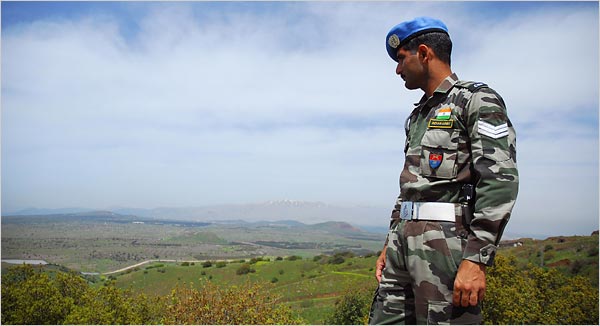
Yehuda Raizner/Agence France-Presse — Getty ImagesAn Indian member of the United Nations force in the Golan Heights, a strategic
plateau that overlooks a swath of northern Israel.
Iraq is a Minefield
Have any of you ever realized that you just may be in a minefield? It’s a difficult conundrum because you don’t want to just stay there, but you also don’t want to move. It seems as though there is no good choice to make. That, according to an analyst at the National Defense University, is the US fate in Iraq currently.
During our relatively short discourse into international ethics, we discussed Table 2.1 from Amstutz’s book, which demonstrates the Three Dimensions of Moral Judgment.
Here it is:
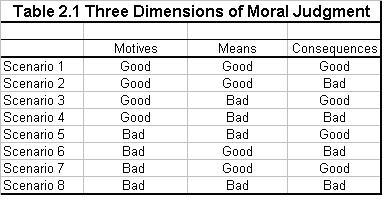
We notice that in order to evaluate the morality of a foreign policy decision, we must judge the motives behind the decision, the means used, and the final result of the decision. A new paper by Joseph J. Collins, of the Institute for National Strategic Studies of the National Defense University analyzes the Bush administration’s decision to invade Iraq in 2003. According to the author,
To date, the war in Iraq is a classic case of failure to adopt and adapt prudent courses of action that balance ends, ways, and means.
The paper is an interesting and nuanced read and I encourage you to take a look. Here is the first page:
Measured in blood and treasure, the war in Iraq has achieved the status of a major war and a major debacle. As of fall 2007, this conflict has cost the United States over 3,800 dead and over 28,000 wounded. Allied casualties accounted for another 300 dead. Iraqi civilian deaths—mostly at the hands of other Iraqis—may number as high as 82,000. Over 7,500 Iraqi soldiers and police officers have also been killed. Fifteen percent of the Iraqi population has become refugees or displaced persons. The Congressional Research Service estimates that the United States now spends over $10 billion per month on the war, and that the total, direct U.S. costs from March 2003 to July 2007 have exceeded $450 billion, all of which has been covered by deficit spending. No one as yet has calculated the costs of long-term veterans’ benefits or the total impact on Service personnel and materiel.
The war’s political impact also has been great. Globally, U.S. standing among friends and allies has fallen. Our status as a moral leader has been damaged by the war, the subsequent occupation of a Muslim nation, and various issues concerning the treatment of detainees. At the same time, operations in Iraq have had a negative impact on all other efforts in the war on terror, which must bow to the priority of Iraq when it comes to manpower, materiel, and the attention of decisionmakers. Our Armed Forces—especially the Army and Marine Corps—have been severely strained by the war in Iraq. Compounding all of these problems, our efforts there were designed to enhance U.S. national security, but they have become, at least temporarily, an incubator for terrorism and have emboldened Iran to expand its influence throughout the Middle East.As this case study is being written, despite impressive progress in security during the surge, the outcome of the war is in doubt. Strong majorities of both Iraqis and Americans favor some sort of U.S. withdrawal. Intelligence analysts, however, remind us that the only thing worse than an Iraq with an American army may be an Iraq after the rapid withdrawal of that army. The 2007 National Intelligence Estimate (NIE) on Iraq’s future stability said that a rapid withdrawal “almost certainly would lead to a significant increase in the scale and scope of sectarian conflict in Iraq, intensify Sunni resistance to the Iraqi government, and have adverse consequences for national reconciliation.” The NIE goes on to say that neighboring countries might intervene, resulting in massive casualties and refugee flows. No one has calculated the psychopolitical impact of a perceived defeat on the U.S. reputation for power or the future of the overall war on terror. For many analysts (including this one), Iraq remains a “must win,” but for many others, despite the obvious progress under General David Petraeus and the surge, it now looks like a “can’t win.” To date, the war in Iraq is a classic case of failure to adopt and adapt prudent courses of action that balance ends, ways, and means.
40th Anniversary of the Prague Spring and Soviet Invasion of Czechoslovakia
This Spring marks the 40th anniversary of the Prague Spring–a domestic, Czech-led liberalization and democratization movement in the former Czechoslovakia–and the subsequent Soviet military invasion of that former communist state. As Czechs sang and wrote their way towards a regime Czechs would describe as “Communism with a human face”, Leonid Brezhnev–the leader of the Soviet Union–rolled Soviet tanks onto the streets of Prague to put an end to Alexander Dubcek’s reforms. This was the first concrete foreign policy manifestation of the “combating of anti-socialist forces,” which came to be known as the Brezhnev Doctrine.
Euronews has an interesting report on the commemoration of the Prague Spring, which has been uploaded to youtube. I encourage you to take a look.
U.N. Security Council Silent on Tibet Protests
How do changing ideas about sovereignty–from sovereignty viewed as a “right” to sovereignty viewed as a “responsibilty”–affect the nature of how states act and the functioning of organizations such as the United Nations? Just before spring break we viewed the documentary The Peacekeepers, where you were able to witness the deliberations that take place behind the scenes at the United Nations and the Security Council specifically. For Wednesday, we’ll read Erik Voeten’s article on “The Political Origins of the UN Security Council’s Ability to Legitimize the Use of Force”, the main point of which is obvious given the title. Today, the Guardian reports that the Security Council remains silent on the current situation in Tibet.
UNITED NATIONS, March 17 (Reuters) – The U.N. Security Council will likely keep silent about China’s crackdown on demonstrations in Tibet, mostly due to belief that provoking Beijing would accomplish nothing, diplomats said on Monday.China, which has sent in troops to enforce control in the regional capital Lhasa, said earlier that the violent protests by Tibetans were organized by followers of the Dalai Lama seeking to derail the Beijing Olympics in August. Tibet’s exiled spiritual leader has denied this charge.“The issue did not come up in the council,” China’s Deputy permanent U.N. representative Liu Zhenmin told Reuters after a meeting of the council on unrelated issues. “This has nothing to do with peace and security,” he said. “It is local violence, … a domestic issue.”China, like the United States, Britain, France and Russia, is a permanent veto-wielding member of the council and would be able to block any attempts by the council to act on Tibet.Russia’s U.N. Ambassador Vitaly Churkin, currently president of the council, told reporters without elaborating that he did not expect the 15-nation Security Council to discuss Tibet. Several other ambassadors confirmed this view.
The United Nations and Peacekeeping in Congo
In PLSC250–intro to IR–this week we viewed a documentary made by the National Film Board of Canada, which addresses the UN’s peacekeeping role in Congo. After reading Chapter 7 of Mingst, you should now be aware that the UN in the world’s most important and powerful IGO, and the UN Security Council plays the most prominent global role in the area of international security. Here are a couple of screen shots from the film and the film’s description:
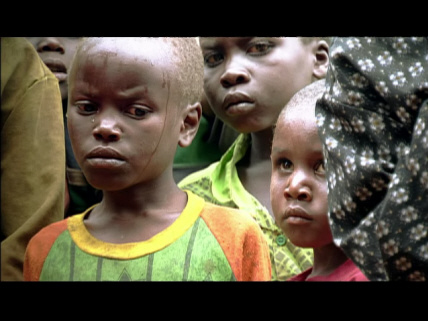
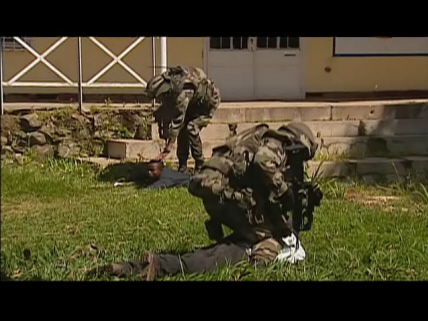
With unprecedented access to the United Nations Department of Peacekeeping, The Peacekeepers provides an intimate and dramatic portrait of the struggle to save “a failed state.” The film follows the determined and often desperate manoeuvres to avert another Rwandan disaster, this time in the Democratic Republic of Congo (the DRC).
Focusing on the UN mission, the film cuts back and forth between the United Nations headquarters in New York and events on the ground in the DRC. We are with the peacekeepers in the ‘Crisis Room’ as they balance the risk of loss of life on the ground with the enormous sums of money required from uncertain donor countries. We are with UN troops as the northeast Congo erupts and the future of the DRC, if not all of central Africa, hangs in the balance.
In the background, but often impinging on peacekeeping decisions, are the painful memory of Rwanda, the worsening crisis in Iraq, global terrorism and American hegemony in world affairs. As Secretary General Kofi Annan tells the General Assembly at the conclusion of The Peacekeepers: “History is a harsh judge. The world will not forgive us if we do nothing.” Whether the world’s peacekeeper did enough remains to be seen.
 Clouds, Clocks, and Sitting at Tables
You must be logged in to post a comment.