What Does One Have to do to Become Irish?

We had a (sometimes spirited) discussion in intro to comparative yesterday about patriotism, nationalism, citizenship and immigration. You may, therefore, find today’s story in the New York Times about a young 11-year-old lad who was born in Ireland and is about as culturally Irish as they come, except for the fact that his African born parents are illegal citizens in Ireland. As a result, his parents face the prospect of being exiled back to Africa, which would force the boy to go also. Quoting the NYT:

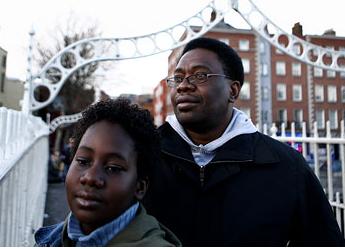
nigerian_irish_boy.jpgDUBLIN — Cork-born and proud of it, George-Jordan Dimbo is top to toe the Irish lad. He studies Gaelic, eats rashers, plays hurling, prays to the saints, papers his walls with parochial school awards, and spends Saturdays at the telly watching Dustin the Turkey, a wisecracking puppet, mock the powerful.

If the Irish government has its way, he may soon be living in Africa.

George, 11, is an Irish citizen and has been since his birth when Ireland, alone in Europe, still gave citizenship to anyone born on its soil. [Do you remember what the legal term for this is?] His mother and father, Ifedinma and Ethelbert Dimbo, are illegal immigrants from Nigeria, who brought him back to Ireland three years ago, judging it the best place to raise him.

Since then, the unusual trio — the Irish schoolboy and his African parents — have shared a single room in a worn Dublin hostel while facing a prospect dreaded by children on both sides of the Atlantic, a parent’s deportation.

“Dear justice minister,” George wrote when he was 9. “I heard my Mommy and Daddy whispering about deportation. Please do not deport us.”

“Remember,” he added, “I am also an Irish child.”

P.S. Bonus points for anyone who can tell me what rashers are!

The Fluid Religious Marketplace in the United States

The New York Times reports on a new poll released by the Pew Forum on Religion and Public Life, which shows a relatively high level of fluidity in the religious identities of residents here in the United States. Analysts and scholars of the role of religion in public life have long understood the US exceptionalism with respect to the important role and place of religion in public life. This has occurred despite (although some would argue because of) the official church-state separation in US society. Most other states with developed economies are much more secular than is the United States, even though some of these states (such as Great Britain and Germany) do not have state/church separation.

The main take-home message of this new Pew Poll, I think, is the fluidity of religious identity here in the United States, where religion is more individualized and personalized and really becomes a type of individual identity. (Remember in Chapter 3 of O’Neil where we differentiated between individual and group identity and discussed whether religious identity could be both.) Conversely, in countries like France, Great Britain, Germany, etc., religion is much more a social–i.e., group–(rather than a religious) identity and is, therefore, much more immutable. Here is an excerpt from the article, with a graphic:

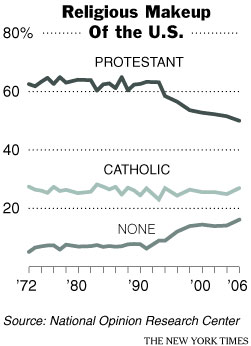
us_religious_makeup.jpgWASHINGTON — More than a quarter of adult Americans have left the faith of their childhood to join another religion or no religion, according to a survey of religious affiliation by the Pew Forum on Religion and Public Life.

The report, titled “U.S. Religious Landscape Survey,” depicts a highly fluid and diverse national religious life. If shifts among Protestant denominations are included, then it appears that 44 percent of Americans have switched religious affiliations.

For at least a generation, scholars have noted that more Americans are moving among faiths, as denominational loyalty erodes. But the survey, based on telephone interviews with more than 35,000 Americans, offers one of the clearest views yet of that trend, scholars said. The United States Census does not track religious affiliation.

It shows, for example, that every religion is losing and gaining members, but that the Roman Catholic Church “has experienced the greatest net losses as a result of affiliation changes.” The survey also indicates that the group that had the greatest net gain was the unaffiliated. Sixteen percent of American adults say they are not part of any organized faith, which makes the unaffiliated the country’s fourth-largest “religious group.”

That 44 percent of Americans have switched religious affiliation is astounding. What are the implcations of this? I can think of two immediately…

You can find the Pew Forum on Religion and Public Life here. Here is a link to a video interview with Pew Forum Director Luis Lugo who talks about the next step in data analysis. Lugo characterizes the United States as having a dynamic “religious marketplace.” Here is a link to an interview with Neela Bannerjee, the New York Times journalist, who wrote the article.

Patriotism–What is it? How can we Measure it?

As budding “social scientists” (the scare quotes are legitimate), it is good form to not only define concepts that are malleable but also to provide qualitative and/or quantitative evidence regarding their existence. A recent brouhaha in American politics centers around the political concept patriotism. What is it? How do we know it exists? Can it be measured? These are all important questions, so important, in fact, that they could determine the outcome of the next US presidential election.

In intro to comparative, we’ve been analyzing social identities, ethnic, national, etc. As we know from reading O’Neil, patriotism is based on the idea of citizenship–an individual’s relationship to the state in which s/he lives. O’Neil defines patriotism as “pride in one’s state.”

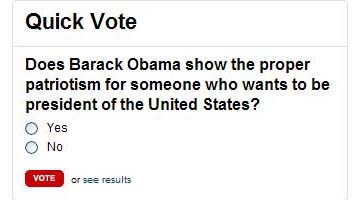
As near as I can tell, some opponents of Barack Obama’s candidacy have based some of their resistance on what they view as his lack of patriotism. If I’m reading this correctly, the base their argument on the fact that Obama does not (in fact, may even refuse to) wear a lapel pin in the shape of an American flag. This is interesting since it also touches upon issues of national identity; remember that we tried to determine just what is meant to be American. Does one have to wear an American flag lapel pin to be considered patriotic? If any of you think that this is an issue of negligible import, I refer you to this screen shot of the CNN website:

cnn-obama-patriotism.jpg

Given that I’m not a citizen of the United States, I’ll leave that for others to answer. I am, however, a citizen of the Republic of Croatia and this episode does remind me of an incident from the mid 1990s, which I, then working for the Helsinki Committee for Human Rights, witnessed. Join me after the jump.

hrvatska-zastava.jpgThe Croatian flag is a tri-color, with horizontal fields of red, white, and blue (from top to bottom), which contains the coat of arms–the “Šahovnica“–in the middle field. The šahovnica has been used in various guises throughout Croatian history as a symbol of Croatian nationhood. While Croats have lived under many different types of regime–Communist Yugoslavia, the Fascist Ustasa regime during WWII, the unitarist, Serb-dominated inter-war regime, the Austro-Hungarian monarchy (you get the point!)–the šahovnica has remained a constant expression and symbol of the Croatian people.

Continue reading “Patriotism–What is it? How can we Measure it?”

Samuel Huntington of “Clash of Civilizations” fame, Interviewed

Charlie Rose interviews Huntington on the ideas in his oft-cited and even more criticized “Clash of Civilizations” thesis. Rose calls the clash thesis “provocative.”  What do you think about the logic of the clash thesis.  Given that you’ve read Amartya Sen’s response to Huntington, what kinds of questions would you have asked Huntington that Rose failed to?  (The Huntington interview runs from 1:55 until about 21:00.  No, Professor Huntington is not a dead-ringer for John Cleese.  That is, in fact, John Cleese, who is interviewed in the middle segment; hence, the screen shot of Cleese.)

You’ve got to Fight…for Your Right…to…Gain Citizenship

During our discussion in class today on different forms of group identity, many of you seemed surprised when I mentioned that there were many non-US citizens currently fighting for the US military in Iraq; many (a majority at least) are doing so in exchange for the promise of US citizenship. Which begs the questions, just how many non-citizens are currently serving in the US military? According to this paper (pdf),

“As of February 2003, there were 37,000 non-citizens serving in active duty in the U.S. armed forces, almost 12,000 foreign nationals serving in the selected reserves, and another 8,000 serving in the inactive national guard and ready reserves.”*

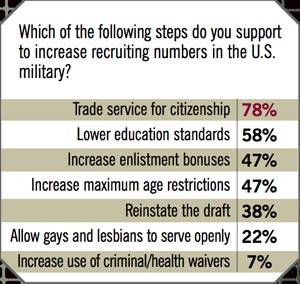
As we learned in class, prior to the establishment and consolidation of nation-states in Europe, post-Westphalia, most political leaders recruited mercenary armies. Thus, the link between military protection and citizenship is a modern phenomenon. This makes the results of a recent survey done by Foreign Policy Magazine very interesting.

recruit_armed_forces.jpg

Many proposals have been suggested to help the military meet its recruiting and retention needs. But an incredible percentage of the index’s officers favor the same solution: Nearly 80 percent support expanding options for legal, foreign permanent residents of the United States to serve in exchange for U.S. citizenship. A high percentage of officers, about 6 in 10, also support the idea of allowing more recruits who have a high school equivalency degree—but no diploma—to serve. Almost 40 percent favor reinstating the draft.

*Not all of these, of course, are serving in Iraq. Moreover, while it is a seemingly large number it is still a very small percentage of the total military.

Partition as a Solution to Ethnic Conflict/Violence

Today in class we discussed ethnic identity and various types of inter-ethnic violence. We saw that a large literature in political science (and related disciplines) sees the very fact of cultural (and especially ethnic) heterogeneity is being the source of much that goes wrong within states and societies. In a previous post, I mentioned Robert Putnam’s recent findings that trust is lower in more heterogeneous societies; there is a burgeoning literature on the deleterious economic impact of ethnic (and other forms of) identity (public goods provision, for example, is lower in more heterogeneous societies).

If the very fact of heterogeneity is the cause of conflict and violence, then wouldn’t a reasonable solution to inter-ethnic conflict/violence be to create new more ethnically homogeneous states out of a single ethnically diverse one? Some argue that this may be a legitimate solution to the extant difficulties in Iraq. Chaim Kaufmann has argued in favor of just this approach. Here (pdf) is an article written by Nicholas Sambanis setting out, then critiquing Chaim Kaufmann’s hypotheses regarding the usefulness of partition to resolve endemic inter-ethnic violence.

You can view a fascinating BBC documentary on the partition of India in 1947 here. Here’s an important quote from the documentary:

“…as a British barrister draws a line on a map…”

Much of the violence that occurred during the partition was the result of Muslims and Hindus (of course, the Sikh/Punjab problem adds another layer of complexity altogether) trying to be on (or being forced to move to) the right side of that barrister’s line. Millions were killed.

U.S. Formally Recognizes Kosovo Independence

We discussed in class today that of the four characteristics of a state, the only one that Kosovo had, at that point, not fulfilled was international recognition by other states. According to this Washington Post story, the United States has begun to change that:

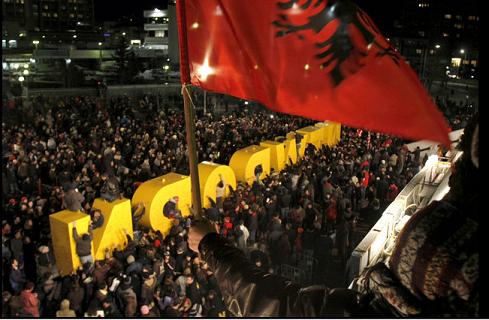
kosovo_independence1.jpgPresident Bush hailed the newly independent Kosovo and officially recognized it as a state and a “close friend” on Monday, expressing strong support for the new Balkans nation even as he rebuffed protests by Serbia and Russia.

The formal announcement came in a statement issued by Secretary of State Condoleezza Rice, who is traveling in Africa with the president. “The United States has today formally recognized Kosovo as a sovereign and independent state,” she said. “We congratulate the people of Kosovo on this historic occasion.”

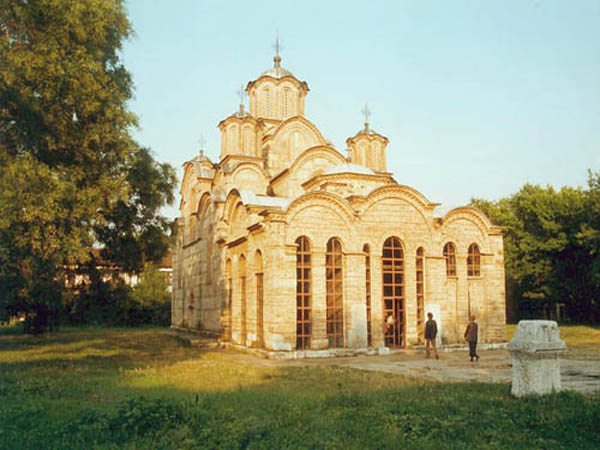
I understand what it feels like to be a Kosovar Albanian today as it takes me back to 15 January 1992, when European and other states, including the United States, formally recognized the independence of the Republic of Croatia. I can also sympathize with Serbs, who must feel like their heart has been ripped out of their body given that Kosovo is integral to history and spirit of the Serbian nation. Ivo Banac has written that “the history of the Balkans is a history migrations, not only peoples, but of lands.” The Serbian nation was founded on land that the Serbs no longer control politically as a result of the vicissitudes of politics in that part of the world and the drift of the center of gravity of Serb political northward over the centuries. It is incumbent upon the new Kosovo government and the international community to allow Serbs to continue to have access to the sacred religious and spiritual monuments of their past.

You can see a comprehensive slide show of photographs marking the situation here.

Below is a photograph of the famous Serbian Christian Orthodox Gračanica Monastery in Kosovo.

gracanica1.jpg

Life, Liberty, and the Pursuit of Happiness

We hold these truths to be self-evident, that all men are created equal, that they are endowed by their Creator with certain unalienable Rights, that among these are Life, Liberty and the pursuit of Happiness.

All of us immediately recognize these powerful sentences as being part of the Declaration of Independence of the United States of America. Happiness is an important concept and has been the object of increased study in political science and comparative politics. Ronald Inglehart (he of World Values Survey fame) argues that there is a strong relationship between happiness and democracy across countries. Inglehart writes:

Correlation is not causation, and this linkage could reflect any of the following things: (1) living under democratic institutions makes people much happier than living under authoritarian institutions; or (2) high levels of subjective well-being are conducive to democratic institutions; or (3) the correlation could be spurious, due to the fact that both subjective well-being and democracy are strongly correlated with some other variable such as high levels of economic development.

Solving this puzzle has far-reaching implications. If the linkage is not spurious and democracy makes people happy, this provides a strong additional argument on behalf of democracy; while if high levels of happiness are conducive to democracy, this can lead to a better understanding of how democracy emerges and flourishes. Using World Values Survey data on happiness levels from 1981 to 2006, and the Freedom House measures of democracy levels from 1972 to 2005, this paper analyzes the relationships between happiness and democracy in order to determine what is causing what.

How happy are Americans? How happy are Germans, Chinese, or Brazilians, for that matter? Who are the happiest people on earth? According to the new World Database of Happiness, it’s the Danes, Swiss and Maltese. Is this a political cultural trait, as Inglehart assumes, or are there structural and institutional factors at work? All three countries are rather small, and European. (Malta and Denmark are, additionally, amongst the most homogeneous states in the world, and this could be having an effect, given new research by Robert Putnam on the potential socially, politically, and economically detrimental effects of ethnic diversity.) Americans, by the way, are ranked #25 in level of happiness.

Kosovar Albanians Declare Independence From Serbia

As of the beginning of 1991, the Socialist Federated Republic of Yugoslavia was an internationally recognized state, which consisted of six republics (Bosnia & Herzegovina, Croatia, Macedonia, Montenegro, Serbia, and Slovenia) and 2 autonomous regions within Serbia–Vojvodina and Kosovo. As of today, with Kosovo declaring its independence from Serbia, the only one of those eight political units that is not an independent state is Vojvodina. The New York Times reports that the euphoric Albanians showed their gratitude to the United States for the development:
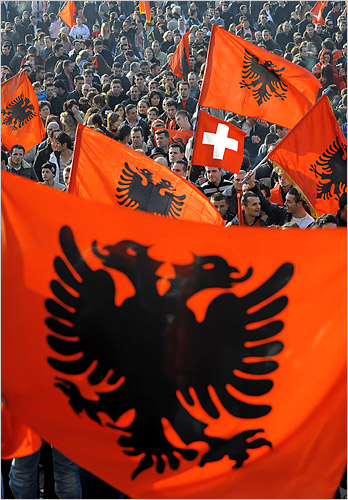
kosovo_independence.jpgPRISTINA, Kosovo — The former Serbian province of Kosovo declared independence on Sunday, sending tens of thousands of euphoric ethnic Albanians into the streets of this war-torn capital to celebrate the end of a long and bloody struggle for national self-determination.

The declaration marks the final dismemberment in the 17-year dissolution of the former Yugoslavia. It also brings to a dramatic climax a showdown between the West — which argues that the former Serbian President Slobodan Milosevic’s brutal subjugation of Kosovo’s majority ethnic Albanians cost Serbia its authority to rule the territory — and Belgrade and its ally Moscow, which counter that Kosovo’s independence declaration is a reckless breach of international law that will spur other secessionist movements across the world.

Ethnic Albanians from across the world streamed into Pristina, braving freezing temperatures and heavy snow, to dance in frenzied jubilation. Beating drums and waiving Albanian flags, they chanted “Independence! Independence! We are free at last!” while an enormous birthday cake was installed on Pristina’s main boulevard.

An outpouring of adulation for the United States — Kosovo’s staunchest ally in its quest for independence and the architect of NATO’s 1999 bombing campaign against Mr. Milosevic — was evident everywhere. Thousands of revelers unfurled giant American flags, carried posters of former President Bill Clinton, and chanted “Thank You U.S.A.!” and “God Bless America.”

Meanwhile, balkaninsight.org reports on an anti-U.S. counter-rally in the streets of the Serbian capital of Belgrade:

17 February 2008 Belgrade _ Hundreds of protesters blocked the Embassy of the United States in downtown Belgrade on Sunday, less than an hour after Kosovo’s leaders unilaterally declared the province’s independence from Serbia.

Protesters in Belgrade pelted the embassy building and police with stones and torches. At least one policeman was carried away in an ambulance. The number of injuries in the crowd could not be verified immediately.

Serbian police in full riot gear had cordoned off the embassy and managed to push protestors away from the embassy. The crowed scattered in nearby streets, but its numbers continued to grow.

Waving Serbian flags, burning signal torches and chanting nationalist and anti-American slogans, the crowd had initially tried to block both entrances to the embassy compound, which stretches over two apartment blocks on Kneza Milosa Street.

“We want to show we hate Yanks and Shiptars [a pejorative for Albanian],” a young protester who identified himself only as Dejan said, using a derogatory Serbian term for Kosovo Albanians.

A good source for views from within Serbia is the B92 broadcast network, whch reports that Serbia has annulled Kosovo’s declaration of independence, judging it to be an illegal act:

BELGRADE — PM Vojislav Koštunica addressed the nation today as ethnic Albanians unilaterally declared Kosovo’s independence.

It a televised address from the seat of the Serbian government in Belgrade, Koštunica rejected this act as illegal, and declared it null and void.

“Kosovo’s unilateral declaration of a false state is the final act of a policy that started with the NATO aggression against Serbia in 1999,” the prime minister said.

“Never has the truth about why Serbia was savagely destroyed by NATO bombs been more clear,” he continued, and added that “NATO’s military interests lie behind the proclamation of this false state.”

From bd at Richmond, here’s a link to reporting by MSNBC on Kosovo.

Roger Clemens, Steroids, and Political Ideologies

In class today, we discussed yesterday’s Congressional hearings dealing with the use of steroids, and other performance-enhancing drugs in baseball, in which our esteemed elected representatives questioned umpteen-time all-star pitcher, Roger Clemens, on his involvement. Those of you who have been following this soap opera understand that one of Clemens’ former trainers, Brian McNamee, and a former teammate, Andy Pettitte, have both accused Clemens of having used steroids and HGH (human growth hormone).

I watched some of the highlights of the testimony, and what was interesting was that here, as in many other contemporary issues in American society, there seemed to be a readily apparent partisan split on the issue, with Republicans believing and supporting Clemens, while Democrats did the opposite. I have no idea why, given the nature of political attitudes and political ideologies, this would be the case. What is it about the issue of steroids in baseball that would “tap into” underlying political attitudes and ideologies in order to make this a clearly ideological issue. Maybe this isn’t an “ideological” issue at all, but a partisan one. By this I mean that for many in this country (especially on Capitol Hill), their partisanship is no longer a means to an underlying ideological end, but an end in and of itself. So if George Bush (with the complicity of both Republican and Democratic-led Congresses during his tenure) spends the people’s money like a drunken soldier, he–a Republican–is immune from criticism by other Republicans, even though his behavior is anathema to conservative economic ideology.

Here is Clemens testifying, and a clip from Mike and the Mad Dog, the most highly rated sports talk show in the New York City area, in which Chris “the Mad Dog” Russo–a Republican–exhorts his listeners in Connecticut to vote long-term Congressman, Christopher Shays (R), out of office for what Russo viewed as Shays’ “grandstanding” during the hearings yesterday.

Mad Dog snarly towards Shays:

Design a site like this with WordPress.com
Get started