No Torture. No Exceptions.

no_torture_no_exceptions.jpg

The above sketch by Thomas V. Curtis, a former Reserve M.P. sergeant, is of an Afghan detainee, Dilawar, who was taken into U.S. custody on December 5, 2002, and died five days later. Dilawar was deprived of sleep and chained to the ceiling of his cell—techniques that the Bush administration has refused
to outlaw for use by the CIA. Further, his legs were, according to a coroner, “pulpified” by repeated blows. Later evidence showed that Dilawar had no connection to the rocket attack for which he’d been apprehended.

One of the most important tenets of my teaching philosophy is to make the classroom a safe forum for diverse and competing points of view. In order to facilitate this, I believe that it is necessary, as much as is humanly possible, to refrain from promoting my own views and importing my personal biases into what I teach. I will temporarily put that tenet aside in order to address the topic of torture.

The United States government tortures. That’s a difficult sentence for me to write. The human rights organization for which I worked in Croatia during the 1990s–the Croatian Helsinki Committee–was at the forefront of the effort in that country to stop human rights abuses, such as torture, that the Tudjman-led regime was committing during those years. I would often find myself in debate with individuals–soldiers, police officers, government officials, religious leaders, and average citizens–about the human rights abuses the government was committing. My argument was basically, “we (in Croatia) are being hypocritical if, on the one hand, we claim that we are superior–in some civilizational sense (this is argument that was made, though I don’t adhere to it)–to the Serbs because we are more “Western” and more democratic, yet we allow our government (with our support) to commit absolutely horrific human rights abuses. We should try to mimic the behavior, then, of Western democracies such as Canada and the United States rather than the abhorrent policies of the Milosevic regime.”

My interlocutors would usually reply, “but, Canada’s, and America’s government would be doing the same thing if 1/3 of their territory was under foreign occupation.” I replied that they would not. I have to apologize to every single one of those people, because they were right and I was wrong. And it didn’t even take foreign occupation for the US government to begin to undermine the fundamental tenets upon which democracy and the respect for human dignity are based. My attitude towards torture is nicely captured by the title of a recent series on torture put out by the magazine Washington Monthly–“No Torture. No Exceptions.”

We’ll take a look at the debate on torture near the end of the semester (in intro to IR) and we’ll see that the strongest moral claim for torture comes from a consequentialist (or utilitarian) perspective; this is why the “ticking bomb scenario” is customarily trotted out to refute deontological arguments. I will argue (and I encourage you to try to prove me wrong) that there are consequentialist reasons for not torturing. I encourage you to read the essays in “No Torture. No Exceptions.” (In fact, if you’re in intro to IR, you’ll have to.)
Woodrow Wilson at the White House

Here is some fascinating (silent) footage of Woodrow Wilson at the White House, no doubt thinking about his Fourteen Points.  I think he’s on the phone to Clemenceau debating the merits of Point Nine.  It’s interesting how many of the points refer to the establishment of new nation-states (getting nations congruent with borders) and/or adjusting borders to more adequately cohere with notions of justice.

Catholicism and the Social Dimension of Sin

Father James Martin takes the London Times to task for their framing of the story of the Catholic Church’s developing views on the nature of sin. (Click here for my blog post on the Times story.)

Father Martin writes in the America Magazine–the national Catholic weekly–that the Times’ story has confused the issue “unnecessarily.” He writes:

pd_hell_070706_ms.jpgMy guess is that some in the media bobbled this story for two reasons, neither of them malicious. First, a general unfamiliarity with the contemporary Catholic tradition of social sin, even though under Pope John Paul II something like “anti-Semitism” was often referred to in those terms. And, second, the fact that a headline that reads “Seven New Deadly Sins” is undeniably sexier than a headline saying, “Vatican Official Deepens Church’s Reflection on Longstanding Tradition of Social Sin.”

The Vatican’s intent seemed to be less about adding to the traditional “deadly” sins (lust, anger, sloth, pride, avarice, gluttony, envy) than reminding the world that sin has a social dimension, and that participation in institutions that themselves sin is an important point upon which believers needed to reflect.

In other words, if you work for a company that pollutes the environment, you have something more important to consider for Lent than whether or not to give up chocolate.

Globalization, the Catholic Church, and Classroom Pedagogy

A while back I had the opportunity to allow a job candidate to come in and use my intro to IR class to give a her candidate classroom lecture. Following the 40-minute lecture–after the candidate and the rest of the faculty had left the room–I asked my students to anonymously write down their impressions of the teaching style of the job candidate. One of the responses was particularly illuminated and the latest news about the Catholic Church’s efforts to reform the concept of sin reminded me of that student’s response. The student’s response was (and I’m paraphrasing here):

“I didn’t like that she went around the room and made everyone answer her introductory question. I pay $40,000 in tuition annually and I have the right to sit in the classroom and be bored and do nothing if that’s what I want to do.”

I felt sorry for this student, because s/he has forgotten a couple of important rules about life, let alone post-secondary education: first, you only get out of something what you put in. Second, and more important, the whole classroom experience is a social experience, and the outcome of the educational process is not only a function of what the student him/herself is doing, and what the instructor is doing, but what others in the classroom are doing as well.

Apropos of the preceding, here is news from the London Times online, which demonstrates the Catholic Church’s approach to the concept of sin:

seven_poster.jpg…[Bishop Gianfranco Girotti] said that priests must take account of “new sins which have appeared on the horizon of humanity as a corollary of the unstoppable process of globalisation”. Whereas sin in the past was thought of as being an invididual matter, it now had “social resonance”.

“You offend God not only by stealing, blaspheming or coveting your neighbour’s wife, but also by ruining the environment, carrying out morally debatable scientific experiments, or allowing genetic manipulations which alter DNA or compromise embryos,” he said.

Bishop Girotti said that mortal sins also included taking or dealing in drugs, and social injustice which caused poverty or “the excessive accumulation of wealth by a few”.

He said that two mortal sins which continued to preoccupy the Vatican were abortion, which offended “the dignity and rights of women”, and paedophilia, which had even infected the clergy itself and so had exposed the “human and institutional fragility of the Church”.

Maybe it’s time for Brad Pitt and Morgan Freeman to do a sequel to Seven. 🙂

First, Conflict Diamonds; now, Junta Jade?

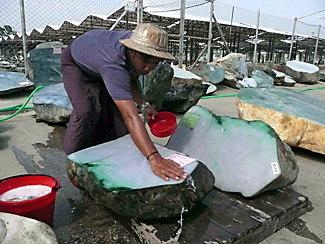
I know; the j in junta is pronounced like an h. Regardless, The Christian Science Monitor asks “Who’s buying Burma’s gems?: Laura Bush’s campaign for a global boycott is being undone by China’s appetite for Olympic souvenirs made of Burmese jade.” The US First Lady argues that those of you purchasing precious gems from Burma are indirectly supporting the rule of the brutal military dictatorship in that southeast Asian country.

burma_jade.jpgIt’s the last hour of the last day of the gems auction in Rangoon, and tired buyers are fanning themselves with worn auction catalogs, and making their final bids.

Over the past five days, jade, rubies, sapphires, and close to $150 million have passed hands here, according to the Union of Myanmar Economic Holdings Ltd., the consortium that dominates Burma’s gemstone trade and is owned by the defense ministry and a clutch of military officers.

Who’s buying? China, India, Singapore, and Thailand are scooping up Burma’s stones. US first lady Laura Bush’s efforts at a global boycott of Burma’s gems seem to have done little to reduce China’s appetite for Burmese jade to make trinkets and souvenirs to sell at the Summer Olympics.

At this recent auction, 281 foreigners attended, leaving behind much-needed foreign currency and generally turning the auction into a resounding success, according to the state-run New Light of Myanmar newspaper.

Mrs. Bush – and human rights campaigners – would not be pleased.

The first lady has taken on the military regime in Burma (Myanmar), urging jewelers not to buy gems from a country where the undemocratic rulers and their cronies amass fortunes selling off the country’s stones, as well as many of the county’s other natural resources – such as minerals, timber, gold, oil, and gas – but keep Burma’s citizens in abject poverty.

She has urged UN Secretary General Ban Ki Moon to act more forcibly on Burma and stood beside President Bush on several occasions recently as he announced the growing list of US sanctions on the country. And, on International Human Right’s Day this past December, Mrs. Bush added her voice to those seeking a global boycott on gems from Burma.

“Consumers throughout the world should consider the implications of their purchase of Burmese gems,” she said in a statement from the White House. “Every Burmese stone bought, cut, polished, and sold sustains an illegitimate, repressive regime.”

Earlier in the semester, we read an article [which he has made available to the general publilc on his web site] by Richard Snyder on the link between “lootable wealth” and political stability. In fact, the final section of his paper deals explicitly with the Burmese tropical timber trade and its role in funding rebel groups. What are the implications of Snyder’s argument for how we–as potential consumers of junta jade–should respond to Laura Bush’s plea? Of course the two phenomena are not exactly the same (Snyder is seeking to understand the link between “lootable wealth” political stability, while Laura Bush is arguing that “lootable wealth” supports dictatorial rule.) Here is the abstract to Snyder’s article:

This article proposes a political economy of extraction framework that explains political order and state collapse as alternative outcomes in the face of lootable wealth. Different types of institutions of extraction can be built around lootable resources – with divergent effects on political stability. If rulers are able to forge institutions of extraction that give them control over revenues generated by lootable resources, then these resources can contribute to political order by providing the income with which to govern. In contrast, the breakdown or absence of such institutions increases the risk of civil war by making it easier for rebels to organize. The framework is used to explain two puzzling cases that experienced sharply contrasting political trajectories in the face of lootable resources: Sierra Leone and Burma. A focus on institutions of extraction provides a stronger understanding of the wide range of political possibilities – from chaos, to dictatorship, to democracy – in resource-rich countries.

Kosovo’s bid for Independence

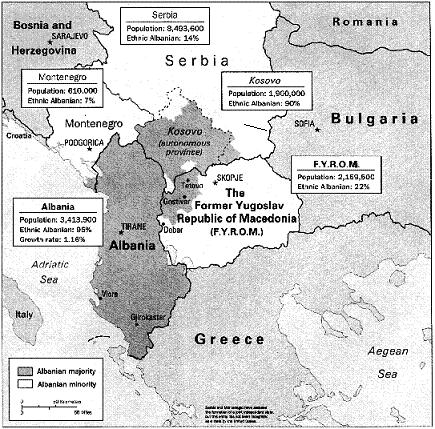
From the BBC, we learn that the Albanian majority in Serbia’s southern region of Kosovo is expected to vote for independence from Serbia within days. The province has been controlled by the international community since the end of the NATO-led war against Slobodan Milošević ‘s regime in 1999. In PLSC250 yesterday, we discussed the Kurdish campaign for self-determination and noted some of the arguments for and against. The most comepelling argument for secession/independence is a deontological argument based on the inherent right of groups to decide for themselves their system of government. The most obvious argument against is a utilitarian one, voiced here by Serbia’s Foreign Minister, Vuk Jeremić :

[Independence for Kosovo] would lead to an uncontrolled cascade of secession

Here’s more from the article:

kosovo.jpgSerbia’s foreign minister has urged the United Nations Security Council to oppose the province of Kosovo’s expected declaration of independence.

Vuk Jeremic said Serbia would not use force to stop the secession but warned that allowing it would give a green light to other separatist movements.

The ethnic Albanian majority in Kosovo is expected to announce its breakaway from Serbia within days.

Russia has warned that recognition of Kosovo would be illegal and immoral.

Speaking after the closed session, Serbia’s foreign minister said that is was not too late for diplomats to prevent Kosovo’s unilateral declaration of independence.

The Fall and Rise of Torture Across Time and Space

Here’s the abstract from an interesting article* on the history of the use of torture by Christopher Einol. I think we’ll read this near the end of the semester. (The subject of the illustration is water-boarding (about which the current US Attorney General does not know whether it is torture or not) during the Spanish Inquisition.)

water_torture.jpgTorture was formally abolished by European governments in the 19th century, and the actual practice of torture decreased as well during that period. In the 20th century, however, torture became much more common. None of the theories that explain the reduction of torture in the 19th century can explain its resurgence in the 20th. This article argues that the use of torture follows the same patterns in contemporary times as it has in earlier historical periods. Torture is most commonly used against people who are not full members of a society, such as slaves, foreigners, prisoners of war, and members of racial, ethnic, and religious outsider groups. Torture is used less often against citizens, and is only used in cases of extremely serious crimes, such as treason. Two general 20th-century historical trends have caused torture to become more common. First, an increase in the number and severity of wars has caused an increase of torture against enemy guerrillas and partisans, prisoners of war, and conquered civilian populations. Second, changes in the nature of sovereignty have caused an expansion in the definition of acts constituting treason.

* CHRISTOPHER J. EINOLF, “The Fall and Rise of Torture: A Comparative
and Historical Analysis”, Sociological Theory 25:2 June 2007. You should have access to the article if you are on campus.

Design a site like this with WordPress.com
Get started