Globalization and Collective Action

Deborah Yasher wrote an interesting article on the link between globalization and collective action. If you are on campus, here is a link to a pdf version of the article. A well-known phenomenon in the field of social movements and collective is the so-called “free-rider problem”. From the Stanford Encyclopedia of Philosophy:

In many contexts, all of the individual members of a group can benefit from the efforts of each member and all can benefit substantially from collective action. For example, if each of us pollutes less by paying a bit extra for our cars, we all benefit from the reduction of harmful gases in the air we breathe and even in the reduced harm to the ozone layer that protects us against exposure to carcinogenic ultraviolet radiation (although those with fair skin benefit far more from the latter than do those with dark skin). If all of us or some subgroup of us prefer the state of affairs in which we each pay this bit over the state of affairs in which we do not, then the provision of cleaner air is a collective good for us. (If it costs more than it is worth to us, then its provision is not a collective good for us.)

Unfortunately, my polluting less does not matter enough for anyone — especially me — to notice. Therefore, I may not contribute my share toward not fouling the atmosphere. I may be a freerider on the beneficial actions of others. This is a compelling instance of the logic of collective action, an instance of such grave import that we pass laws to regulate the behavior of individuals to force them to pollute less.

Review Article

Globalization and Collective Action

Activists beyond Borders: Advocacy Networks in International Politics

Margaret E. Keck; Kathryn Sikkink
Has Globalization Gone Too Far?

Dani Rodrik
Limits of Citizenship: Migrants and Postnational Membership in Europe

Yasemin Nuhoğlu Soysal
Review author[s]: Deborah J. Yashar
Comparative Politics, Vol. 34, No. 3. (Apr., 2002), pp. 355-375.

World’s Top 10 (International Relations) Think Tanks by FPRI

The Foreign Policy Research Institute has compiled a list of the world’s top ten think tanks. You can find the report archived at the International Crisis Group’s website here.

Here are the top 10, according to FPRI:

Top 10 Think Tanks Globally
(Arranged Alphabetically)

Think Tank

Country

Centre for European Policy Studies

Belgium

French Institute of International Relations

France

German Institute for International Politics and Security

Germany

Institute of World Economy and International Relations

Russia

International Crisis Group

Belgium

International Institute for Strategic Studies

United Kingdom

Jaffee Center for Strategic Studies

Israel

Japan Institute of International Affairs

Japan

Royal Institute of International Affairs

United Kingdom

Shanghai Institute for International Studies

China

Crisis Group Named in Top Ten Global Think Tanks

The Crisis Group is a non-governmental Organization (NGO) that does great work on conflict around the world. From the group’s website, we find out:

The International Crisis Group has been listed as one of the “Top 10 Think Tanks in the World” in a new survey, based on peer review, conducted over 18 months by the Think Tanks and Civil Societies Program at the Philadelphia-based Foreign Policy Research Institute.

The Crisis Group have archived the Foreign Policy Research Institute’s report here.

From the group’s “about” page, we learn about the Crisis Group’s purpose:

The International Crisis Group (Crisis Group) is an independent, non-profit, non-governmental organisation, with some 145 staff members on five continents, working through field-based analysis and high-level advocacy to prevent and resolve deadly conflict.

Crisis Group’s approach is grounded in field research. Teams of political analysts are located within or close by countries at risk of outbreak, escalation or recurrence of violent conflict. Based on information and assessments from the field, it produces analytical reports containing practical recommendations targeted at key international decision-takers. Crisis Group also publishes CrisisWatch, a twelve-page monthly bulletin, providing a succinct regular update on the state of play in all the most significant situations of conflict or potential conflict around the world.

The State–Weber’s definition, the role of legitimacy & Iraq

The state is an important concept in politics, and it is often one that is difficult to grasp for many students new to the study of comparative politics. Probably the most studied work on the state is that of German social scientist Max Weber, who in a lecture given in 1918 (which would eventually be published in 1919 under the name “The Politics of Vocation”) set out a formal definition of the state, and demonstrated the link between that and what is called “legitimacy”.

Below the fold, I’ll provide what I consider to be the crucial part of Weber’s lecture, with an assessment of how this relates to the contemporary situation in Iraq below:
Continue reading “The State–Weber’s definition, the role of legitimacy & Iraq”

A Unique Indicator of Economic Development–Luminous Flux

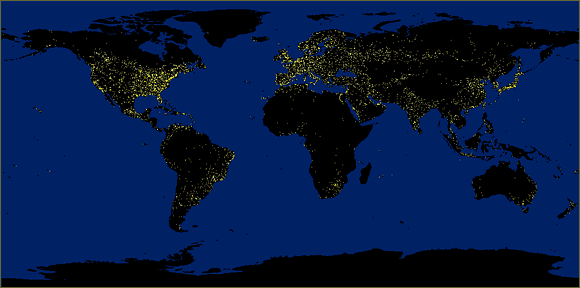
Or light. Below you will find a fascinating map from the World Resources Institute, (which is a great website, featuring information on such matters as renewable fresh water resources, literacy rates, and other phenomena that are found at the “intersection of the environment and human needs.”

world_city_lights.gif

Here is a description of the map:

“The National Geophysical “city lights” database depicts stable lights and radiance calibrated lights of the world (which includes lights from cities, towns, industrial sites, gas flares, fires, and lightning illuminated clouds). A high concentration of city lights is especially found in industrialized densely populated regions such as western Europe, Japan, and the U.S.. Alternatively, few “city lights” are shown in economically poorer and sparsely populated regions (e.g. central and northern Africa and South America). Moderate “city lights” are found in several densely populated “developing countries” (e.g. India, Indonesia, eastern Brazil, and South Africa). The “city lights” data may be used a proxy for population distribution or infrastructure (e.g. in which it may be assumed that the occurrence of few city lights is correlated with the presence of institutional, political, and industrial infrastructure).”

“And you thought choosing your Spring Course Schedule was difficult…”

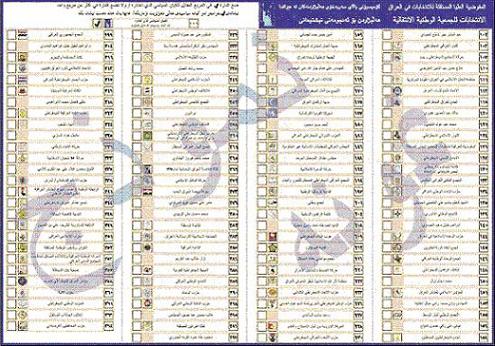
Here is a picture of the ballot that faced Iraqis as they arrived at the polls in late January, 2005. That’s correct; each of those is a different political party, 111 in all!

iraq_2005_ballot1.jpg

And what about the results? Here was the structure of the parliament following the January 2005 Parliamentary elections: Continue reading ““And you thought choosing your Spring Course Schedule was difficult…””

The Failed States Index by the Fund for Peace

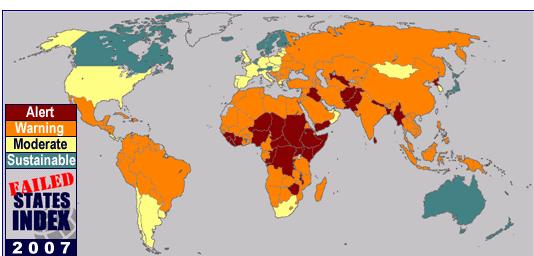
Here is another great resource compiled by the Fund for Peace. The Failed States Index tracks the stability of, at last count (2007) 177 states around the world on the basis of twelve indicators, grouped into social, economic and political categories. Some of the specific indicators are demographic pressures, a legacy of vengeance, uneven economic development and the rise of factionalized elites. Once again, there is a wealth of information and data at the Fund for Peace website, which goes beyond the Failed States Index. Here is a map based on data from 2007:

failed_states_index_2007.jpg

Continue reading “The Failed States Index by the Fund for Peace”

Transparency International Corruption Index

Here’s another excellent source of information from an NGO, Transparency International, that investigates, writes about, and collects data dealing with corruption. This NGO puts out an annual Transparency Index, listing countries around the world with respect to the level of corruption in each.

What is Transparency International?

Transparency International, the global civil society organisation leading the fight against corruption, brings people together in a powerful worldwide coalition to end the devastating impact of corruption on men, women and children around the world.
TI’s mission is to create change towards a world free of corruption.

Transparency International challenges the inevitability of corruption, and offers hope to its victims. Since its founding in 1993, TI has played a lead role in improving the lives of millions around the world by building momentum for the anti-corruption movement. TI raises awareness and diminishes apathy and tolerance of corruption, and devises and implements practical actions to address it.

Here is a link to the Corruption Perceptions Index (CPI), and Bribe Payers Index (BPI), among others. There is a wealth of information on this site related to corruption.

Africa Rising?

One of the recurring themes of global political development is the inability of sub-Saharan countries to “get things right.” From corruption to anemic economic growth, to political instability and civil war, sub-Saharan Africa suffers to a degree unrivaled by other regions of the world. A recent article in the Boston Globe reports on some apparent successes in this part of the world.

Here are some snippets:

“The state of Africa is a scar on the conscience of the world,” Tony Blair, then prime minister of England, famously said in 2001. “But if the world, as a community, focused on it, we could heal it. And if we don’t, that scar will become deeper and angrier still.”

“But it’s not the whole story. By many standards, Africa is doing better than it has in decades. The number of democratically elected governments has risen sharply in the past decade, and the number of violent conflicts has dropped. African economies, and African businesses, are starting to show impressive results, and not just by the diminished standards the rest of the world reserves for its poorest continent. The runaway inflation that crippled African economies for decades is on the ebb, and foreign investment is rising. Last month, the World Bank reported that average GDP growth in Sub-Saharan Africa has averaged 5.4 percent over the last decade, better than the United States, with some countries poised for dramatic expansion.

“For the first time in a long time, you have the potential that a handful of countries could break from the pack and become leopards, cheetahs, or whatever the African equivalent of an Asian Tiger would be,” says John Page, the World Bank’s chief Africa economist, referring to the nickname given East Asian nations like Taiwan and South Korea because of their double-digit growth in the 1960s, ’70s and ’80s.”

It all suggests that much of Africa, after decades of sclerosis and strife, may have turned a corner. Economists believe that several African countries have made the sort of fundamental changes in governance and economic management that could buttress them against swings in commodity prices and the other global economic shocks that in the past have been so devastating.

“The turnaround has been pretty stunning, and there’s something deeper going on than just a surge in oil and commodity prices,” says Edward Miguel, an associate professor of economics at the University of California, Berkeley. “You’re seeing more responsible governments, more democracies, and better economic policies.”

Design a site like this with WordPress.com
Get started