Cuba’s Human Welfare Indicators

Recent news regarding Fidel Castro’s plans to step aside in favor of his brother have returned Cuba to the news headlines here in the United States.  It has prompted some to take stock of Castro’s tenure as Cuba’s leader of nearly five decades.  Unfortunately, much of what we are likely to read will be ideologically-driven and devoid of much empirical substance.  For a comparative look at Castro’s and Batista’s regimes, we turn to Cal-Berkeley economist Brad DeLong:

ist2_64313_vintage_1950s_cars_in_havana_cuba.jpgThe hideously depressing thing is that Cuba under Battista [sic]–Cuba in 1957–was a developed country. Cuba in 1957 had lower infant mortality than France, Belgium, West Germany, Israel, Japan, Austria, Italy, Spain, and Portugal. Cuba in 1957 had doctors and nurses: as many doctors and nurses per capita as the Netherlands, and more than Britain or Finland. Cuba in 1957 had as many vehicles per capita as Uruguay, Italy, or Portugal. Cuba in 1957 had 45 TVs per 1000 people–fifth highest in the world. Cuba today has fewer telephones per capita than it had TVs in 1957.

You take a look at the standard Human Development Indicator variables–GDP per capita, infant mortality, education–and you try to throw together an HDI for Cuba in the late 1950s, and you come out in the range of Japan, Ireland, Italy, Spain, Israel. Today? Today the UN puts Cuba’s HDI in the range of Lithuania, Trinidad, and Mexico. (And Carmelo Mesa-Lago thinks the UN’s calculations are seriously flawed: that Cuba’s right HDI peers today are places like China, Tunisia, Iran, and South Africa.)

Thus I don’t understand lefties who talk about the achievements of the Cuban Revolution: “…to have better health care, housing, education, and general social relations than virtually all other comparably developed countries.” Yes, Cuba today has a GDP per capita level roughly that of–is “comparably developed”–Bolivia or Honduras or Zimbabwe, but given where Cuba was in 1957 we ought to be talking about how it is as developed as Italy or Spain.

This week in intro to comparative, we’ll discuss various indicators of well-being and welfare, such as GDP per capita and the HDI, comparing the indicators themselves and comparing different countries.
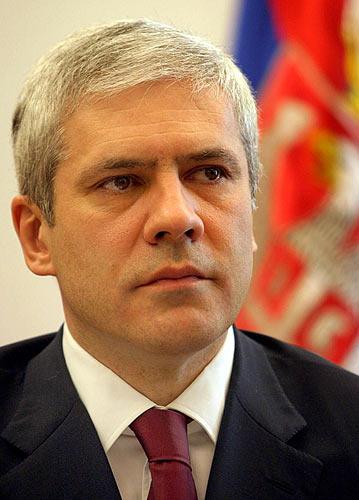

Serbian President Reacts to Yesterday’s Violence in Belgrade

Recently elected Serbian President, Boris Tadić, has responded to yesterday evening’s violence in Belgrade, which involved the torching of the US Embassy by an unruly mob numbering hundreds.  The mob was but a tiny minority of the crowd of hundreds of thousands, which had gathered earlier in the day to peacefully protest Kosovo’s declaration of independence on Monday of this week.  Tadić, a the leader of the moderate Democratic Party in Serbia, had this to say about the events:

tadic.jpg Tadić, who was in Romania Thursday, today said he has “asked all relevant institutions for reports on yesterday’s unrest in Belgrade”.
For the same reason, he was called a session of the Council for National Security…

…Tadić is also strongly condemning the violence, looting and burning, that ended in one death and nearly 200 injured, as well as huge material damage to the city.

“There is no justification for violence, no one must dare to justify it with a single word,” his press service said in a statement…

…Tadić went on to say that “this is not Serbia and Serbia will never be like this”.

“The state must have law and order and such violence must never happen again, anywhere,” Tadić said.

Human Trafficking–Katia’s Story

A confluence of events–globalization, technological and communications advances, and halting (or no) democratization–has led to an unprecedented rise in global human trafficking. States and governments have been unable to make a dent in this growing trade, where human beings are sold like cattle to be used as indentured servants and sex slaves. Here is a documentary about one such person, Katia from Ukraine, whose husband’s friend kidnapped and sold her in Turkey, whence she was moved to western Europe where she was forced into prostitution. (The documentary is in five parts. Here is part one.)

Samuel Huntington of “Clash of Civilizations” fame, Interviewed

Charlie Rose interviews Huntington on the ideas in his oft-cited and even more criticized “Clash of Civilizations” thesis. Rose calls the clash thesis “provocative.”  What do you think about the logic of the clash thesis.  Given that you’ve read Amartya Sen’s response to Huntington, what kinds of questions would you have asked Huntington that Rose failed to?  (The Huntington interview runs from 1:55 until about 21:00.  No, Professor Huntington is not a dead-ringer for John Cleese.  That is, in fact, John Cleese, who is interviewed in the middle segment; hence, the screen shot of Cleese.)

Serb Demonstrators Attack US and Croatian Embassies in Belgrade

The Washington Post reports that following a massive (upwards of 150,000 participants) and peaceful demonstration in the Serbian capital of Belgrade, with the theme “Kosovo is Serbia”, a group numbering a few thousand at most has attacked the US and (neighboring) Croatian embassies, setting the US embassy on fire. The demonstrations were held in the aftermath of Albanian Kosovars’ official declaration of independence on Monday. The US is one of many countries to have officially recognized Kosovo as the newest ex-Yugoslav independent state, setting off a public and official outcry on the part of Serbs, for whom Kosovo is the historical birthplace of their nation.

Politicians in Belgrade are caught between their rhetoric to do what it takes (short of violence) to prevent Kosovo from achieving full-fledged independence and the lack of many good non-violent options to do so, given the Serb leadership’s openly declared goal of one day joining the European Union. One possibility would be to energize (or otherwise entice) the Serbs in neighboring Bosnia and Herzegovina to agitate for higher levels of autonomy, or outright independence, stressing the similarities of the situations. This would certainly raise the ire of European leaders and would not earn the Serbs any bonus points in their quest for further integration into European political and economic institutions.

Here is footage from the Belgrade independent media outlet B92:

From the “About Video” (translated by me): Beograd — Stotine nasilnih demonstranata nakon završetka mitinga napalo američku i hrvatsku ambasadu. U 19:13 intervenisala policija.

“Upon the conclusion of the [official] demonstration, undreds of violent demonstrators attacked the American and Croatian embassies. The police intervened at 7:13 pm.”

You can find a gallery of photographs from the day in Belgrade at B92’s website here.

A Good Resource for Information on “Eurasia”

eurasianet.jpg

Eurasianet.org has a very informative website that offers news from Eurasia. Here is a snippet from their about page (when you find a source online always read their “about” or “description” page to get an idea of what the organization is, if they have any political biases, etc.):

EurasiaNet provides information and analysis about political, economic, environmental and social developments in the countries of Central Asia and the Caucasus, as well as in Russia, the Middle East, and Southwest Asia. The web site also offers additional features, including newsmaker interviews and book reviews.

Based in New York, EurasiaNet advocates open and informed discussion of issues that concern countries in the region. The web site presents a variety of perspectives on contemporary developments, utilizing a network of correspondents based both in the West and in the region. The aim of EurasiaNet is to promote informed decision making among policy makers, as well as broadening interest in the region among the general public.

EurasiaNet is operated by the Central Eurasia Project of the Open Society Institute.

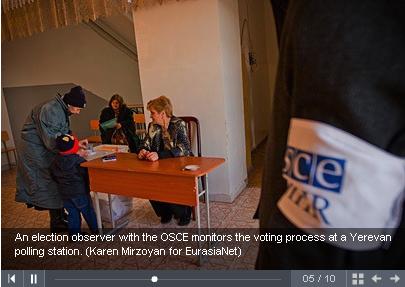
Today, they report on contested presidential elections in Armenia, where opposition supporters claim fraud has taken place while supporters of current Prime Minister (and declared winner) Serzh Sarkisian believe that their candidate has won with more than 50% of the vote, obviating the need for a run-off election (in many electoral systems, for a candidate to be declared the official winner, s/he must have received a majority (i.e., 50%) of votes cast. If no candidate passes that threshold, a run-off election is held where the two leaders go head-to-head.) You can read the Washington Post’s report here, with a snippet below:

armenia_elections.jpgYEREVAN, Armenia — Thousands of opposition supporters marched through Armenia’s capital Wednesday after an election official said complete results showed that the prime minister had won the presidential election.

Allegations of fraud and threats of mass protests have raised concerns about the stability of the volatile, strategic country, located at the juncture of the energy-rich Caspian Sea region and southern Europe and bordering Iran.

An initial count of the ballots showed Prime Minister Serge Sarkisian had nearly 53 percent of the vote in Tuesday’s election, Central Election Commission chief Garegin Azarian said _ enough to win outright and avoid a runoff. Top opposition candidate Levon Ter-Petrosian had 21.5 percent, Azarian said.

Ter-Petrosian’s backers have alleged widespread fraud, and a crowd gathered in central Yerevan to protest the results, swelling to some 20,000 as riot police with truncheons guarded the election commission building a five-minute walk away.

The protesters then marched to the government headquarters in a broad central square, many shouting “Levon!” and raising a clenched fist _ Ter-Petrosian’s campaign symbol. Helmeted police blocked the building, and the protesters moved on, marching toward the election commission building.

I have no doubt that the authorities have falsified the election and I will protest with all those who also feel cheated,” Simon Grigorian, a 38-year-old engineer, said at the protest.

You’ve got to Fight…for Your Right…to…Gain Citizenship

During our discussion in class today on different forms of group identity, many of you seemed surprised when I mentioned that there were many non-US citizens currently fighting for the US military in Iraq; many (a majority at least) are doing so in exchange for the promise of US citizenship. Which begs the questions, just how many non-citizens are currently serving in the US military? According to this paper (pdf),

“As of February 2003, there were 37,000 non-citizens serving in active duty in the U.S. armed forces, almost 12,000 foreign nationals serving in the selected reserves, and another 8,000 serving in the inactive national guard and ready reserves.”*

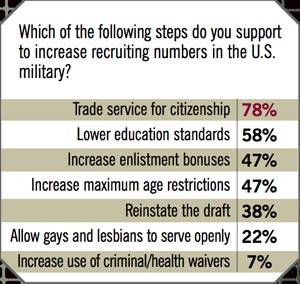
As we learned in class, prior to the establishment and consolidation of nation-states in Europe, post-Westphalia, most political leaders recruited mercenary armies. Thus, the link between military protection and citizenship is a modern phenomenon. This makes the results of a recent survey done by Foreign Policy Magazine very interesting.

recruit_armed_forces.jpg

Many proposals have been suggested to help the military meet its recruiting and retention needs. But an incredible percentage of the index’s officers favor the same solution: Nearly 80 percent support expanding options for legal, foreign permanent residents of the United States to serve in exchange for U.S. citizenship. A high percentage of officers, about 6 in 10, also support the idea of allowing more recruits who have a high school equivalency degree—but no diploma—to serve. Almost 40 percent favor reinstating the draft.

*Not all of these, of course, are serving in Iraq. Moreover, while it is a seemingly large number it is still a very small percentage of the total military.

Partition as a Solution to Ethnic Conflict/Violence

Today in class we discussed ethnic identity and various types of inter-ethnic violence. We saw that a large literature in political science (and related disciplines) sees the very fact of cultural (and especially ethnic) heterogeneity is being the source of much that goes wrong within states and societies. In a previous post, I mentioned Robert Putnam’s recent findings that trust is lower in more heterogeneous societies; there is a burgeoning literature on the deleterious economic impact of ethnic (and other forms of) identity (public goods provision, for example, is lower in more heterogeneous societies).

If the very fact of heterogeneity is the cause of conflict and violence, then wouldn’t a reasonable solution to inter-ethnic conflict/violence be to create new more ethnically homogeneous states out of a single ethnically diverse one? Some argue that this may be a legitimate solution to the extant difficulties in Iraq. Chaim Kaufmann has argued in favor of just this approach. Here (pdf) is an article written by Nicholas Sambanis setting out, then critiquing Chaim Kaufmann’s hypotheses regarding the usefulness of partition to resolve endemic inter-ethnic violence.

You can view a fascinating BBC documentary on the partition of India in 1947 here. Here’s an important quote from the documentary:

“…as a British barrister draws a line on a map…”

Much of the violence that occurred during the partition was the result of Muslims and Hindus (of course, the Sikh/Punjab problem adds another layer of complexity altogether) trying to be on (or being forced to move to) the right side of that barrister’s line. Millions were killed.

U.S. Formally Recognizes Kosovo Independence

We discussed in class today that of the four characteristics of a state, the only one that Kosovo had, at that point, not fulfilled was international recognition by other states. According to this Washington Post story, the United States has begun to change that:

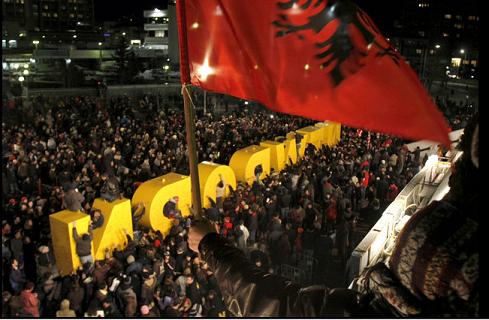
kosovo_independence1.jpgPresident Bush hailed the newly independent Kosovo and officially recognized it as a state and a “close friend” on Monday, expressing strong support for the new Balkans nation even as he rebuffed protests by Serbia and Russia.

The formal announcement came in a statement issued by Secretary of State Condoleezza Rice, who is traveling in Africa with the president. “The United States has today formally recognized Kosovo as a sovereign and independent state,” she said. “We congratulate the people of Kosovo on this historic occasion.”

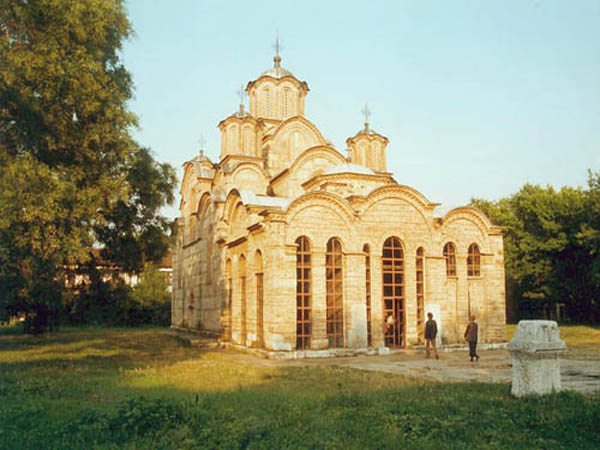
I understand what it feels like to be a Kosovar Albanian today as it takes me back to 15 January 1992, when European and other states, including the United States, formally recognized the independence of the Republic of Croatia. I can also sympathize with Serbs, who must feel like their heart has been ripped out of their body given that Kosovo is integral to history and spirit of the Serbian nation. Ivo Banac has written that “the history of the Balkans is a history migrations, not only peoples, but of lands.” The Serbian nation was founded on land that the Serbs no longer control politically as a result of the vicissitudes of politics in that part of the world and the drift of the center of gravity of Serb political northward over the centuries. It is incumbent upon the new Kosovo government and the international community to allow Serbs to continue to have access to the sacred religious and spiritual monuments of their past.

You can see a comprehensive slide show of photographs marking the situation here.

Below is a photograph of the famous Serbian Christian Orthodox Gračanica Monastery in Kosovo.

gracanica1.jpg

Life, Liberty, and the Pursuit of Happiness

We hold these truths to be self-evident, that all men are created equal, that they are endowed by their Creator with certain unalienable Rights, that among these are Life, Liberty and the pursuit of Happiness.

All of us immediately recognize these powerful sentences as being part of the Declaration of Independence of the United States of America. Happiness is an important concept and has been the object of increased study in political science and comparative politics. Ronald Inglehart (he of World Values Survey fame) argues that there is a strong relationship between happiness and democracy across countries. Inglehart writes:

Correlation is not causation, and this linkage could reflect any of the following things: (1) living under democratic institutions makes people much happier than living under authoritarian institutions; or (2) high levels of subjective well-being are conducive to democratic institutions; or (3) the correlation could be spurious, due to the fact that both subjective well-being and democracy are strongly correlated with some other variable such as high levels of economic development.

Solving this puzzle has far-reaching implications. If the linkage is not spurious and democracy makes people happy, this provides a strong additional argument on behalf of democracy; while if high levels of happiness are conducive to democracy, this can lead to a better understanding of how democracy emerges and flourishes. Using World Values Survey data on happiness levels from 1981 to 2006, and the Freedom House measures of democracy levels from 1972 to 2005, this paper analyzes the relationships between happiness and democracy in order to determine what is causing what.

How happy are Americans? How happy are Germans, Chinese, or Brazilians, for that matter? Who are the happiest people on earth? According to the new World Database of Happiness, it’s the Danes, Swiss and Maltese. Is this a political cultural trait, as Inglehart assumes, or are there structural and institutional factors at work? All three countries are rather small, and European. (Malta and Denmark are, additionally, amongst the most homogeneous states in the world, and this could be having an effect, given new research by Robert Putnam on the potential socially, politically, and economically detrimental effects of ethnic diversity.) Americans, by the way, are ranked #25 in level of happiness.

Design a site like this with WordPress.com
Get started