Challenges to Rational Choice Theory

The fundemental assumption regarding human behavior, upon which the whole edifice of rational choice theory (RCT) rests is that human beings are rational; specifically, it means that they act in order to maximize their self-interest by “maximizing expected utility”. The construction above takes into account our preferences (utility) and the fact that the link between our actions and outcomes are rarely certain, but that we are able to adequately estimate (beliefs) the likelihood of achieving a specific goal given an accompanying action.

In the example of Lebron James I posted earlier, he has a generally good idea of his preferences (he prefers–other things equal–to hit a 3-pointer over a field goal or a free throw) and his beliefs (he knows his stats regarding his 3-point shooting percentage, his field goal, and free throw percentages as well). Given his beliefs and preferences, Lebron can easily act–and generally does–in an instrumentally rational manner.

How valid, though, is the assumption that human beings do act in an instrumentally rational manner? In other words, do individuals always maximize their expected utility? The short answer is no. Some political scientists believe that political culture often acts to mitigate instrumentally rational behavior. [We’ll discuss this in class on Tuesday.] Whole sub-disciplines in behavioral psychology and behavioral economics can point to copious amounts of research data demonstrating the lack of rationality in human beings, often in fairly simple situations. Michael Sherman asks “why people believe weird [i.e., irrational] things about money”:

Would you rather earn $50,000 a year while other people make $25,000, or would you rather earn $100,000 a year while other people get $250,000? Assume for the moment that prices of goods and services will stay the same.

Surprisingly — stunningly, in fact — research shows that the majority of people select the first option; they would rather make twice as much as others even if that meant earning half as much as they could otherwise have. How irrational is that?

Continue reading “Challenges to Rational Choice Theory”

Blog your way to a $2000 Scholarship

Here is an opportunity that some of you may want to take a look at.  The site College Schoarships.org is giving out a series of $2000 scholarships to college students who blog about politics.  Here is some of the information; click here to find out more about the competition and about the organization.

The 2nd Annual Political Blogging Scholarship

Scholarship Amount – $2,000

Laptop.Do you maintain a political weblog and attend college? Would you like $2,000 to help pay for books, tuition, or other living costs? If so, read on.
We’re giving away $2,000 this year to a college student who blogs about politics. Our scholarship is awarded annually.

Scholarship Requirements:

  • Your blog must contain unique and interesting information about political issues, current events, opinions, etc. No spam bloggers please!!!
  • U.S. citizen;
  • 3.0 GPA;
  • Currently attending full-time in post-secondary education; and
  • If you win, you must be willing to allow us to list your name and blog on this page. We want to be able to say we knew you before you became a well educated, rich, and famous blogging legend.

Why a Political Blogging Scholarship?

When we first introduced our general Blogging Scholarship in 2006, we didn’t really know what to expect. The applicants had such varied interests and style. There were 10 finalists, all outstanding at what they did. In the end, the winner of the popular vote was a political blogger.

We then realized it’s very hard for others to compete with political bloggers when it comes to rallying votes. Instead of banning political bloggers from entering this year’s Blogging Scholarship without any compensation, we decided to create a separate scholarship just for political bloggers.

With the 2008 presidential election run already well underway, bloggers figure to play a big roll in the next elections.

Political Blog Categories

When submitting your application, please label your affiliation as one of the following:

  • Republican Party
  • Democratic Party
  • Other 3rd Party

We are accepting scholarship applications from all political bloggers, and our directors will decide on a blog from each category to become a finalist. If we do not receive an application from one of the political categories, we will leave out that particular category during the final round. In true democratic fashion, voting will be open to the public to decide the winner between the finalists.

More Trouble in East Timor–President shot in coup attempt

In a previous post, I used the current political situation in the relatively new state of East Timor as an illustration of the importance of having a strong state to facilitate political and economic development.  The situation in that country has become even more dire as we hear that East Timor’s President, Jose Ramos-Horta–a former winner of the Nobel Peace Prize–has been shot in an attempted assassination attempt.  From the BBC:

East Timor’s President Jose Ramos-Horta is in a critical condition and has been put into an induced coma, after being shot by rebel soldiers.

Mr Ramos-Horta was shot in a pre-dawn attack on his Dili home, and later airlifted to Australia for treatment.

Later Prime Minister Xanana Gusmao declared a 48-hour state of emergency, including a night-time curfew.

Mr Gusmao, who was targeted in a separate incident but was unharmed, described the events as a coup attempt.

Rebel leader Alfredo Reinado and another rebel died in the attack on Mr Ramos-Horta.

Australian PM Kevin Rudd pledged to send more peacekeepers to East Timor.

He said the “attempt to assassinate the democratically elected leadership of a close friend and neighbour of Australia’s is a deeply disturbing development”.

Here’s more from the New York Times, and according to this report from Australia’s ABC, UN police failed to help the injured President:

East Timor’s Government says United Nations forces failed to help President Jose Ramos Horta after he was shot in an assassination attempt in Dili this morning.

He was shot in the arm and stomach after fugitive rebel leader Alfredo Reinado launched a pre-dawn raid on his home.

Mr Ramos Horta is now in a serious but stable condition in Royal Darwin Hospital after being evacuated on a Careflight plane this afternoon.

He was sedated on the flight from Dili to Darwin and the hospital says he is suffering three gunshot wounds – two to the upper chest and one to the abdomen.

East Timor Prime Minister Xanana Gusmao, who was also attacked but escaped unharmed, has confirmed that Reinado was shot dead during the raid.

The country’s Foreign Ministry has issued a statement which said that UN police stayed about 300 metres away from where Mr Ramos Horta was shot.

Reading Questions on Political Culture

Here are questions for the three assigned readings. (Note that I have uploaded a video on Blackboard that explains how to interpret the numerical results from regression analysis.)

Please come to class prepared to answer the following questions:

General Questions

After having read the three required articles, what is your assessment of the concept political culture? Is there evidence that national political cultures exist? Do you have reason to believe that political culture is a concept that can be adequately defined? Can we use the concept political culture to account for cross-national patterns in various political phenomena? How does each of the
authors use the concept political culture and what is their assessment of its utility as an explanatory mechanism in comparative politics?

Inglehart, Ronald–“The Renaissance of Political Culture”

  • What is the significance of Figure 1 n p. 1206?
  • Is there a correlation between life satisfaction and level of economic development [see Figure 2]? Explain.
  • Why does Inglehart analyze the phenomena i) life satisfaction, and ii) interpersonal trust?
  • What is the logic underlying the relationship between culture and economic development as outlined in Weber’s “the Protestant Ethic?”
  • The relative growth rates of Protestant as against non-Protestant countries in the 1970s and 1980s seems to undermine Weber’s “Protestant ethnic” argument. How does Inglehart reconcile the argument with the empirical evidence?
  • What is post-materialism and what is the relationship bebetween post-materialist values and economic growth?

Continue reading “Reading Questions on Political Culture”

Do national cultures exist? Do supra-national cultures exist?

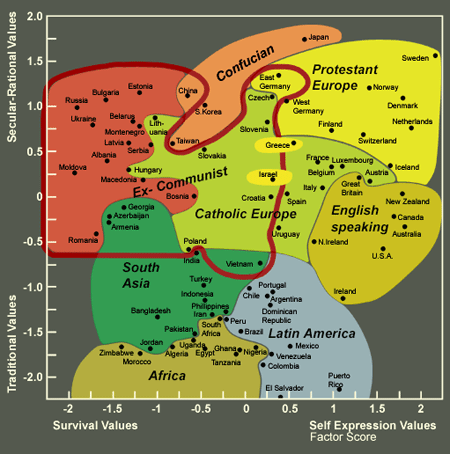
Here is a map from Ronald Inglehart’s World Values Survey organization web site. The site allows users to analyze data collected by the World Values Survey in dozens of countries around the world. We are reading Inglehart’s The Renaissance of Political Culture this week and will analyze the importance of political culture for understanding political outcomes, such as democracy and economic development. Are some cultures more compatible with democracy and economic growth than others? Is culture a more compelling framework for testing political phenomena than is rational choice?

Inglehart-Welzel Cultural Map of the World

This map reflects the fact that a large number of basic values are closely correlated; they can be depicted in just major two dimensions of cross-cultural variation

inglehart_weltzel_value_map.gif

Lebron James behaving in an Instrumentally Rational Manner

In PLSC240 today, I introduced you to the rational choice theory (RCT), an increasingly important explanatory mechanism in political science. The basic idea behind RCT is that one can analyze political outcomes on the basis of understanding individual behavior. The fundamental assumption regarding individual behavior is that all human beings (regardless of where they are from) act in an instrumentally rational manner. What does this mean? It means selecting the means or action (instrument) that will maximize one’s expected utility. Huh? Well, here’s an explanation by way of an example from King James. Click on the picture to link to a page where you can view the video clip.lebron.jpg

In that clip, we saw Lebron James hit a “step-back 3”; in other words, he stepped his right foot back behind the 3-point line so that his shot (were it to go in the basket) would be worth three points rather than two. You often see players do this. In so doing, they are acting in an instrumentally rational manner by maximizing their expected utility. Follow along for the logic, and for some mathematical notation.

We all value things in life, and an NBA player–during the 48 minutes (or portion thereof) that he is on the floor values points (among other things). He wants to score as many points as possible, other things being equal. Because he values points, they give him utility. From a rational choice perspective, an individual is acting in an instrumentally rational manner if she takes the action/behavior that will maximize her expected utility. Moreover, she should be consistent–i.e., given the same utility and environmental constraints the individual should select the same action/behavior every time, and any other individual would do the same.

In the NBA, some shots from “the field” are worth 3 points, while others are worth 2. Thus, Lebron in the situation shown in the video clip can quantify the utility of his preferences: they are u(3pt) = 3, u(2pt) = 2. In other words, the utility (u) to Lebron of making a 3-point shot is 3, and of making a 2-point shot is 2. Deciding whether to take a 3-point shot or a 2-point shot would be a straightforward task if he knew for certain that the ball would go in the hoop every time he shot. Of course, he isn’t certain. What are his beliefs about the probability of each of these shots going in?

Well, fortunately the NBA keeps statistics on these types of things. He shoots 33% from beyond the 3-point line, and 40% from a foot inside that line. Thus, his beliefs are Pr(2pt )= 0.4, and Pr(3pt) = 0.33. The probability of successfully making a 2-point shot–one foot inside the line–is 0.4, etc. Given that we now know both his preferences and beliefs, we can determine what is the instrumentally rational action for Lebron to take.

What is his expected utility (EU) of attempting a 2-point shot?

EU(2pt) = Pr(2pt) · u(2pt), which is 0.4· 2 = 0.8

What is his expected utility (EU) of attempting a 3-point shot?

EU(3pt) = Pr(3pt) · u(3pt), which is 0.33· 3 = 0.99

Since 0.99 > 0.8, Lebron is “maximizing his expected utility” by “stepping back to hit the three.” Isn’t rational choice fun?

Comparative Welfare States in Advanced Industrial Economies

In a couple of weeks, we–in PLSC240–will address the topic of political economy.  We’ll compare states around the world with respect to institutions such as tax regimes, openness of borders to goods and services imported from abroad, and also with respect to welfare state spending.  Andrew Gelman has posted on his blog a review–which will be published in Political Science Quarterly–of a new book by Clem Brooks and Jeff Manza, titled Why Welfare States Persist.  Not surprisingly, the answer is that they are publicly popular.  What is more interesting, though, is why the size of the welfare state differs amongst countries with relatively similar income levels.  Can you can think a cultural explanation?  Institutional?  Rational Choice?

Rich capitalist democracies around the world differ widely in their welfare states—their systems of government-provided social support–despite having comparable income levels. Brooks and Manza report that welfare state spending constituted 27% of GDP in “social democratic countries” such as Sweden and 26% of GDP in “Christian democratic countries” such as Germany, but only 17% in “liberal democracies” such as the United States and Japan. These differences are correlated with differences in income inequality and poverty rates between countries.

In their book, Brooks and Manza study how countries with different levels of the welfare state differ in their average policy preferences, as measured by a cross-national survey that asks whether respondents think the government should (a) provide a job to everyone who wants one, and (b) reduce income differences between rich and poor. Brooks and Manza find that countries where government jobs policies and redistribution are more popular are the places where the welfare state is larger, and this pattern remains after controlling for time trends, per-capita GDP of the country, immigration, women’s labor force participation, political institutions, and whether the ruling party is religious or on the left.

Next week, you will have a chance to test this hypothesis when we comparatively analyze public opinion attitudes around the world using the World Values Survey.   Is this relationship real?  Does it apply to states that are not advanced industrial economies?  We’ll find out next week.

US Intelligence Director Assesses Al Qaeda Threat

A new article in the New York Times analyzes Mike McConell’s Tuesday testimony to the Senate Intelligence Committee.  How successful has the war on terror been in destroying th threat capability of that terrorist network?  According to McConell’s testimony, not too successful, unfortunately:

Al Qaeda is gaining in strength from its refuge in Pakistan and is steadily improving its ability to recruit, train and position operatives capable of carrying out attacks inside the United States, the director of national intelligence told a Senate panel on Tuesday.

The director, Mike McConnell, told lawmakers that Osama bin Laden and his deputy, Ayman al-Zawahri, remained in control of the terrorist group and had promoted a new generation of lieutenants. He said Al Qaeda was also improving what he called “the last key aspect of its ability to attack the U.S.” — producing militants, including new Western recruits, capable of blending into American society and attacking domestic targets.

A senior intelligence official said Tuesday evening that the testimony was based in part on new evidence that Qaeda operatives in Pakistan were training Westerners, most likely including American citizens, to carry out attacks. The official said there was no indication as yet that Al Qaeda had succeeded in getting operatives into the United States.

One point merits comment: The ability of a non-territorially-based network to threaten powerful states like the US is severely diminished without protection from states, like Pakistan.  Why Pakistan is an ideal refuge for Al Qaeda is a complicated story, but it goes back to the initial founding of the state in the 1940s, and the fact that the Pakistani state has never truly controlled–ie., asserted the monopoly of political violence in the parts of Pakistan in which members of Al Qaeda are currently taking refuge.  A more forceful response from the Pakistani government could have truly powerful destabilizing effects on Pakistan, and on the region as a whole.

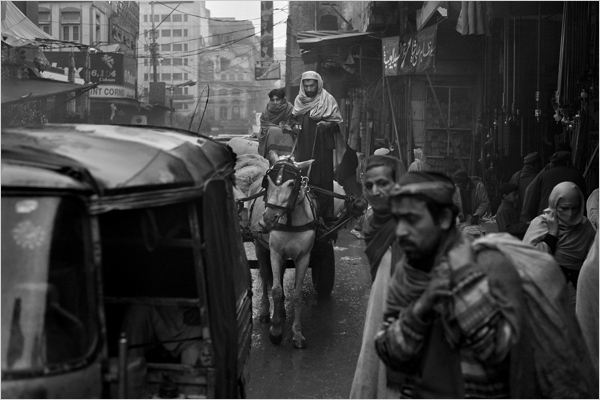
See this slide show at the following link, for a fascinating look at Peshawar, a Pakistani city right at the heart of the battle:

peshawar.jpg

State Capacity and the US Federal Budget

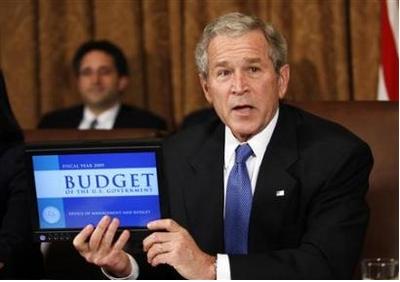
bush_budget.jpgWe’re currently discussing and analyzing the state, and its important role in comparative politics. One of the dimensions on which we can compare state power is “capacity.” What is capacity? According to O’Neil (p.38-39), “capacity is the ability of the state to wield power in order to carry out the basic tasks of providing security and reconciling freedom and equality. A state with high capacity is able to formulate and enact fundamental policies and ensure stability and security for both itself and its citizens.” We were presented with evidence today of a demonstration of the high capacity of the United States as President George W. Bush unveiled his new 3.1 trillion-dollar (I’m no mathematician, but that’s at least a couple of gazillion dollars, isn’t it?) budget. Any state that can make its citizens cough up that much money, more or less willingly, has to have high capacity.

The photograph is from Yahoo News, click here to see a video clip of the president submitting this year’s federal budget, the first one in American history to be submitted in electronic form. As the president correctly surmised, “this will save a lot of trees!”

It Just Keeps on Getting Worse: Violence Escalates in Chad

From the BBC, we learn that the situation in the African state of Chad is going downhill quickly. According to the Failed States Index compiled by the Fund For Peace, Chad was the 5th most failed state in 2007. Chad has been affected negatively by the ongoing conflict and genocide in the neighboring state of Sudan.

Thousands of people are fleeing the Chad capital, N’Djamena, after two days of fierce fighting between government and rebel forces in the city.

chad.jpgThe government says it has pushed the rebels out of the city but they say they withdrew to give civilians the chance to evacuate. Aid workers report that fighting is continuing outside the city, while dead bodies litter the streets.

The UN Security Council has urged member states to help the government. The BBC’s Laura Trevelyan at the UN in New York says this non-binding statement gives the go-ahead to France and other countries to help President Idriss Deby’s forces against the rebels.

Chad’s former colonial power France has a military base in Chad and has previously helped the government with logistics and intelligence. Thousands of people have been streaming across the Ngueli bridge, which separates Chad from Cameroon.

Local officials have told the UN refugee agency that thousands were also crossing at the border town of Kousseri. “We’re expecting a lot more people coming,” said UNHCR spokesman Ron Redmond. He also said he was extremely concerned for the 240,000 Darfur refugees in Chad.

The International Crisis Group released a report back in 2006 detailing the situation in Chad and fearing a return to war in that country. You can view the executive summary here, where there is a link to the full report (the full report is only in French, however). Here is a snippet from that summary:

The April 2006 rebel offensive brought Chad to the brink of all-out civil war. The victory that President Idriss Déby ultimately achieved in pushing the United Front for Democracy and Change (FUCD) back from the gates of the capital, N’Djamena, to its Darfur sanctuary settled nothing on the military front and underscored the political fragility of the regime. The army’s success was primarily due to French logistical and intelligence support, while the setback paradoxically may encourage the armed opposition groups to forge closer links in order to pursue a war of attrition in the north, the east and along the border with the Central African Republic. The crisis is far from resolved, and is likely to be an enduring one.

Only weeks before the 3 May presidential elections, Déby had to fight off spectacular defections of senior figures from the army and the political elite as well as assassination attempts, all likewise aimed at preventing him from gaining a third term but he won the controversial elections with 64.67 per cent of the vote.[1] Though opposition groups challenged the result, France and the wider international community hastily accepted it to avoid further destabilisation, while declaring that they now expected the president to democratise his regime.

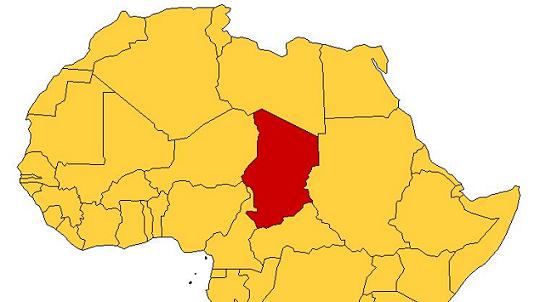
Chad (red on the map) is in north-central Africa and is on the eastern border of Sudan.

chad_map.jpg

Design a site like this with WordPress.com
Get started