
“Who” is China? A Constructivist Approach to Security

William A. Callahan is a fellow at the Woodrow Wilson Center for International Scholars who is currently working on a project that links Chinese notions of self-identity and that country’s broader security environment.  As you may have guessed, Callahan approaches the topic from a constructivist perspective, in which issues of culture and identity are paramount.  A realist would never ask “who” is China, but “what” is China.   Here’s a snippet:

Who is China? This question is fundamental to the internal debate among Chinese elites as they grapple with national identity which, in turn, affects policy decisions…culture and history are intimately linked to China’s current foreign policy outlook.

Callahan’s book project analyzes how history, geography, and ethnicity shape China’s relations with the world. “To understand this, we must look at how China relates to itself,” he said. “China’s national security is closely tied to its national insecurities.”

One such insecurity is its shame over lost territory. Callahan cited “national humiliation maps” that outline historical China’s imperial boundaries juxtaposed with present-day borders. “These maps, which are produced for public consumption, narrate how China lost territory to imperialist invaders in the 19th century—especially Taiwan to Japan and the North and West to Russia,” said Callahan. “China lost a large chunk of territory. The humiliation—and how to cleanse it—is an important point that shapes China’s nationalism and pride.”

In fact, most demonstrations in China about any given problem usually have a historical aspect, he said, such as in 1999, when the United States bombed the Chinese Embassy in Belgrade, which was viewed in China as a humiliation similar to those of a century ago at the hands of the West.

“Idealized versions of China’s imperial past are now inspiring Chinese scholars’ and policymakers’ plans for China’s future—and the world’s future—in ways that challenge the international system,” said Callahan. This makes the study of identity politics all the more critical.

China and Japan, for example, have close economic relations but cool social and political ties. Callahan said, “China relates to Japan as an evil state, recalling World War II atrocities, such as the Nanjing massacre, and this memory has taken over the relationship.”

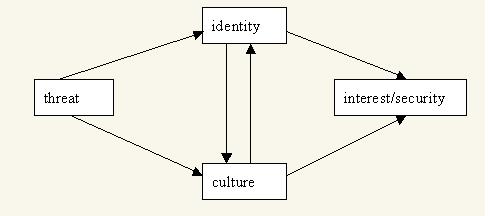
Notice the importance of the premise in the penultimate paragraph: that “idealized versions of China’s past” (i.e., culture and identity) are having a causal impact on China’s foreign policy.  This contrasts starkly with realist conceptions of the nature of international relations.  Below are two diagrams from Shih demonstrating the difference between realist and constructivist conceptions of security.
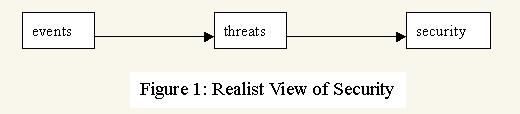
shih_realist_security.jpg

shih_constructivist_security.jpg

Notice that the impact of threats on security is not direct in the constructivist view; rather, it is mediated by culture and identity, both of which also affect each other.
US Intelligence Director Assesses Al Qaeda Threat

A new article in the New York Times analyzes Mike McConell’s Tuesday testimony to the Senate Intelligence Committee.  How successful has the war on terror been in destroying th threat capability of that terrorist network?  According to McConell’s testimony, not too successful, unfortunately:

Al Qaeda is gaining in strength from its refuge in Pakistan and is steadily improving its ability to recruit, train and position operatives capable of carrying out attacks inside the United States, the director of national intelligence told a Senate panel on Tuesday.

The director, Mike McConnell, told lawmakers that Osama bin Laden and his deputy, Ayman al-Zawahri, remained in control of the terrorist group and had promoted a new generation of lieutenants. He said Al Qaeda was also improving what he called “the last key aspect of its ability to attack the U.S.” — producing militants, including new Western recruits, capable of blending into American society and attacking domestic targets.

A senior intelligence official said Tuesday evening that the testimony was based in part on new evidence that Qaeda operatives in Pakistan were training Westerners, most likely including American citizens, to carry out attacks. The official said there was no indication as yet that Al Qaeda had succeeded in getting operatives into the United States.

One point merits comment: The ability of a non-territorially-based network to threaten powerful states like the US is severely diminished without protection from states, like Pakistan.  Why Pakistan is an ideal refuge for Al Qaeda is a complicated story, but it goes back to the initial founding of the state in the 1940s, and the fact that the Pakistani state has never truly controlled–ie., asserted the monopoly of political violence in the parts of Pakistan in which members of Al Qaeda are currently taking refuge.  A more forceful response from the Pakistani government could have truly powerful destabilizing effects on Pakistan, and on the region as a whole.

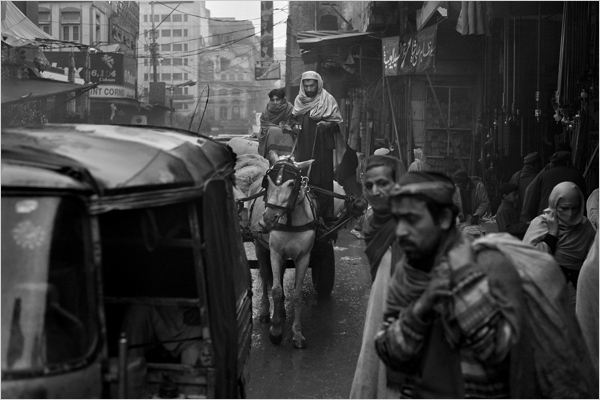
See this slide show at the following link, for a fascinating look at Peshawar, a Pakistani city right at the heart of the battle:

peshawar.jpg

India’s Role in the Illegal Trafficking of Body Parts

This worrisome story in the New York Times sheds light on an increasingly brazen network of doctors and bandits who have organized an international trafficking ring in human body parts, such as kidneys.  While increasing numbers of Indians, and residents of other less-developed countries willingly sell their kidneys many, like the gentleman in the story, are the victims of deception and fraud.

GURGAON, India — As the anesthetic wore off, Naseem Mohammed said, he felt an acute pain in the lower left side of his abdomen. Fighting drowsiness, he fumbled beneath the unfamiliar folds of a green medical gown and traced his fingers over a bandage attached with surgical tape. An armed guard by the door told him that his kidney had been removed.

Mr. Mohammed was the last of about 500 Indians whose kidneys were removed by a team of doctors running an illegal transplant operation, supplying kidneys to rich Indians and foreigners, police officials said. A few hours after his operation last Thursday, the police raided the clinic and moved him to a government hospital.

Many of the donors were day laborers, like Mr. Mohammed, picked up from the streets with the offer of work, driven to a well-equipped private clinic, and duped or forced at gunpoint to undergo operations. Others were bicycle rickshaw drivers and impoverished farmers who were persuaded to sell their organs, which is illegal in India.

Although several kidney rings have been exposed in India in recent years, the police said the scale of this one was unprecedented. Four doctors, five nurses, 20 paramedics, three private hospitals, 10 pathology clinics and five diagnostic centers were involved, Mohinder Lal, the police officer in charge of the investigation, said.

Timor Leste (East) and Nation-Building

The International Crisis Group (ICG) has a new report on the situation in Timor Leste. Some of you may be aware that Timor Leste broke away from Indonesia four years ago following a brutal war of secession, during which forces loyal to the Indonesian government were alleged to have committed horrendous crimes against humanity. Thanks to UN intervention, the killing stopped and the small state of Timor Leste gained its independence. Recently, however, the UN-directed nation-building exercise in Timor Leste has imploded, along with domestic order.

According to the ICG.

Four years after Timor-Leste gained independence, its police and army were fighting each other in the streets of Dili. The April-June 2006 crisis left both institutions in ruins and security again in the hands of international forces. The crisis was precipitated by the dismissal of almost half the army and caused the virtual collapse of the police force. UN police and Australian-led peacekeepers maintain security in a situation that, while not at a point of violent conflict, remains unsettled. If the new government is to reform the security sector successfully, it must ensure that the process is inclusive by consulting widely and resisting the temptation to take autocratic decisions. A systematic, comprehensive approach, as recommended by the UN Security Council, should be based on a realistic analysis of actual security and law-enforcement needs. Unless there is a non-partisan commitment to the reform process, structural problems are likely to remain unresolved and the security forces politicised and volatile.

The problems run deep. Neither the UN administration nor successive Timorese governments did enough to build a national consensus about security needs and the kind of forces required to meet them. There is no national security policy, and there are important gaps in security-related legislation. The police suffer from low status and an excess of political interference. The army still trades on its heroism in resisting the Indonesian occupation but has not yet found a new role and has been plagued by regional (east-west) rivalry. There is a lack of transparency and orderly arrangements in political control as well as parliamentary and judicial oversight with respect to both forces.

The situation in Timor Leste illustrates–from the perspective of comparative politics–the importance of the state and its crucial role in facilitating stability by consolidating political power and maintaining, to paraphrase Weber, a monopoly on the legitimate use of political violence. From an IR perspective, we see the difficulty of imposing legitimate order on a society from outside, whether–as is the case here–through intergovernmental organizations (IGOs) like the United Nations, or–as in Iraq–through unilateral, or multilateral means.

Here’s a report from the BBC on the upheavals of April-June 2006.

Winter 2008 issue of Orbis dedicated to “Assessing Democratic Transitions”

Just a note to remind me that the Winter 2008 issue of Orbis has a symposium on entitled “Assessing Democratic Transitions Today.” Here is the partial table of contents:

Introduction Adrian A. Basora
Must Democracy Continue to Retreat in Postcommunist Europe and Eurasia? Adrian A. Basora
The Tasks of Democratic Transition and Transferability Valerie Bunce
Ukraine: Lessons Learned from Other Post-Communist Transitions Mykola Riabchuk
Central Asia: U.S. Bases and Democratization Alexander Cooley
East and South East Asia: Lessons from Democratic Transitions Tom Ginsburg
Can Outsiders Bring Democracy to Post-Conflict States? John R. Schmidt
Design a site like this with WordPress.com
Get started