
Here is a link to my syllabus; I approach the teaching of comparative politics from a thematic perspective. Rather than impose the study of specific countries and regions of the world on the students, I teach them topics and concepts and leave assignments, papers and other activities as instruments to allow students to study countries and societies that they find interesting.
Category: Teaching
Kosovo’s bid for Independence
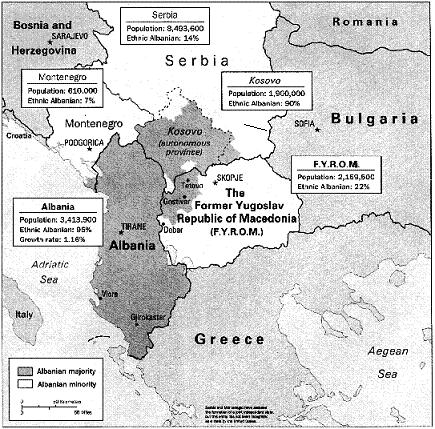
From the BBC, we learn that the Albanian majority in Serbia’s southern region of Kosovo is expected to vote for independence from Serbia within days. The province has been controlled by the international community since the end of the NATO-led war against Slobodan Milošević ‘s regime in 1999. In PLSC250 yesterday, we discussed the Kurdish campaign for self-determination and noted some of the arguments for and against. The most comepelling argument for secession/independence is a deontological argument based on the inherent right of groups to decide for themselves their system of government. The most obvious argument against is a utilitarian one, voiced here by Serbia’s Foreign Minister, Vuk Jeremić :
[Independence for Kosovo] would lead to an uncontrolled cascade of secession
Here’s more from the article:
Serbia’s foreign minister has urged the United Nations Security Council to oppose the province of Kosovo’s expected declaration of independence.
Vuk Jeremic said Serbia would not use force to stop the secession but warned that allowing it would give a green light to other separatist movements.
The ethnic Albanian majority in Kosovo is expected to announce its breakaway from Serbia within days.
Russia has warned that recognition of Kosovo would be illegal and immoral.
Speaking after the closed session, Serbia’s foreign minister said that is was not too late for diplomats to prevent Kosovo’s unilateral declaration of independence.
The Fall and Rise of Torture Across Time and Space
Here’s the abstract from an interesting article* on the history of the use of torture by Christopher Einol. I think we’ll read this near the end of the semester. (The subject of the illustration is water-boarding (about which the current US Attorney General does not know whether it is torture or not) during the Spanish Inquisition.)
Torture was formally abolished by European governments in the 19th century, and the actual practice of torture decreased as well during that period. In the 20th century, however, torture became much more common. None of the theories that explain the reduction of torture in the 19th century can explain its resurgence in the 20th. This article argues that the use of torture follows the same patterns in contemporary times as it has in earlier historical periods. Torture is most commonly used against people who are not full members of a society, such as slaves, foreigners, prisoners of war, and members of racial, ethnic, and religious outsider groups. Torture is used less often against citizens, and is only used in cases of extremely serious crimes, such as treason. Two general 20th-century historical trends have caused torture to become more common. First, an increase in the number and severity of wars has caused an increase of torture against enemy guerrillas and partisans, prisoners of war, and conquered civilian populations. Second, changes in the nature of sovereignty have caused an expansion in the definition of acts constituting treason.

* CHRISTOPHER J. EINOLF, “The Fall and Rise of Torture: A Comparative
and Historical Analysis”, Sociological Theory 25:2 June 2007. You should have access to the article if you are on campus.
Italians and Europeans–The Two Solitudes?
Here is an animated short film by Bruno Bozzetto, which shows the putative differences between Italians and Europeans (notice the not-so-subtle “othering” that is implicit in the title). Have you ever been to Italy? Are these differences real, and if so, can political culture account for them? What underlying differences in political attitudes would help explain the divergence in behaviors demonstrated in the video? It’s interesting that Italy was one of the original six members of the European Union (which was then called the European Coal and Steel Community (ECSC). This was quite monumental as the other five members were on the other side of the Alps. Have a look at Bozzetto’s animated short:
P.S. This could easily be titled “Europe and Croatia!”
PLSC240–Next Blog Assignment
Hello student-bloggers:
Your next blog post will be due on Friday, February 15th at 6:00pm.
The prompt for your post is “The rational choice/political culture debate and [my topic].” Once again, I will emphasize that you have wide latitude to post, and anything will be acceptable as long as it is somehow related to the prompt above. In addition, please take note of the rubric I will be using to grade your blog. Remember that I will give you a provisional grade as of the mid-term break (this grade will not be factored into your final grade; it is meant to give you an idea of what your blog grade would be at the end of the semester if the character/quality of your posts were to remain the same until the end of the semester). You can find the rubric in the Assignments folder of Blackboard.
Best of luck,
J.
Challenges to Rational Choice Theory
The fundemental assumption regarding human behavior, upon which the whole edifice of rational choice theory (RCT) rests is that human beings are rational; specifically, it means that they act in order to maximize their self-interest by “maximizing expected utility”. The construction above takes into account our preferences (utility) and the fact that the link between our actions and outcomes are rarely certain, but that we are able to adequately estimate (beliefs) the likelihood of achieving a specific goal given an accompanying action.
In the example of Lebron James I posted earlier, he has a generally good idea of his preferences (he prefers–other things equal–to hit a 3-pointer over a field goal or a free throw) and his beliefs (he knows his stats regarding his 3-point shooting percentage, his field goal, and free throw percentages as well). Given his beliefs and preferences, Lebron can easily act–and generally does–in an instrumentally rational manner.
How valid, though, is the assumption that human beings do act in an instrumentally rational manner? In other words, do individuals always maximize their expected utility? The short answer is no. Some political scientists believe that political culture often acts to mitigate instrumentally rational behavior. [We’ll discuss this in class on Tuesday.] Whole sub-disciplines in behavioral psychology and behavioral economics can point to copious amounts of research data demonstrating the lack of rationality in human beings, often in fairly simple situations. Michael Sherman asks “why people believe weird [i.e., irrational] things about money”:
Would you rather earn $50,000 a year while other people make $25,000, or would you rather earn $100,000 a year while other people get $250,000? Assume for the moment that prices of goods and services will stay the same.
Surprisingly — stunningly, in fact — research shows that the majority of people select the first option; they would rather make twice as much as others even if that meant earning half as much as they could otherwise have. How irrational is that?
Lebron James behaving in an Instrumentally Rational Manner
In PLSC240 today, I introduced you to the rational choice theory (RCT), an increasingly important explanatory mechanism in political science. The basic idea behind RCT is that one can analyze political outcomes on the basis of understanding individual behavior. The fundamental assumption regarding individual behavior is that all human beings (regardless of where they are from) act in an instrumentally rational manner. What does this mean? It means selecting the means or action (instrument) that will maximize one’s expected utility. Huh? Well, here’s an explanation by way of an example from King James. Click on the picture to link to a page where you can view the video clip.
In that clip, we saw Lebron James hit a “step-back 3”; in other words, he stepped his right foot back behind the 3-point line so that his shot (were it to go in the basket) would be worth three points rather than two. You often see players do this. In so doing, they are acting in an instrumentally rational manner by maximizing their expected utility. Follow along for the logic, and for some mathematical notation.
We all value things in life, and an NBA player–during the 48 minutes (or portion thereof) that he is on the floor values points (among other things). He wants to score as many points as possible, other things being equal. Because he values points, they give him utility. From a rational choice perspective, an individual is acting in an instrumentally rational manner if she takes the action/behavior that will maximize her expected utility. Moreover, she should be consistent–i.e., given the same utility and environmental constraints the individual should select the same action/behavior every time, and any other individual would do the same.
In the NBA, some shots from “the field” are worth 3 points, while others are worth 2. Thus, Lebron in the situation shown in the video clip can quantify the utility of his preferences: they are u(3pt) = 3, u(2pt) = 2. In other words, the utility (u) to Lebron of making a 3-point shot is 3, and of making a 2-point shot is 2. Deciding whether to take a 3-point shot or a 2-point shot would be a straightforward task if he knew for certain that the ball would go in the hoop every time he shot. Of course, he isn’t certain. What are his beliefs about the probability of each of these shots going in?
Well, fortunately the NBA keeps statistics on these types of things. He shoots 33% from beyond the 3-point line, and 40% from a foot inside that line. Thus, his beliefs are Pr(2pt )= 0.4, and Pr(3pt) = 0.33. The probability of successfully making a 2-point shot–one foot inside the line–is 0.4, etc. Given that we now know both his preferences and beliefs, we can determine what is the instrumentally rational action for Lebron to take.
What is his expected utility (EU) of attempting a 2-point shot?
EU(2pt) = Pr(2pt) · u(2pt), which is 0.4· 2 = 0.8
What is his expected utility (EU) of attempting a 3-point shot?
EU(3pt) = Pr(3pt) · u(3pt), which is 0.33· 3 = 0.99
Since 0.99 > 0.8, Lebron is “maximizing his expected utility” by “stepping back to hit the three.” Isn’t rational choice fun?
Printing PDF Handouts–Instructions
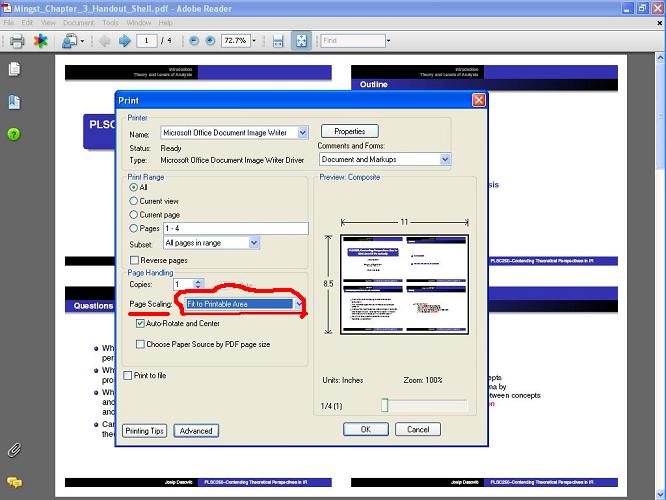
You must print the PDF handouts correctly in order to be able to read them; otherwise the font is much too small. To do so, first select “Print” and then select the Page Scaling option “Fit to printable area” (see below):
President Bush’s Speech Announcing Start of Military Operations in Iraq
Here is President Bush’s address to the nation announcing the beginning of military operations in Iraq in 2003. How can we use the framework of the “levels-of-analysis” to understand the Bush administration decision to take military action against the Saddam Hussein regime?
Using Powerpoint-type Presentations in Class

The rise in the ubiquity of use of Powerpoint-type (and I use the phrase Powerpoint-type since Powerpoint is but one–although the most popular–type of software used for electronic lecture presentations; I use the Beamer package add-on for the type-setting software LaTeX) presentations has led to a spirited debate in the field of academia. Some argue that the presentations are self-defeating and do not advance any sane pedagogical objective, while others swear by the benefits.
I see both advantages and disadvantages to their use but believe that ultimately, like with most tools, there is no inherent value in the tool itself, but that the value of the tool (for better or worse) comes in its application. Thus, I think that Powerpoint-type lectures can be used to enhance the educational experience and one’s pedagogical objectives. The issue, then, revolves around determining just what the best use of Powerpoint is.
Thankfully, there has been some research on the subject. From the blog “Thinking about College Teaching“, here is a snippet from a post explaining the best use of Powerpoint in classs:
I found a research study that compared student learning for four ways of combining PowerPoint presentations with distribution to students. (I no longer have a citation for that study.) One group of students did not receive any handouts, a second group received complete handouts prior to discussion, a third group received complete handouts after discussion, and a fourth group received skeletal handouts prior to the discussion and complete handouts after the discussion. Learning was greatest in the last group, and that was the model I followed…
…I went through that file and deleted most content except for slide headings. I made that file available to students on the Blackboard site for my course prior to class, and those who wanted it could download it and bring a printed copy to class. After I completed the class discussion, I made the [complete] file available. The most enterprising students brought the outline version to class, took notes on it, and later compared their notes to my complete version. In any case, I did not spend the school’s money to duplicate materials that only some students wanted. Students were satsified with that arrangement when I explained that they would learn the most that way.
This is what I will do for the remainder of the semester. When I am using Powerpoints, which will be about every second or third session, I’ll post the Powerpoint lecture outlines on Blackboard, the post the complete version there after I have completed the lecture. If it takes more than one session to finish a lecture, the completed version will be posted after the lecture has been completed in full.
 Clouds, Clocks, and Sitting at Tables
You must be logged in to post a comment.