Does the Acquisition of Nuclear Weapons Change States’ Behaviour?

Political scientist James Fearon has an interesting blog post on the political science blog, The Monkey Cage. In it, he asks, and then gives an answer to, the question “How do states act after they get nuclear weapons?” The issue, Fearon notes, is gaining increasing attention in the United States, given the alleged quest by Iran to develop nuclear weapons. The issue also resonates in Canada, with Stephen Harper recently affirming his fear of the Iranian regime acquiring nukes. From this CBC interview with Peter Mansbridge, Harper responds in the affirmative to Mansbridge’s characterization of an interview Harper had given a couple of weeks earlier on the issue of Iran’s quest for nuclear weapons:

…in your view, they [Iran’s regime] want nuclear weapons, and they would not be shy about using them.[see the exchange below]

In opposition to views like Harper’s are the views of what Fearon calls “proliferation optimists” such as the well-known realist Kenneth Waltz, who claims that contrary to our repeated expectations about the behaviour of post-nuclear states, the opposite has turned out to be true much more often than not. What does Fearon find empirically? First, he sets up what it is, specifically, that he is measuring:

The following graph shows, for each of the nine states that acquired nuclear capability at some time between 1945 and 2001, their yearly rate of militarized disputes in years when they didn’t have nukes, and the rate for years when they did.

Here is a graph of Fearon’s finding with his summary below:

China, France, India, Israel, Pakistan, and the UK all saw declines in their total militarized dispute involvement in the years after they got nuclear weapons.  A number of these are big declines.  USSR/Russia and South Africa have higher rates in their nuclear versus non-nuclear periods, though it should be kept in mind that for the USSR we only have four years in the sample with no nukes, just as the Cold War is starting.
 

My Intro to IR Class is full of Realists

Last Tuesday in POLI 1140, the students completed an class oil-market exercise in which pairs of students engaged in a strategic situation that required them to sell oil at specific prices. Many students were able to understand relatively quickly that the “Oil Game” was an example of the classic prisoner’s dilemma (PD). As Mingst and Arreguin-Toft note on page 78, the crucial point about the prisoner’s dilemma:

Neither prisoner knows how the other will respond; the cost of not confessing if the other confesses is extraordinarily high. So both will confess, leading to a less-than-optimal outcome for both.

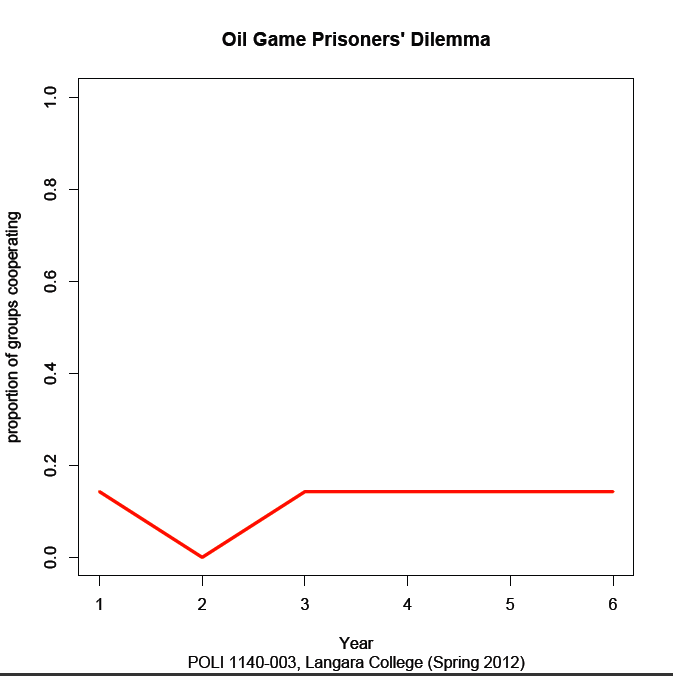
From a theoretical perspective (and empirical tests have generally confirmed this) there will likely be very little cooperation in one-shot prisoner’s dilemma-type situations. Over repeated interaction, however, learning can contribute to higher levels of cooperation. With respect to IR theories, specifically, it is argued that realists are more likely to defect in PD situations as they are concerned with relative gains. Liberals, on the other hand, who value absolute gains more highly, are more likely to cooperate and create socially more optimal outcomes. What were the results in our class?

The graph above plots the level of cooperation across all six years (stages) of the exercise. There were seven groups and what the probabilities demonstrate is that in each year there was only one group for which the interaction was cooperative. In year 2, there was not a single instance of cooperation. Moreover, it was the same group that cooperated. Therefore, one of the groups cooperated 5 out of 6 years, while none of the other six groups cooperated a single time over the course of the sex years!! What a bunch of realists!!

If you were involved in this exercise, please let me know your reactions to what happened.

Chapter 1 or Chapter 2 Post–Global Military Expenditures

As I noted in POLI 1140 today, your blog assignment for this week is to write a post related to anything in Chapters 1 or 2 of the Mingst and Arreguin-Toft textbook. You have until midnight, Friday January 20 to publish your post. Here is an example of what I would consider to be a good post–format, content, and length.

Military Expenditures as percentage of GDP

On p. 3 of Chapter 1 of the text (in the Thinking Theoretically section), the authors write:

In brief, realism posits that states exist in an anarchic international system. Each state bases its policies on an interpretation of national interest defined in terms of power.

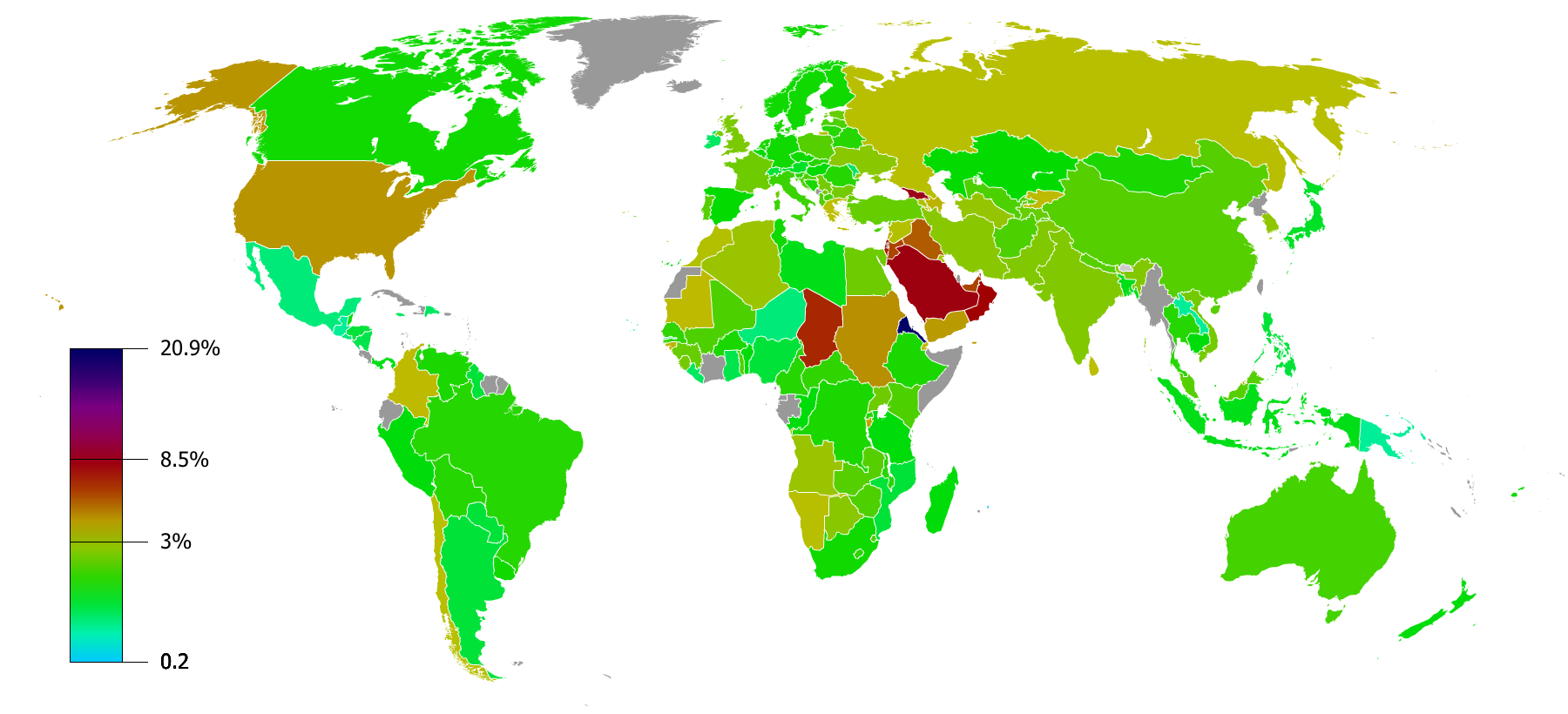
While there are many types of power–economic, political, prestige, etc.,–the most important source of power and the one which states generally seek to increase as much as possible, is military power. Because of anarchy, realists believe that states are constantly concerned about their security. States that feel more insecure seek to increase their power, thereby increasing the sizes of their military, all else being equal. It would be interesting to find out which states spend a lot on their military, and which states spend less. Fortunately, Globalsecurity.org has compiled the data for us. In their most recent summary of global military expenditures (from 2011), we find some interesting data. I have copied the top 20 (in terms of absolute dollars spent) in the table below. For a list of all countries, click on the link above.

WORLD Gross Domestic Product Military Spending
State GDP rank % GDP
mil
rank Military spending
WORLD $70,155,374,950,000.00


$2,157,172,000,000.00
United States $14,120,000,000,000.00 2 5.20% 25 $741,200,000,000.00
China $8,818,000,000,000.00 3 4.30% 23 $380,000,000,000.00
India $3,680,000,000,000.00 5 2.50% 62 $92,000,000,000.00
Russia $2,116,000,000,000.00 8 3.90% 27 $82,500,000,000.00
Saudi Arabia $590,900,000,000.00 23 10.00% 3 $59,090,000,000.00
France $2,094,000,000,000.00 9 2.60% 57 $54,444,000,000.00
United Kingdom $2,123,000,000,000.00 7 2.40% 63 $50,952,000,000.00
Turkey $879,900,000,000.00 17 5.30% 16 $46,634,700,000.00
Germany $2,815,000,000,000.00 6 1.50% 102 $42,225,000,000.00
Korea, South $1,362,000,000,000.00 13 2.70% 53 $36,774,000,000.00
Brazil $2,010,000,000,000.00 10 1.70% 89 $34,170,000,000.00
Japan $4,149,000,000,000.00 4 0.80% 150 $33,192,000,000.00
Italy $1,737,000,000,000.00 11 1.80% 86 $31,266,000,000.00
Indonesia $960,200,000,000.00 16 3.00% 47 $28,806,000,000.00
Iran $825,900,000,000.00 19 2.50% 60 $20,647,500,000.00
Spain $1,359,000,000,000.00 14 1.20% 122 $16,308,000,000.00
Taiwan $734,300,000,000.00 20 2.20% 68 $16,154,600,000.00
Israel $206,900,000,000.00 51 7.30% 6 $15,103,700,000.00
Greece $332,900,000,000.00 35 4.30% 24 $14,314,700,000.00
Canada $1,277,000,000,000.00 15 1.10% 127 $14,047,000,000.00

Continue reading “Chapter 1 or Chapter 2 Post–Global Military Expenditures”

Design a site like this with WordPress.com
Get started