The Relationship Between Wealth and Health

The BBC reports on fascinating new research, which concludes that “economic growth does not necessarily translate into improvements in child mortality.” There are two points I wish to make about this: First, it illustrates an important trend in the development literature regarding the correct metric to use to determine, and compare, levels of well-being worldwide. Historically, well-being has been captured by the crude instrument of Gross National Product (GDP) per capita, but the realization that, for many reasons, the measure was too crude to be a satisfactory indicator of well-being development led to the introduction of other measures, the most useful of which is the Human Development Index (HDI) put out by the United Nations Development Program (UNDP). (Why might GDP per capita be a misleading indicator of well-being?)

The second point follows from the first; one’s policy prescriptions vis-a-vis issues of development are to a large extent determined by just which indicator of well-being one believes best captures the essential nature of that elusive concept. As such, IGOs such as the World Bank, have focused attention on overall economic growth, while scholars such as Amartya Sen (who champions the “capabilities approach”) do not view growth tout court as a magical anti-poverty elixir.

From the BBC article:

Ten million children still die every year before their fifth birthday, 99% of them in the developing world, according to Save the Children.

A study comparing economic performance with child mortality reveals that some countries have not translated wealth into improvements across society.

Survival is too often just a “lottery”, said Save the Children’s David Mepham.

He said that even the poorest countries can cut child mortality by following simple policies, but at the moment “a child’s chance of making it to its fifth birthday depends on the country or community it is born into”.

Lagging behind

Angola comes at the bottom of a new “Wealth and Survival” league table drawn up by the UN Development Programme (UNDP).

The figures for child mortality in India are shocking
Shireen Miller
Save the children India

There are few countries in the world where there are such stark wealth contrasts as there are between the wealth of oil-rich coastal strip around the Angolan capital Luanda, and the war-ravaged interior.

UNDP statisticians calculate that more than half of the babies who die in Angola could be saved were the country to spread its wealth more fairly.

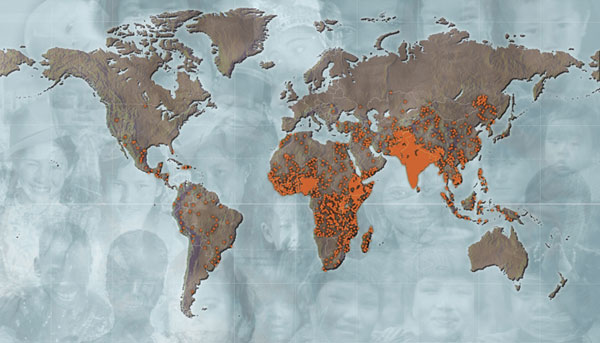
child_mortality_map.jpg

Click on the map to be taken to the Johns Hopkins Bloomberg School of Public Health’s Magazine for an article on child mortality.

[Each orange dot is equivalent to 5,000 child deaths.]
 

Individuals Having an Impact on IR

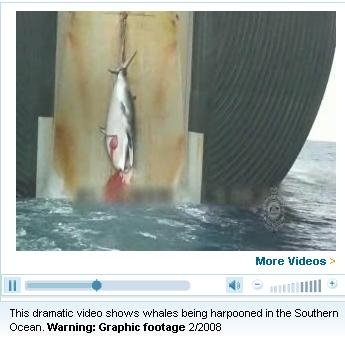
In a previous post, I asked you to consider not how international relations affects you, but how the way in which you behave, and the actions that you take have an effect on IR. Here’s a story about how changing individual attitudes in Japan may be having a greater impact on the whaling industry than the combined efforts of states and NGOs over the last couple of decades. You can see a graphically disturbing video of whales being killed at the link above.

JAPAN’s whalers are going broke and have been forced to slash prices because no one wants to eat their growing mountain of whale meat.

whale_slaughter.jpgThe farcical truth of Japan’s whaling industry was exposed yesterday by Japanese media reports that the Institute for Cetacean Research is struggling to repay $37 million in government subsidies.

The report came as Japanese embassy officials made a stern protest in Canberra over the Federal Government’s release of shocking whaling photographs.

The ICR, responsible for Japan’s lethal “research operation”, is flooding Japan with cheap whale meat that it cannot sell, according to the reports in respected newspaper Asahi Shimbun.

Meat and other parts of whales killed during ICR “scientific research” in the Southern Ocean is sold to a private fisheries company Kyodo Senpaku, which manages the sale of whale meat in the Japanese market. But while ICR has consistently increased the number of whales it kills – by 30 per cent between 2005 and 2006 – there has been no rise in domestic demand for whale meat or products.

Greenpeace Australia Pacific whales campaign director Rob Nicholl said the losses were further proof that there was no market for whale meat in Japan.
“It’s standard economics. There is an oversupply. They’ve had to reduce the price but they still can’t get rid of the stuff,” he said.

Do you think that this story can shed any light on a potential solution to the drug and human trafficking industries? How specifically?

New York Times special Report on Pollution and Economic Growth in China

You can find a fascinating 10-part report on the dramatic environmental impact of China’s miraculous economic growth in the New York Times. The report, Choking on Growth, provides readers and viewers a multimedia perspective on growth and pollution. From the perspective of comparative politics, it is important to note that some scientists and other scholars in China are trying to estimate the impact of environmental destruction on the general welfare of China’s citizens. They have begun to use a new measure of well-being, “green GDP”, arguing in effect that GDP itself is not an accurate measurement of a society’s well-being. In PLSC240, we will analyze other indicators of well-being, including HDI, the Gini Index, etc, when we study Political Economy (Chapter 4). From an IR perspective, we can ask ourselves what right or responsibility those outside China (whether IGOs like the UN, or other states like Japan and the US) have to intervene and attempt to reverse the damage China is causing to its own and the planet’s fragile ecosystem. Here is a link to a compelling video and some images below from the New York Times:

[rockyou id=99737780&w=500&h=350]

World Economic Forum Releases Global Risks Report for 2008

The World Economic Forum, a Swiss-based NGO whose motto is “entrepreneurship in the global public interest”, has recently released its Global Risks Report for 2008.  They view four main issues as presenting the most potential global risk over the next twelve months and beyond.

The present report looks at global risks from a range of different perspectives. The first part of the report focuses on four emerging issues that are shaping the global risk landscape: systemic financial risk, food security, supply chains and the role of energy. On systemic financial risk, we put current market turmoil in the historical context and ask how the transformation of the global financial system over the last two decades may require us to rethink our expectations and understanding of systemic risk in the future. On food security, we discuss how the subject has moved from the periphery of the global risk landscape to its centre, and ask whether the world is ready to cope with the various trade-offs that the new food economy is generating. On supply chains, we investigate a potentially hidden set of vulnerabilities in the global economy to supply chain disruptions. Finally, on energy, we outline the emergence of a range of energy-related risks and ask if the world can move towards secure and sustainable energy.

China 2007 Trade Surplus Record $262bn

China’s rising economic and military power has caused some concern in the United States and in Europe. Just like China in the 1980s, China’s economic policies–particularly as it relates to the values of its currency and the effect that has had on China’s foreign trade and current accounts–have irked politicians and pundits (hello, Lou Dobbs) here in the US. They will not be heartened by the news that China’s trade surplus has reached a record $262 billion. Interestingly, however, the EU replaced the US as China’s largest export market.

China’s trade surplus rose by nearly 50 per cent to a record $262bn in 2007, but import growth exceeded export growth in each of the final three months of the year, suggesting that the country’s controversial trade imbalance may be peaking.

In another first, the European Union also replaced the US as China’s largest export market. Sales to the expanded EU grew by 29.2 per cent in 2007, compared to just 14 per cent to the US.

Design a site like this with WordPress.com
Get started