Leaderless Jihad–the Transformation of Al Qaeda

In PLSC250, we have discussed both Samuel Huntington’s prediction of the nature of the new world order (as outlined in his “Clash of Civlizations” thesis) and Yahya Sadowski’s response (“Political Islam: Asking the Wrong Questions”). David Ignatius has written an op-ed piece in the Washington Post today, which amounts to a book review of former CIA officer Marc Sagerman’s new book, “Leaderless Jihad.” Find some excerpts posted below. How does Sagerman’s view fit with the views expressed by Sadowski in his article?

Sageman has a résumé that would suit a postmodern John le Carré. He was a case officer running spies in Pakistan and then became a forensic psychiatrist. What distinguishes his new book, “Leaderless Jihad,” is that it peels away the emotional, reflexive responses to terrorism that have grown up since Sept. 11, 2001, and looks instead at scientific data Sageman has collected on more than 500 Islamic terrorists — to understand who they are, why they attack and how to stop them.

The heart of Sageman’s message is that we have been scaring ourselves into exaggerating the terrorism threat — and then by our unwise actions in Iraq John McCain, that, as McCain’s Web site puts it, the United States is facing “a dangerous, relentless enemy in the War against Islamic Extremists” spawned by al-Qaeda. making the problem worse. He attacks head-on the central thesis of the Bush administration, echoed increasingly by Republican presidential candidate

The numbers say otherwise, Sageman insists. The first wave of al-Qaeda leaders, who joined Osama bin Laden in the 1980s, is down to a few dozen people on the run in the tribal areas of northwest Pakistan. The second wave of terrorists, who trained in al-Qaeda’s camps in Afghanistan during the 1990s, has also been devastated, with about 100 hiding out on the Pakistani frontier. These people are genuinely dangerous, says Sageman, and they must be captured or killed. But they do not pose an existential threat to America, much less a “clash of civilizations.”

It’s the third wave of terrorism that is growing, but what is it? By Sageman’s account, it’s a leaderless hodgepodge of thousands of what he calls “terrorist wannabes.” Unlike the first two waves, whose members were well educated and intensely religious, the new jihadists are a weird species of the Internet culture. Outraged by video images of Americans killing Muslims in Iraq, they gather in password-protected chat rooms and dare each other to take action. Like young people across time and religious boundaries, they are bored and looking for thrills.

“It’s more about hero worship than about religion,” Sageman said in a presentation of his research last week at the New America Foundation, a liberal think tank here. Many of this third wave don’t speak Arabic or read the Koran. Very few (13 percent of Sageman’s sample) have attended radical madrassas.

The Political Economy of Assassination

Today in intro to IR, we discussed the role of individuals in international politics.  On Friday, we’ll look at the policy debate on page 152 of Mingst, where the debate question is “Should ‘bad’ or ‘corrupt’ leaders be forcibly removed by the international community?  Mingst provides arguments for and against.  What about not only removing them, but having them assassinated?  Two economists–Ben Olken and Ben Jones–have decided to take a look at the link between assassinations and other factors such as democratization and economic growth.  What have they found?

Olken wonders whether economic devel­opment and the path to democratization are shaped more by broad historical forces or by the actions of specific leaders—be they demo­cratically elected prime ministers or thuggish authoritarians…

…In “Hit or Miss? The Effect of Assassinations on Institutions and War,” Olken and Jones looked at the effects of political assassination, using a strict empirical methodology that takes into account economic conditions at the time of the killing and what Olken calls a “novel data set” of assas­sination attempts, successful and unsuccessful, between 1875 and 2004.

Olken and Jones discovered that a country was “more likely to see democratization follow­ing the assassination of an autocratic leader,” but found no substantial “effect following assassinations—or assassination attempts—on democratic leaders.” They concluded that “on average, successful assassinations of autocrats produce sustained moves toward democracy.”

…In “Do Leaders Matter? National Leadership and Growth since World War II,” Olken and Jones explored whether “individual political leaders make a difference in economic growth.” This is tricky business for the researcher because, as Olken explains, a country’s economic situa­tion can affect the election of a leader: when the economic outlook is good, for instance, presi­dents are more likely to be reelected. [This is the problem of endogeneity–JD] So Olken and Jones looked at 57 leaders who died in office from accidents or natural causes and “found big changes in growth when autocratic leaders die in office—both positive and negative,” but no sub­stantial change when democratic leaders died in office. “The results suggest,” they write, “that individual leaders can play crucial roles in shap­ing the growth of nations,” provided they are ruling with minimal or nonexistent checks and balances to their power (think Augusto Pinochet or Robert Mugabe).


Calvin and Hobbes and IR Theory

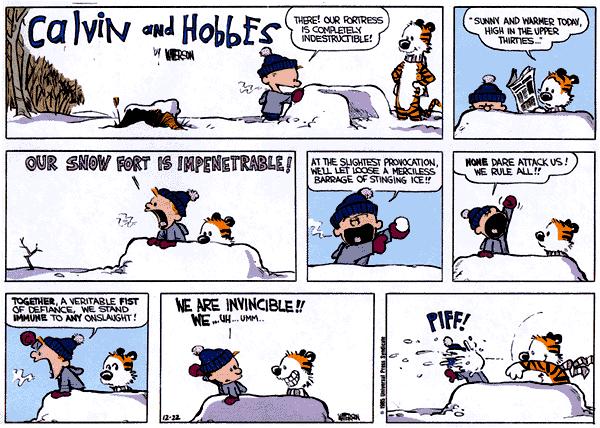
Which theory of IR immediately comes to mind upon reading this Calvin and Hobbes cartoon? Why? One of the more clever students in Intro to IR noticed that one of the character’s names gives us an obvious clue.

calvin_hobbes_modern_threats.jpg

The answer is below the fold…

Continue reading “Calvin and Hobbes and IR Theory”

Personality Characteristics of Individual Leaders–Hugo Chavez and George W. Bush

In class on Wednesday, we’ll be analyzing the individual level of analysis in international relations. Do individuals matter? In other words, do they have an effect independent of the state and systemic levels, or do individuals lie at the periphery of international relations? Margaret Hermann–a political psychologist–has found that that leaders can be characterized based on a host of personality characteristics. Some of these are nationalism, need for power, need for affiliation, distrust of others, etc. On the basis of a composite of these characteristics, Hermann believed that leaders were more likely to have one or the other of two foreign policy orientations–independent leader, participatory leader. Watch these two clips and think about how you would characterize Chávez’s and Bush’s foreign policy orientations, respectively.

The Global Perspectives box on p. 146 in Mingst, asks the following questions:

  1. Is it personality or policies that have made Chavez popular and powerful? Using Herman’s personality characteristics, how would you classify Chavez?
  2. How has the person of Chavez augmented the power of the Venezuelan state?

The same could be asked of President Bush:

  1. Is it personality or policies that have made President Bush popular and powerful? Using Herman’s personality characteristics, how would you classify Bush?
  2. How has the person of Bush augmented the power of the US state?

The World Health Organization on Drug-Resistant From of Tuberculosis

The Vancouver Sun reports on the most recent announcement of the World Health Organization (WHO) regarding the dangerous multi-drug resistant strain of tuberculosis (MDR-TB) .

A report published Tuesday, Anti-Tuberculosis Drug Resistance in the World, is the largest survey to date on the scale of drug resistance in tuberculosis. It is based on information collected between 2002 and 2006 on 90,000 TB patients in 81 countries.

The organization [WHO] estimates there are nearly half a million new cases of multi-drug resistant TB every year.

“TB drug resistance needs a frontal assault. If countries and the international community fail to address it aggressively now we will lose this battle,” said WHO spokesman, Dr. Mario Raviglione. “In addition to specifically confronting drug-resistant TB and saving lives, programs worldwide must immediately improve their performance in diagnosing all TB cases rapidly and treating them until cured, which is the best way to prevent the development of drug resistance.”

The report also found that extensively drug-resistant tuberculosis (XDR-TB), a virtually untreatable form of the respiratory disease, has been recorded in 45 countries.

But the true scale of the problem, internationally, remains unknown. Only six countries in Africa – the region with the highest incidence of TB in the world – were unable to provide drug resistance data.

We’ll take a look at the global challenge posed by diseases such as TB in the last week of the semester.

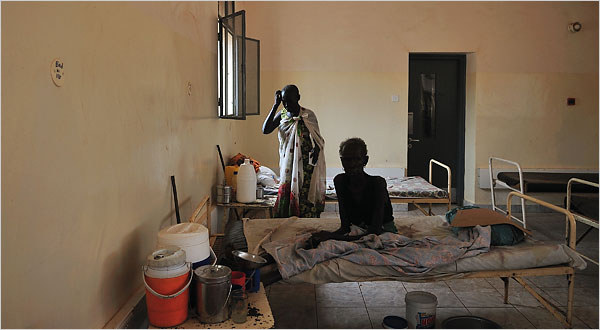
UPDATE: The New York Times also has this story on its front page, with a photograph of a TB clinic in Sudan.

tb_sudan.jpg

Violin Diplomacy in North Korea

You remember the “ping-pong diplomacy” of the Nixon years? Well, get ready for a little bit of “violin diplomacy”, with news that the New York Philharmonic Orchestra has landed in Pyongyang, the capital of the most politically isolated state on earth, North Korea. The Boston Globe reports and uses the occasion to look back at other episodes of cultural diplomacy:

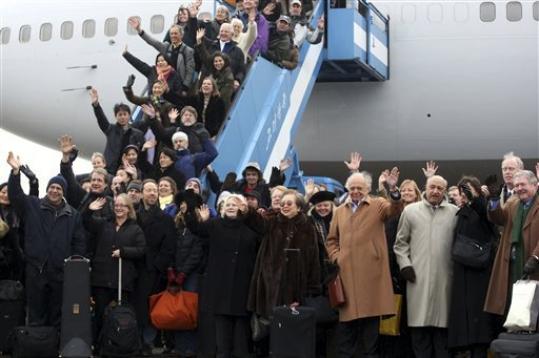
539w.jpg
Members of the New York Philharmonic orchestra wave as they arrive at the airport in Pyongyang for a two day visit to North Korea on Monday, Feb. 25, 2008. (AP Photo/David Guttenfelder)
Some other noteworthy episodes of cultural diplomacy, according to the Boston Globe:
CHINAApril 1971 — The U.S. Table Tennis Team accepts a surprise invitation from China, making the group the first American non-communist delegation allowed into China since the communist takeover in 1949. This “pingpong diplomacy” helps lay the path for President Richard Nixon’s historic trip to China the following year.1979 — Acclaimed violinist Isaac Stern embarks on a cultural tour of China in which he performs and mentors young Chinese musicians, encounters that are chronicled in an Oscar-winning documentary, “Mozart to Mao.”IRAN Continue reading “Violin Diplomacy in North Korea”

US Missile Test–Sign of an Arms Race in Space?

The United States military has shot down a stray satellite via sea-launched missile. While the Pentagon insists that the episode was meant to prevent the falling satellite from becoming a potential hazard upon its descent to earth, military analysts are not persuaded. It will be difficult to disabuse those with a realist mindset that the exercise was not in response to China’s similar missile exercise in January 2007. Time Magazine’s Jeffrey Kluger writes:

sm3_missle_0220.jpgThis week, the Pentagon tried something different. On Wednesday evening, it announced that it successfully launched a sea-based missile and shot down a crippled satellite gliding 150 miles overhead, in a $60 million effort to blast it out of the sky before it could tumble home and hurt someone. It’s been a neat little feat on the part of the military planners — but that doesn’t mean they’re telling the whole truth about why they bothered in the first place.

The clay pigeon in the military’s cross hairs was an unnamed, 5,000-lb. spy satellite that was launched in 2006 and never quite got its purchase in space, suffering a malfunction almost immediately upon its arrival in orbit. Comparatively low-orbiting craft like this one tumble back to Earth faster than high-orbiting ones, as the upper wisps of the planet’s atmosphere produce increasing amounts of drag, pulling the object lower and lower. This one was on a trajectory that would have caused it to begin its terminal plunge sometime in March, sending it on a fiery descent that should have entirely — or at least mostly — incinerated it.

So why make the effort at such a complicated bit of sharpshooting just to bag a target that was coming down anyway? The Pentagon says it’s all about safety. Five thousand pounds of out-of-control satellite can do an awful lot of damage if it drops on the wrong spot. What’s more, this particular satellite is carrying a 500-lb. tank of frozen hydrazine fuel — nasty stuff if you’re unlucky enough to inhale it. Striking the ground at reentry speed, the gas could immediately disperse over a patch of ground as big as two football fields…

The more believable explanation for the duck hunt is that it’s been an exercise in politics rather than safety. Washington was none too pleased in January of 2007 when China shot down one of its own weather satellites after it had outlived its usefulness, a bit of technological sword-rattling that proved it could target any other nation’s orbiting hardware with equal ease. Beijing too made vague claims of worrying about the public weal, but Washington saw the act more as the political statement it probably was, and concluded — correctly — that American spy satellites are not quite as safe as they once were. An American shootdown would be one way to return the gesture. The timing is particularly suspicious since Russia and China issued a joint condemnation of the militarization of space only days before the Pentagon went public with its plans. While Beijing’s sudden pacifism is hardly credible after it own exercise in cosmic skeet-shooting, neither is the Washington’s insistence that there is no linkage between the two events.

Another possibility is that the Pentagon was indeed nervous about something aboard the satellite, but not the tank of fuel. Spy satellites are, by definition, made of secret hardware, and nothing so pleases one military power as the chance to seize and pick over the technology of another. Should American camera and communications components fall into the wrong hands, whatever tactical advantage was gained in developing them would be lost.

Serbian President Reacts to Yesterday’s Violence in Belgrade

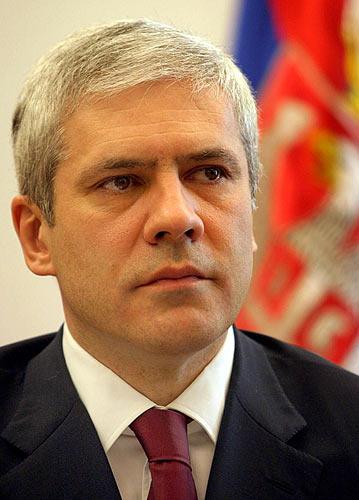
Recently elected Serbian President, Boris Tadić, has responded to yesterday evening’s violence in Belgrade, which involved the torching of the US Embassy by an unruly mob numbering hundreds.  The mob was but a tiny minority of the crowd of hundreds of thousands, which had gathered earlier in the day to peacefully protest Kosovo’s declaration of independence on Monday of this week.  Tadić, a the leader of the moderate Democratic Party in Serbia, had this to say about the events:

tadic.jpg Tadić, who was in Romania Thursday, today said he has “asked all relevant institutions for reports on yesterday’s unrest in Belgrade”.
For the same reason, he was called a session of the Council for National Security…

…Tadić is also strongly condemning the violence, looting and burning, that ended in one death and nearly 200 injured, as well as huge material damage to the city.

“There is no justification for violence, no one must dare to justify it with a single word,” his press service said in a statement…

…Tadić went on to say that “this is not Serbia and Serbia will never be like this”.

“The state must have law and order and such violence must never happen again, anywhere,” Tadić said.

Human Trafficking–Katia’s Story

A confluence of events–globalization, technological and communications advances, and halting (or no) democratization–has led to an unprecedented rise in global human trafficking. States and governments have been unable to make a dent in this growing trade, where human beings are sold like cattle to be used as indentured servants and sex slaves. Here is a documentary about one such person, Katia from Ukraine, whose husband’s friend kidnapped and sold her in Turkey, whence she was moved to western Europe where she was forced into prostitution. (The documentary is in five parts. Here is part one.)

Design a site like this with WordPress.com
Get started