Janjaweed Militia Renews Scorched-Eart Policy in Darfur

The New York Times reports that the notorious Janjaweed militia is once again active in Darfur.

 darfur_scortched_earth.jpg

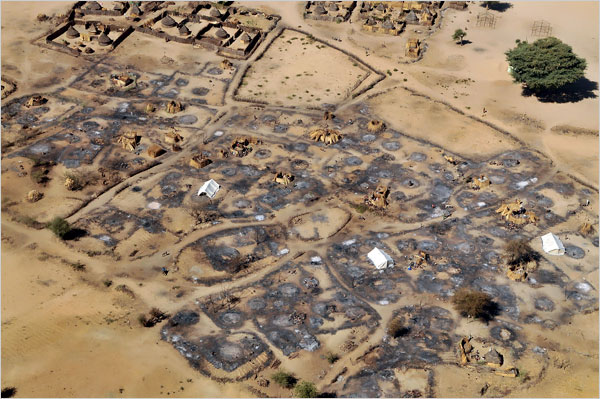
Abu Surouj, Sudan, after government forces and allied militias burned the town last month. Such attacks in Sudan are a return to the tactics that terrorized Darfur in the early, bloodiest stages of the conflict.

Photo: Lynsey Addario for The New York Times

 SULEIA, Sudan — The janjaweed are back.
They came to this dusty town in the Darfur region of Sudan on horses and camels on market day. Almost everybody was in the bustling square. At the first clatter of automatic gunfire, everyone ran.

The militiamen laid waste to the town — burning huts, pillaging shops, carrying off any loot they could find and shooting anyone who stood in their way, residents said. Asha Abdullah Abakar, wizened and twice widowed, described how she hid in a hut, praying it would not be set on fire.

“I have never been so afraid,” she said.

The attacks by the janjaweed, the fearsome Arab militias that came three weeks ago,, were a return to the tactics that terrorized Darfur in the early, bloodiest stages of the conflict.

Such brutal, three-pronged attacks of this scale — involving close coordination of air power, army troops and Arab militias in areas where rebel troops have been — have rarely been seen in the past few years, when the violence became more episodic and fractured. But they resemble the kinds of campaigns that first captured the world’s attention and prompted the Bush administration to call the violence in Darfur genocide.

I noticed the same pattern during the wars in the former Yugoslavia in the 1990s, with militia groups acting in close concert with government support.  In my study of the Croatian region of Baranya, I noticed that the villages in which civilians were killed all had one thing in common–they were on (or very near) a major regional road.  This meant that government military forces (with their tanks and armed personnel carriers) had easy access to these villages, allowing the militias to swoop in and do their thing.
Kenyan Leaders Sign Peace Agreement

Kenya’s political leaders have finally reached an agreement that Kenyans hope will signal the end of the recent instability and inter-ethnic bloodshed, which resulted from disputed elections in late December of last year. The New York Times reports that the structure of the political system in Kenya has been altered as a result of an agreement between President Mwai Kibaki and opposition leader Raila Odinga:

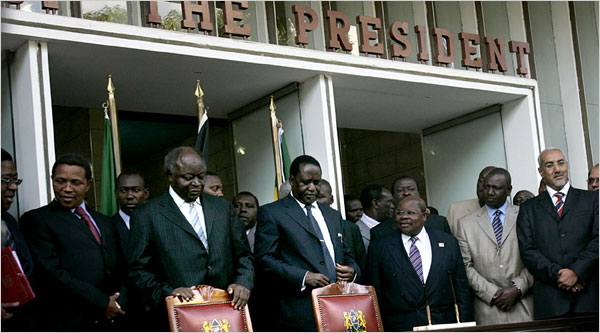
29kenya-span-600.jpgNAIROBI, Kenya — Kenya’s rival leaders broke their tense standoff on Thursday, agreeing to share power in a deal that may end the violence that has engulfed this nation but could be the beginning of a long and difficult political relationship.

The country seemed to let out a collective cheer as Mwai Kibaki, the president, and Raila Odinga, the top opposition leader, sat down at a desk in front of the president’s office, with a bank of television cameras rolling, and signed an agreement that creates a powerful prime minister position for Mr. Odinga and splits cabinet posts between the government and the opposition.

The two sides, which have been bitterly at odds for the past two months, will now be fused together in a government of national unity.

But there are still many thorny issues to resolve, starting with how the new government will function with essentially two bosses who have tried unsuccessfully to work together before. The government must also deal with the delicate business of reassigning the choice positions already given to Mr. Kibaki’s allies.

When we get back from the spring break, in intro to comparative we will analyze the political systems of several democracies around the world and you’ll realize that very few democracies have institutionalized a system that contains a strong Prime Minister and strong President. The most successful example is probably France, with its semi-presidential system. Even in strongly democratic France, however, political stability is often compromised when the President and Prime Minister are members of different political parties, as will be the case in Kenya. It will be interesting to see how the Kenyan version of cohabitation will develop in the coming months and years.

Patriotism–What is it? How can we Measure it?

As budding “social scientists” (the scare quotes are legitimate), it is good form to not only define concepts that are malleable but also to provide qualitative and/or quantitative evidence regarding their existence. A recent brouhaha in American politics centers around the political concept patriotism. What is it? How do we know it exists? Can it be measured? These are all important questions, so important, in fact, that they could determine the outcome of the next US presidential election.

In intro to comparative, we’ve been analyzing social identities, ethnic, national, etc. As we know from reading O’Neil, patriotism is based on the idea of citizenship–an individual’s relationship to the state in which s/he lives. O’Neil defines patriotism as “pride in one’s state.”

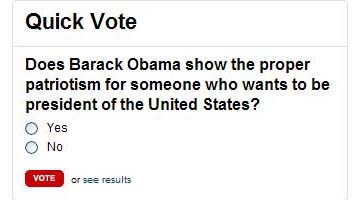
As near as I can tell, some opponents of Barack Obama’s candidacy have based some of their resistance on what they view as his lack of patriotism. If I’m reading this correctly, the base their argument on the fact that Obama does not (in fact, may even refuse to) wear a lapel pin in the shape of an American flag. This is interesting since it also touches upon issues of national identity; remember that we tried to determine just what is meant to be American. Does one have to wear an American flag lapel pin to be considered patriotic? If any of you think that this is an issue of negligible import, I refer you to this screen shot of the CNN website:

cnn-obama-patriotism.jpg

Given that I’m not a citizen of the United States, I’ll leave that for others to answer. I am, however, a citizen of the Republic of Croatia and this episode does remind me of an incident from the mid 1990s, which I, then working for the Helsinki Committee for Human Rights, witnessed. Join me after the jump.

hrvatska-zastava.jpgThe Croatian flag is a tri-color, with horizontal fields of red, white, and blue (from top to bottom), which contains the coat of arms–the “Šahovnica“–in the middle field. The šahovnica has been used in various guises throughout Croatian history as a symbol of Croatian nationhood. While Croats have lived under many different types of regime–Communist Yugoslavia, the Fascist Ustasa regime during WWII, the unitarist, Serb-dominated inter-war regime, the Austro-Hungarian monarchy (you get the point!)–the šahovnica has remained a constant expression and symbol of the Croatian people.

Continue reading “Patriotism–What is it? How can we Measure it?”

Serbian President Reacts to Yesterday’s Violence in Belgrade

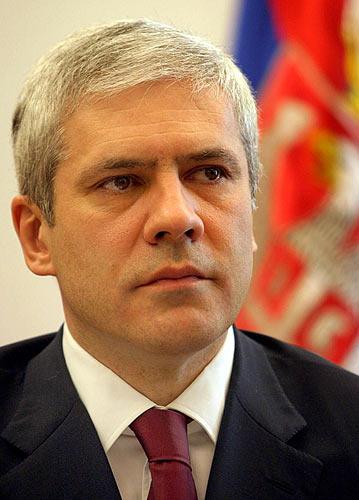
Recently elected Serbian President, Boris Tadić, has responded to yesterday evening’s violence in Belgrade, which involved the torching of the US Embassy by an unruly mob numbering hundreds.  The mob was but a tiny minority of the crowd of hundreds of thousands, which had gathered earlier in the day to peacefully protest Kosovo’s declaration of independence on Monday of this week.  Tadić, a the leader of the moderate Democratic Party in Serbia, had this to say about the events:

tadic.jpg Tadić, who was in Romania Thursday, today said he has “asked all relevant institutions for reports on yesterday’s unrest in Belgrade”.
For the same reason, he was called a session of the Council for National Security…

…Tadić is also strongly condemning the violence, looting and burning, that ended in one death and nearly 200 injured, as well as huge material damage to the city.

“There is no justification for violence, no one must dare to justify it with a single word,” his press service said in a statement…

…Tadić went on to say that “this is not Serbia and Serbia will never be like this”.

“The state must have law and order and such violence must never happen again, anywhere,” Tadić said.

Turkish Military in Northern Iraq

While Iraq still maintains legal sovereignty over the majority Kurdish areas in the north of the country, the Kurds in that region have been enjoying de facto autonomy/independence since the end of the first Gulf War in 1991.  A direct result of United Nations Security Council resolutions mandating, above all else, the establishment of a no-fly zone in northern Iraq, Saddam Hussein’s regime had no presence there from 1991 on.  The ouster of Saddam’s regime has only made Kurdish control of the territory more secure.  It’s not inconceivable that a Kosovo-type situation could obtain here as well.   A crucial difference in the Kurdish situation is the presence of a large group of ethnic Kurds living in neighboring Turkey, who have waged a sporadic, decades-long campaign (using various tactics, including terrorism) to pressure the Turkish government into granting the Kurds more autonomy, if not outright independence.  The situation has become even more serious, as this report from the New York Times illustrates:

ISTANBUL — Turkey’s military said on Friday that it had sent ground troops into northern Iraq on Thursday night, in an operation aimed at weakening Kurdish militants there, but it was unclear how many or how long they would stay.

The Turkish General Staff, in an announcement on its Web site, gave no details on the size of the incursion. An American military spokesman in Baghdad said the ground offensive would be of “limited duration.”

The Turkish offensive appears to be aimed at dealing a surprise blow to the Kurdish militants, the Kurdistan Workers’ Party, before the snow along the mountainous border between the two countries melts and the guerrillas make their traditional spring advance into Turkey.

The militants, known as the P.K.K., want greater autonomy for Turkey’s Kurdish minority and have fought the Turkish military for decades. Some of their hide-outs are in Turkey, but some are in northern Iraq, and the rebels have crossed the border into Turkey repeatedly to attack.

It was not clear what role the United States had played in the incursion. But the operation sets two of its closest allies in a troubled region against each other. Turkey is a NATO member that borders Iran, Iraq and Syria; the Iraqi Kurds, who control northern Iraq, are the most important American partners in the Iraq war.

The United States has been wary of Turkish efforts to stamp out the Kurdish militants, with Turkish officials chafing at what they view as a double-standard, escalation tension between the NATO allies.

Serb Demonstrators Attack US and Croatian Embassies in Belgrade

The Washington Post reports that following a massive (upwards of 150,000 participants) and peaceful demonstration in the Serbian capital of Belgrade, with the theme “Kosovo is Serbia”, a group numbering a few thousand at most has attacked the US and (neighboring) Croatian embassies, setting the US embassy on fire. The demonstrations were held in the aftermath of Albanian Kosovars’ official declaration of independence on Monday. The US is one of many countries to have officially recognized Kosovo as the newest ex-Yugoslav independent state, setting off a public and official outcry on the part of Serbs, for whom Kosovo is the historical birthplace of their nation.

Politicians in Belgrade are caught between their rhetoric to do what it takes (short of violence) to prevent Kosovo from achieving full-fledged independence and the lack of many good non-violent options to do so, given the Serb leadership’s openly declared goal of one day joining the European Union. One possibility would be to energize (or otherwise entice) the Serbs in neighboring Bosnia and Herzegovina to agitate for higher levels of autonomy, or outright independence, stressing the similarities of the situations. This would certainly raise the ire of European leaders and would not earn the Serbs any bonus points in their quest for further integration into European political and economic institutions.

Here is footage from the Belgrade independent media outlet B92:

From the “About Video” (translated by me): Beograd — Stotine nasilnih demonstranata nakon završetka mitinga napalo američku i hrvatsku ambasadu. U 19:13 intervenisala policija.

“Upon the conclusion of the [official] demonstration, undreds of violent demonstrators attacked the American and Croatian embassies. The police intervened at 7:13 pm.”

You can find a gallery of photographs from the day in Belgrade at B92’s website here.

Partition as a Solution to Ethnic Conflict/Violence

Today in class we discussed ethnic identity and various types of inter-ethnic violence. We saw that a large literature in political science (and related disciplines) sees the very fact of cultural (and especially ethnic) heterogeneity is being the source of much that goes wrong within states and societies. In a previous post, I mentioned Robert Putnam’s recent findings that trust is lower in more heterogeneous societies; there is a burgeoning literature on the deleterious economic impact of ethnic (and other forms of) identity (public goods provision, for example, is lower in more heterogeneous societies).

If the very fact of heterogeneity is the cause of conflict and violence, then wouldn’t a reasonable solution to inter-ethnic conflict/violence be to create new more ethnically homogeneous states out of a single ethnically diverse one? Some argue that this may be a legitimate solution to the extant difficulties in Iraq. Chaim Kaufmann has argued in favor of just this approach. Here (pdf) is an article written by Nicholas Sambanis setting out, then critiquing Chaim Kaufmann’s hypotheses regarding the usefulness of partition to resolve endemic inter-ethnic violence.

You can view a fascinating BBC documentary on the partition of India in 1947 here. Here’s an important quote from the documentary:

“…as a British barrister draws a line on a map…”

Much of the violence that occurred during the partition was the result of Muslims and Hindus (of course, the Sikh/Punjab problem adds another layer of complexity altogether) trying to be on (or being forced to move to) the right side of that barrister’s line. Millions were killed.

The Economist’s Diary on Kenya

The eminent British magazine, The Economist, currently has a correspondent in Kenya writing up daily reports in the Internet edition, which can be viewed here. There is, of course, much to be concerned about in Kenya these days, but as an academic I found the latest dispatch especially interesting:

Morning, Professor Alan Ogot’s office, Kisumu

ALAN Ogot (pictured below), one of Kenya’s leading historians, is the chancellor of Moi University in Eldoret. Like me, he graduated from St Andrew’s University in Scotland, but he was there in the 1950s, and his life before and since has been colourful and consequential.

Mr Ogot spends the first part of our interview delving into Luo history. Contrary to their reputation among some Kikuyus and white Kenyans as agitators, he says the Luo have always done the jobs no one else wanted to do. For a thousand years they have aspired to “fairness” and “reciprocity”. He gives examples of religious and political movements to argue that Luoland was the most progressive part of Kenya. That changed with independence in 1963 and the rise of a Kikuyu elite who mistrusted Luos.

Mr Ogot had lunch with Tom Mboya on the day Mboya was shot dead in 1969. Mboya was one of several Luo politicians tipped for the presidency and Mr Ogot thinks the Luo have never recovered from his death. “What followed was a police state. We were not allowed to speak our mind.”

 Then Mr Ogot moves on to the damage done to academia in Kenya by the post-election violence. He wonders what the future of research is in the country. Some of Africa’s best research institutions are located around Nairobi. Most are closed, he says, some burned, and the best minds driven out.
He points out that Maseno, the local university in Luoland, was over half Kikuyu. “Most of these people are not coming back. Who will provide them with security?” Other universities across the country are being similarly ethnically cleansed. “You call these universities? They’ll be worse than primary schools…”

…Since the election he has hardly left his house. A woman and child were shot dead outside his front gate. The police mistakenly killed a caretaker in a neighbouring house. “They have apologised, but what will that do?”

I’ve highlighted what I think are the interesting parts of the snippet I posted. First, contrary to what I have been reading in the newspapers lately, inter-ethnic relations between the Kukuyu and Luo, specifically, have not been as tolerant and peaceful and many have led us to believe. Second is the horrific damage that is being done to Kenya’s post-secondary educational system as a result of the current political situation there. A Boston Globe column that was published before the elections held out hope for Africa, and pointed to Kenya’s potential role as a leader for the rest of the continent. Now what?

Ethnic Segregation in Kenya Continues Unabated

Kenya seems to be following the template set out in previous inter-ethnic conflicts (see a previous post on the results of residential segregation in Baghdad), where the ultimate result is a more ethnically segregated society.  The “un-mixing of peoples” continues unabated in that increasingly unstable state.  The New York Times reports:

segregation_of_kenya.jpg

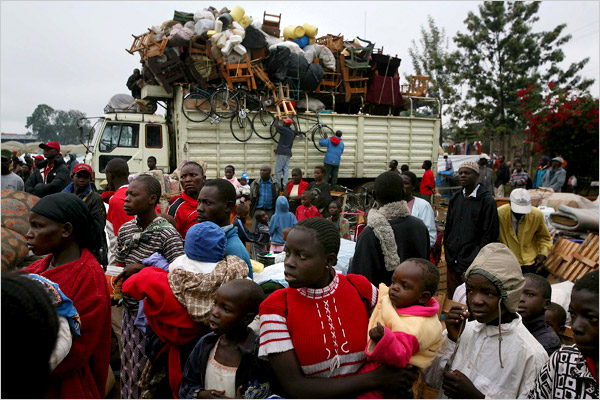
Following a flawed election, and a wave of ethnic and political violence, Kenya, once one of Africa’s most promising nations, is resegregating itself. Members of ethnic groups, like these Luos, left, waited for transportation to their ancestral homes.

Photo: Joao Silva for The New York Times

 OTHAYA, Kenya — Sarah Wangoi has spent her entire life — all 70 years of it — in the Rift Valley. But last month, she was chased off her farm by a mob that called her a foreigner. She now sleeps on the cold floor of a stranger’s house, seeking refuge in an area of Kenya where her ethnic group, the Kikuyu, is strong. It is, supposedly, her homeland.

“I am safe now,” said Ms. Wangoi, though the mob still chases her in her dreams.

Across the country, William Ojiambo sat in a field where the ground was too hard to plow. He, too, sought refuge with his ethnic group, the Luo. He used to live in an ethnically mixed town called Nakuru but was recently evicted by a gang from another ethnic group that burned everything he owned.

“We came here with nothing, like cabbages thrown in the back of a truck,” Mr. Ojiambo said.

Kenya used to be considered one of the most promising countries in Africa. Now it is in the throes of ethnically segregating itself. Ever since a deeply flawed election in December kicked off a wave of ethnic and political violence, hundreds of thousands of people have been violently driven from their homes and many are now resettling in ethnically homogenous zones.

Luos have gone back to Luo land, Kikuyus to Kikuyu land, Kambas to Kamba land and Kisiis to Kisii land. Even some of the packed slums in the capital, Nairobi, have split along ethnic lines.

Kenyan Violence Menacing for Intertribal Marriages

Kenya’s political troubles have had a immediate impact on marriages composed of partners of different tribes. Individuals in inter-tribal or inter-ethnic marriages are often twice cursed in the event of inter-ethnic violence. On the one hand, each marriage partner is increasingly distrusted by members of the other ethnic/tribal group. But what makes matter even worse is that they are also ostracized and often the victims of violence on the part of members of their own group. Their sin is that, having married someone from the rival ethnic group/tribe, they are no longer seen as trustworthy. In noticed in Croatia that this led to counter-intuitive outcomes where individuals who had married spouses of the other ethnic group often become publicly intolerant toward members of the spouse’s group. This was not the result of true ethnic hostility but in order to prove the individual’s ethnic/nationalist bona fides to his (and it was mostly males in this case) own ethnic brethren.

Here is a report from the Associated Press about a woman in Kenya whose husband had to leave home, fearing for his life.

He doesn’t call. He doesn’t write. His cell phone has been switched off for weeks. After 17 years, Naomi Kering’s husband is gone — one more intertribal marriage fallen victim to the violence that has followed Kenya‘s disastrous presidential election.

“The kids always ask me, ‘Where is he?’ And I always say he is going to come back,” Kering, a 34-year-old of the Kalenjin tribe, told The Associated Press as she stood in the rubble of her home, torched by a mob last month because her kenya_divided_love_abc5031.jpghusband is a Kikuyu. “But I hope he stays away, because I love him and I want him to be safe.”

Since the Dec. 27 vote, marriages that united different ethnic groups have felt the strain as communities shun the Kikuyu tribe of President Mwai Kibaki, whose disputed re-election unleashed a wave of bloodshed that has killed at least 685 people.

Until now, marriages like Kering’s were common enough to go largely unnoticed, representing hope for what Kenya could be as a nation. But now the fabric of Kenyan society is fraying, forcing families to confront tribal identities many had cast aside long ago.

“This election has changed the very essence of these marriages,” said the Rev. Charles Kirui, a Catholic priest whose church in the nearby town of Burnt Forest shelters hundreds of Kikuyus. “Marriages are breaking up because of a tribal conflict, which means we really have a problem in Kenya.”

There are no figures on how many families are affected, but the impact is particularly felt in the heart of opposition territory in western Kenya, where tribal tensions have been most inflamed by the election.

This country of 38 million was once seen as a stable democracy on a violent continent. But it depended on a delicate balance of intertribal power.

Design a site like this with WordPress.com
Get started