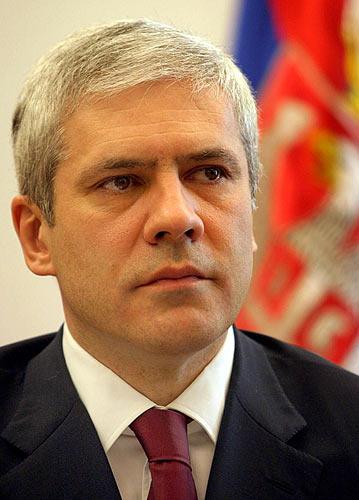
Serbian President Reacts to Yesterday’s Violence in Belgrade

Recently elected Serbian President, Boris Tadić, has responded to yesterday evening’s violence in Belgrade, which involved the torching of the US Embassy by an unruly mob numbering hundreds.  The mob was but a tiny minority of the crowd of hundreds of thousands, which had gathered earlier in the day to peacefully protest Kosovo’s declaration of independence on Monday of this week.  Tadić, a the leader of the moderate Democratic Party in Serbia, had this to say about the events:

tadic.jpg Tadić, who was in Romania Thursday, today said he has “asked all relevant institutions for reports on yesterday’s unrest in Belgrade”.
For the same reason, he was called a session of the Council for National Security…

…Tadić is also strongly condemning the violence, looting and burning, that ended in one death and nearly 200 injured, as well as huge material damage to the city.

“There is no justification for violence, no one must dare to justify it with a single word,” his press service said in a statement…

…Tadić went on to say that “this is not Serbia and Serbia will never be like this”.

“The state must have law and order and such violence must never happen again, anywhere,” Tadić said.

Turkish Military in Northern Iraq

While Iraq still maintains legal sovereignty over the majority Kurdish areas in the north of the country, the Kurds in that region have been enjoying de facto autonomy/independence since the end of the first Gulf War in 1991.  A direct result of United Nations Security Council resolutions mandating, above all else, the establishment of a no-fly zone in northern Iraq, Saddam Hussein’s regime had no presence there from 1991 on.  The ouster of Saddam’s regime has only made Kurdish control of the territory more secure.  It’s not inconceivable that a Kosovo-type situation could obtain here as well.   A crucial difference in the Kurdish situation is the presence of a large group of ethnic Kurds living in neighboring Turkey, who have waged a sporadic, decades-long campaign (using various tactics, including terrorism) to pressure the Turkish government into granting the Kurds more autonomy, if not outright independence.  The situation has become even more serious, as this report from the New York Times illustrates:

ISTANBUL — Turkey’s military said on Friday that it had sent ground troops into northern Iraq on Thursday night, in an operation aimed at weakening Kurdish militants there, but it was unclear how many or how long they would stay.

The Turkish General Staff, in an announcement on its Web site, gave no details on the size of the incursion. An American military spokesman in Baghdad said the ground offensive would be of “limited duration.”

The Turkish offensive appears to be aimed at dealing a surprise blow to the Kurdish militants, the Kurdistan Workers’ Party, before the snow along the mountainous border between the two countries melts and the guerrillas make their traditional spring advance into Turkey.

The militants, known as the P.K.K., want greater autonomy for Turkey’s Kurdish minority and have fought the Turkish military for decades. Some of their hide-outs are in Turkey, but some are in northern Iraq, and the rebels have crossed the border into Turkey repeatedly to attack.

It was not clear what role the United States had played in the incursion. But the operation sets two of its closest allies in a troubled region against each other. Turkey is a NATO member that borders Iran, Iraq and Syria; the Iraqi Kurds, who control northern Iraq, are the most important American partners in the Iraq war.

The United States has been wary of Turkish efforts to stamp out the Kurdish militants, with Turkish officials chafing at what they view as a double-standard, escalation tension between the NATO allies.

Serb Demonstrators Attack US and Croatian Embassies in Belgrade

The Washington Post reports that following a massive (upwards of 150,000 participants) and peaceful demonstration in the Serbian capital of Belgrade, with the theme “Kosovo is Serbia”, a group numbering a few thousand at most has attacked the US and (neighboring) Croatian embassies, setting the US embassy on fire. The demonstrations were held in the aftermath of Albanian Kosovars’ official declaration of independence on Monday. The US is one of many countries to have officially recognized Kosovo as the newest ex-Yugoslav independent state, setting off a public and official outcry on the part of Serbs, for whom Kosovo is the historical birthplace of their nation.

Politicians in Belgrade are caught between their rhetoric to do what it takes (short of violence) to prevent Kosovo from achieving full-fledged independence and the lack of many good non-violent options to do so, given the Serb leadership’s openly declared goal of one day joining the European Union. One possibility would be to energize (or otherwise entice) the Serbs in neighboring Bosnia and Herzegovina to agitate for higher levels of autonomy, or outright independence, stressing the similarities of the situations. This would certainly raise the ire of European leaders and would not earn the Serbs any bonus points in their quest for further integration into European political and economic institutions.

Here is footage from the Belgrade independent media outlet B92:

From the “About Video” (translated by me): Beograd — Stotine nasilnih demonstranata nakon završetka mitinga napalo američku i hrvatsku ambasadu. U 19:13 intervenisala policija.

“Upon the conclusion of the [official] demonstration, undreds of violent demonstrators attacked the American and Croatian embassies. The police intervened at 7:13 pm.”

You can find a gallery of photographs from the day in Belgrade at B92’s website here.

Condoleeza Rice, International Relations Theory and the Bush Administration

In class today, I tried to convince you that understanding IR from a theoretical perspective was not simply some abstract, pedantic pursuit, but that the theoretical lens through which we view international relations does have real-world implications, many of which are dramatic.

I noted the role of Condoleeza Rice as the chief National Security Advisor to President Bush during his first term and also noted that Rice has long held a realist view of international relations. As you must know by now (I think I’ve mentioned it about 503 times since the beginning of the semester), realists view the state as the only prominent actor in international affairs. This was Rice’s view upon assuming her new position and this was manifested in the security objectives of the incoming administration, which did not believe, initially, that a non-state actor like Al Qaeda was a grave threat to the security of the United States.

Here are excerpts from Rice’s article in Foreign Affairs magazine in the midst of the 2000 presidential election campaign:

Summary: With no Soviet threat, America has found it exceedingly difficult to define its “national interest.” Foreign policy in a Republican administration should refocus the country on key priorities: building a military ready to ensure American power, coping with rogue regimes, and managing Beijing and Moscow. Above all, the next president must be comfortable with America’s special role as the world’s leader…

Continue reading “Condoleeza Rice, International Relations Theory and the Bush Administration”

Do Americans view China as an Emerging Strategic Threat?

China’s miraculous economic growth has become a source of concern for some Americans who hold a realist view of international politics. The argument is that the increase in economic prowess will lead (is leading) to an increase in military power and a heightened strategic threat to the predominance of the United States in global affairs. How concerned is the average American with China’s emergence on the international scene? One of the best places to find the answer to this question, and to all questions related to the public’s views regarding international affairs is the Chicago Council on Global Affairs. The Council has archived on its website reports on public attitudes going all the way back to 1975. An important virtue of these surveys is that they disaggregate elite opinion from the rest of the public.

As for Americans’ views of China, in the 2006 survey slightly more than one-third of Americans viewed China as a strategic threat (click on the chart below for a larger image). Not surprisingly, almost 3/4 of Americans viewed international terrorism as a strategic threat to US interests, putting that issue at number one. Click the link above for the whole report, which polled the public on other issues, such as international trade, immigration, and global warming.

Chicago Council Survey 2006

China 2007 Trade Surplus Record $262bn

China’s rising economic and military power has caused some concern in the United States and in Europe. Just like China in the 1980s, China’s economic policies–particularly as it relates to the values of its currency and the effect that has had on China’s foreign trade and current accounts–have irked politicians and pundits (hello, Lou Dobbs) here in the US. They will not be heartened by the news that China’s trade surplus has reached a record $262 billion. Interestingly, however, the EU replaced the US as China’s largest export market.

China’s trade surplus rose by nearly 50 per cent to a record $262bn in 2007, but import growth exceeded export growth in each of the final three months of the year, suggesting that the country’s controversial trade imbalance may be peaking.

In another first, the European Union also replaced the US as China’s largest export market. Sales to the expanded EU grew by 29.2 per cent in 2007, compared to just 14 per cent to the US.

Design a site like this with WordPress.com
Get started