
The State and Democratization

The Polity IV data set code book, has a section entitled Indicators of Democracy and Autocracy (Composite Indicators), the authors write about the development of the state and the evolution of political participation as a corollary.  If you read it in tandem with this post on Max Weber’s view of the state and state legitimacy, you’ll begin to understand the nature of the state and why it has become the dominant contemporary form of political organization.

Three broad processes have reshaped the global landscape of state structures during the last two centuries One is an extraordinary expansion in the absolute and relative power of the state, a process that began i Europe. The new states created by the American and French revolutions marked the threshold between political world dominated by monarchies, whose claims to absolutism were belied by the fact that most social and economic life was autonomous from state control or extraction, and a political world in which state power was based on ever-widening control and mobilization of human and material resources exchange for broadened rights of popular participation. An integral part of this process was the development of bureaucracies with high capacities to regulate, tax, and mobilize people in the service of state policy. 

The second process was the transformation of the structures of political participation and legitimation. This transformation followed one of two paths, toward plural democracy or mass-party autocracy. The popular side of the bargain by which most West European rulers built state power in the nineteenth century was to acknowledge the right of widespread participation in policy making.  That right was given institutional expression in elected assemblies which could review, and sometimes initiate, public policy; in elections direct or indirect, of chief ministers; and in recognition of citizens’ rights to voice and act on political opinions. The concept of bargain is a metaphor for sequences of political crises and reforms in which these rulers granted rights for participation, however limited, to all significant social classes and groups, while simultaneously extending the state’s right and capacity to regulate, tax, and mobilize the human and material bases of state power. 

The process of political democratization had its own logic and dynamic which, in most of Western Europe, eroded all but a few symbolic vestiges of traditional autocracy (see for example Bendix 1978). Nonetheless, pressures to extend democratization have always contended with the self-interested desire of rulers to preserve and enhance their autonomy from political constraints. Theempires of Central and Eastern Europe–Germany, Russia, Austro-Hungary–implemented thetrappings but not the substance of effective democratic participation in the late nineteenth and early
Barack Obama on the Financial System, Uncertainty and Risk

In my post below, I linked to an article by Thomas Homer-Dixon in which, among other things, he argued that the problem with the contemporary financial system is that the arcane machinations and lack of transparency (Level-III assets, anyone?)  have transformed the market from one of risk–which can form the basis for a stable financial system–to uncertainty–which cannot.  So the question then, is how to create the conditions under which banks and other financial institutions, and investors can adequately assess risk.  The lack of transparency is the reason that the credit markets have currently seized up and the Federal Reserve has had to come to the rescue of Bear Stearns. (Ben Bernanke–the Chairman of the Federal Reserve–himself has argued that “banks will fail” over the next couple of years.  Indeed, a couple of small regional American banks have already failed.)

By coincidence, Democratic Presidential candidate Barack Obama gave a speech at Cooper Union in New York setting out his vision of how his policies would help the engine  of the American (and international) financial system become more transparent and a solid foundation for the US and world economy.  I encourage you to watch the speech, wherein Obama presents his view of the nature of the relationship between the market and state (government).

“It’s worth taking a moment to reflect on the role that the market has played in the development of the American story.  The great task before our founders was putting into practice the ideal that government could simultaneously serve liberty and advance the common good.  For Alexander Hamilton, the young Secretary of the Treasury, that task was bound to the vigor of the American economy.  Hamilton had a strong belief in the power of the market, but he balanced that belief with the conviction that human enterprise, ‘may be beneficially stimulated by prudent aids and encouragements on the part of the government [state]'”

State Capacity and the US Federal Budget

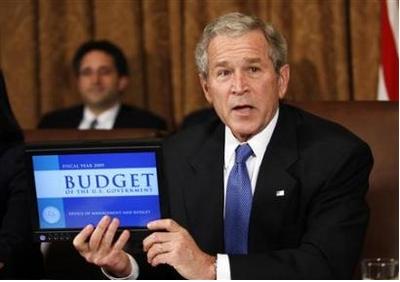
bush_budget.jpgWe’re currently discussing and analyzing the state, and its important role in comparative politics. One of the dimensions on which we can compare state power is “capacity.” What is capacity? According to O’Neil (p.38-39), “capacity is the ability of the state to wield power in order to carry out the basic tasks of providing security and reconciling freedom and equality. A state with high capacity is able to formulate and enact fundamental policies and ensure stability and security for both itself and its citizens.” We were presented with evidence today of a demonstration of the high capacity of the United States as President George W. Bush unveiled his new 3.1 trillion-dollar (I’m no mathematician, but that’s at least a couple of gazillion dollars, isn’t it?) budget. Any state that can make its citizens cough up that much money, more or less willingly, has to have high capacity.

The photograph is from Yahoo News, click here to see a video clip of the president submitting this year’s federal budget, the first one in American history to be submitted in electronic form. As the president correctly surmised, “this will save a lot of trees!”

Design a site like this with WordPress.com
Get started