Kenya, ethnic diversity, and fractionalization scores

Had you taken my Introduction to Comparative Politics class in the fall of 2007, you would have been faced with writing a paper in response to this:

There is much debate regarding the determinants of, and obstacles to, democratization. Are states that rely on natural resources for a large share of their GDP less likely to become and remain democratic? Does ethnic diversity present an obstacle to the democratization and democratic consolidation of a regime? Your term paper will answer one of these two questions either in the affirmative or the negative.

In addition to making the theoretical argument, students were asked to use Iraq and one other state to illustrate and support their argument(s). A few students chose to write on Kenya. I hope they go back and read their papers in light of the current situation in that multi-ethnic state.

Is Kenya ethnically diverse? How can we measure ethnic (or religious, or linguistic) diversity? There is a formula called the fractionalization index, which essentially gives us an idea of how diverse a state is. You can find a table–in Appendix A (which I have excerpted here) of over 100 states around the world with their corresponding fractionalization scores (in three categories), in this National Bureau of Economic Research (NBER) paper by Alesina et al. here The higher the value the higher the level of diversity. Notice the relatively low diversity of states like Poland and Norway and the high amount of diversity of almost all African states. Which is the best way to measure “diversity”? Ethnically? Linguistically? By religion?


Country
Date (Ethnicity Data)
Ethnic
Language
Religion
Afghanistan
1995
0.7693
0.6141
0.2717
Canada
1991
0.7124
0.5772
0.6958
China
1990
0.1538
0.1327
0.6643
Croatia
1991
0.3690
0.0763
0.4447
Kenya
2001
0.8588
0.8860
0.7765
Malawi
1998
0.6744
0.6023
0.8192
Mozambique
1983
0.6932
0.8125
0.6759
Nigeria
1983
0.8505
0.8503
0.7421
Norway
1998
0.0586
0.0673
0.2048
Portugal
1998
0.0468
0.0198
0.1438
USA
2000
0.4901
0.2514
0.8241

Links to Student Blogs in PLSC250–Section 03

Here is where I would like you to leave information about your blog. Please click and a comment giving the rest of us the information necessary to add your blog to our blogroll.Blog name:URL: leave out the “www”The First Initial and last name of the blog partners.

_PLSC250-03-blogname

http://blogaddress.com

M. Student and K. Student

Pew Global Attitudes Project

In the past, while talking with students, listening to discussion in class or grading papers, I’ve often heard unsubstantiated claims such as “the world is not with President Bush”, or “even the Europeans hate us”, etc.  Noting that these claims are unsubstantiated does not mean they are not true.  What it does mean is that I need further proof of the veracity of the claims than simply the student’s recitation of that claim.  Similarly, you should be skeptical in class if I try to claim something without providing evidence to support that claim.  With respect to statements such as the ones I referenced above, the Pew Global Attitudes Project is a fantastic resource.  This organization polls publics around the world on a host of issues related to international politics, international affairs, and the domestic ramifications of international events and issues.

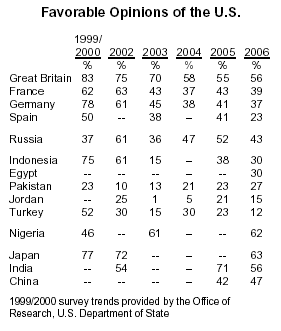
So just how do people around the world view the United States, and how has that opinion changed since 2000?  Well, look no further than this report here:


favorable_opinions_of_the_us.gif

Now, if a student were to write, according to widely available survey evidence, Europeans  (at least in Great Britain, France, Spain, and Germany) hold a much less favorable view of the US in 2006 than they did in 2000 (Pew Global 2006), then that would be more compelling.

Croatia: A Human Trafficking Victim Speaks With RFE/RL

The extent of human trafficking, for prostitution mainly, but also for indentured servitude has increased dramatically since the collapse of communism in eastern Europe. A more interdependent and globalized world leads to opportunities for many, but also to horror and destitution for an increasing number of the world’s most vulnerable. Here is an account of a Croatian victim from Radio Free Europe/Radio Liberty (RFE/RL–an excellent website for information on the former communist world, the Middle East, and parts of western Asia).

ZAGREB, June 15, 2006 (RFE/RL) — Trafficking in women for the purpose of sexual exploitation is becoming increasingly widespread in countries undergoing transition. Many young women seeking better jobs and better lives find themselves against their will in secret brothels of Western countries. Such is the warning of nongovernmental women’s unions in Croatia, where 45 victims of trafficking have been identified in the last four years. Unofficial numbers are many times greater.

“It happened abroad,” says Martina, a 29-year-old trafficking victim from Zagreb. “I was sold for 3,500 euros [$4,400]. I was beaten, raped, forced against my will. They would put out cigarette butts on me and cut me with razors.

It was like a horror movie, she says. Martina was 19 years old at that time, trained as a cook. She lived in the suburbs of Zagreb and desired a better job and a better life. She met a young man who told her about his brother who had a restaurant in Italy, but who had a hard time finding good employees.

‘It Sounded Rather Convincing’

“He told me that if I really wanted to work I could come with him, but that if I did not intend to pursue work there I could be back in Croatia in three days,” Martina said. “It sounded rather convincing. Given that my life had been miserable since I was born — my father was an alcoholic and my mother ill — I went there without a second thought.”

“As soon as I arrived and as soon as he brought me to his apartment, everything started. He told me there was no work and that I had crossed the border in order to work as a prostitute, that he had paid a ton of money for me and that he will come for me in three days, and that I had to be ready by then,” she continued. “I told him to get his mother ready instead, and then he hit me on the head with his fist. Since we were in the kitchen I turned around and struck him with a pot. Naturally, I was no match for him physically. He beat and raped me constantly for three days, to the point where I was lying in blood and urine while tied to a bed. He then brought two of his friends who raped me, put out cigarette butts on me, and cut me with razors.”

Martina was locked in a Rome apartment for two months. Instead of working in a restaurant, she was beaten and raped daily until she was “broken” and had become a sexual slave. Then, she says, the man who bought her took her out to the street.

Four Passports

“That man was from Bosnia,” she said. “We found in his apartment four passports and another girl from Croatia who was also a mother of three. That was a complete horror. They beat me endlessly. A girl of 16 from Albania almost bled to death in my arms because they had pushed a car antenna into her vagina. A girl from Bosnia was found dead. That is when I completely broke down.”

Two prostitutes appearing in a World Cup-related advertisement in Halle, Germany (epa)She said she had been completely dulled, as if separated from her own body. Even when there was a chance of escape she remained a prostitute.

“There was no way for me to be freed from what had happened to me,” Martina said. “I endured this for six years. I went to the street with prostitutes, not in order to work, but to see the people who come to them and who force them to do this. Then I would throw a bottle of gasoline on their car or puncture their tires. I didn’t care what would happen. I did one or three customers — I didn’t care. I didn’t look at those people.”

Martina was a typical, vulnerable young woman without steady employment or family support. Nobody wondered about her disappearance. After all, even her own father beat her from a very young age. Sadly, that experience prepared her for what she endured in Rome.

Globalization, Economic Development and Indentured Servitude

We will be addressing the topic of globalization later in the semester and will be viewing this video on the use of what amounts to slave labor in the silk industry in India.

I found this on the Human Trafficking and Modern-day Slavery website.

Human Trafficking Website 2007-2008. Country by country reports of human trafficking, modern day slavery, contemporary slavery, debt bondage, serfdom, forced labor, forced marriage, transferring of wives, inheritance of wives, and transfer of a child for purposes of exploitation.

World Economic Forum Releases Global Risks Report for 2008

The World Economic Forum, a Swiss-based NGO whose motto is “entrepreneurship in the global public interest”, has recently released its Global Risks Report for 2008.  They view four main issues as presenting the most potential global risk over the next twelve months and beyond.

The present report looks at global risks from a range of different perspectives. The first part of the report focuses on four emerging issues that are shaping the global risk landscape: systemic financial risk, food security, supply chains and the role of energy. On systemic financial risk, we put current market turmoil in the historical context and ask how the transformation of the global financial system over the last two decades may require us to rethink our expectations and understanding of systemic risk in the future. On food security, we discuss how the subject has moved from the periphery of the global risk landscape to its centre, and ask whether the world is ready to cope with the various trade-offs that the new food economy is generating. On supply chains, we investigate a potentially hidden set of vulnerabilities in the global economy to supply chain disruptions. Finally, on energy, we outline the emergence of a range of energy-related risks and ask if the world can move towards secure and sustainable energy.

Do Americans view China as an Emerging Strategic Threat?

China’s miraculous economic growth has become a source of concern for some Americans who hold a realist view of international politics. The argument is that the increase in economic prowess will lead (is leading) to an increase in military power and a heightened strategic threat to the predominance of the United States in global affairs. How concerned is the average American with China’s emergence on the international scene? One of the best places to find the answer to this question, and to all questions related to the public’s views regarding international affairs is the Chicago Council on Global Affairs. The Council has archived on its website reports on public attitudes going all the way back to 1975. An important virtue of these surveys is that they disaggregate elite opinion from the rest of the public.

As for Americans’ views of China, in the 2006 survey slightly more than one-third of Americans viewed China as a strategic threat (click on the chart below for a larger image). Not surprisingly, almost 3/4 of Americans viewed international terrorism as a strategic threat to US interests, putting that issue at number one. Click the link above for the whole report, which polled the public on other issues, such as international trade, immigration, and global warming.

Chicago Council Survey 2006

China 2007 Trade Surplus Record $262bn

China’s rising economic and military power has caused some concern in the United States and in Europe. Just like China in the 1980s, China’s economic policies–particularly as it relates to the values of its currency and the effect that has had on China’s foreign trade and current accounts–have irked politicians and pundits (hello, Lou Dobbs) here in the US. They will not be heartened by the news that China’s trade surplus has reached a record $262 billion. Interestingly, however, the EU replaced the US as China’s largest export market.

China’s trade surplus rose by nearly 50 per cent to a record $262bn in 2007, but import growth exceeded export growth in each of the final three months of the year, suggesting that the country’s controversial trade imbalance may be peaking.

In another first, the European Union also replaced the US as China’s largest export market. Sales to the expanded EU grew by 29.2 per cent in 2007, compared to just 14 per cent to the US.

Design a site like this with WordPress.com
Get started