
Sarah Palin should have taken PLSC250

Had one of my Introduction to International Relations students been taking questions from Charlie Gibson tonight, s/he would have been well prepared to answer his question regarding the “Bush Doctrine”.  As my students (still?) know, the “Bush Doctrine” was most clearly and forcefully enunciated in the 2002 National Security Strategy of the United States.  While there are three major components to the “Bush Doctrine”, the most important of which (at least the one that received the most attention and presented the most radical departure from the part-realist, part-liberal, bi-partisan, pre-9/11 US foreign policy framework was the idea of using preemptive military force, without the need for there to be an imminent threat.

Democratic critics have often charged Bush and his administration with claiming that Saddam Hussein posed an “imminent threat”, but I have yet to see any evidence that anyone speaking for the administration did so.  And it’s not a surprise, as the Bush Doctrine allows the use of force without imminent threat.  Maybe Governor Palin should bring some of those critics along with her to my class.  And if the Republican Party would like to hire a IR tutor for Governor Palin, they’ll find my rates more than reasonable.
Pope Benedict XVI a Foreign Policy Radical

The Pope delivered a speech last week to the United Nations in which he argued–as have many radicals over the last few decades–that the will of the international community to act in order to solve important global problems is being undermined because a few states have accrued too much power.  The Associated Press has more:

NEW YORK – Pope Benedict XVI warned diplomats at the United Nations on Friday that international cooperation needed to solve urgent problems is “in crisis” because decisions rest in the hands of a few powerful nations.

In a major speech on his U.S. trip, Benedict also said that respect for human rights, not violence, was the key to solving many of the world’s problems.

While he didn’t identify the countries that have a stranglehold on global power, the German pope — just the third pontiff to address the U.N. General Assembly — addressed long-standing Vatican concerns about the struggle to achieve world peace and the development of the poorest regions.

On the one hand, he said, collective action by the international community is needed to solve the planet’s greatest challenges.

On the other, “we experience the obvious paradox of a multilateral consensus that continues to be in crisis because it is still subordinated to the decisions of a few.”

The pope made no mention of the United States in his speech, though the Vatican did not support the U.S.-led invasion of Iraq in 2003, which occurred despite the Bush administration’s failure to gain Security Council approval for it. At other moments on his trip, Benedict has been overtly critical of the U.S., noting how opportunity and hope have not always been available to minorities.

The pope said questions of security, development and protection of the environment require international leaders to work together in good faith, particularly when dealing with Africa and other underdeveloped areas vulnerable to “the negative effects of globalization.”

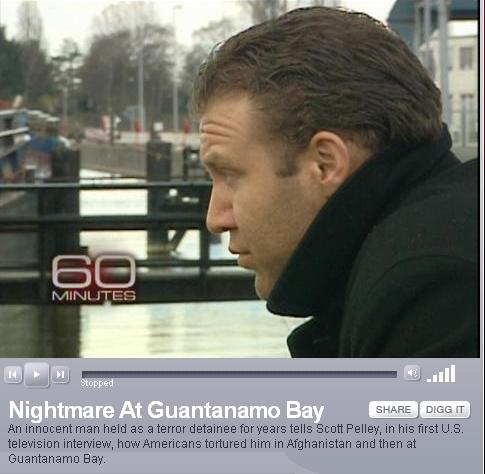
60 Minutes Report on Torture in Guantanamo Bay

Via the CBS news program 60 Minutes, we learn about a German resident of Turkish origin who was tortured by his captors in Afghanistan and Guantanamo Bay.  From the description:

An innocent man held as a terror detainee for years tells Scott Pelley, in his first U.S. television interview, how Americans tortured him in Afghanistan and then at Guantanamo Bay.

You can find the video report here.

Catholic Church’s View of Torture–Another Post in Support of My Anti-Torture Jeremiad

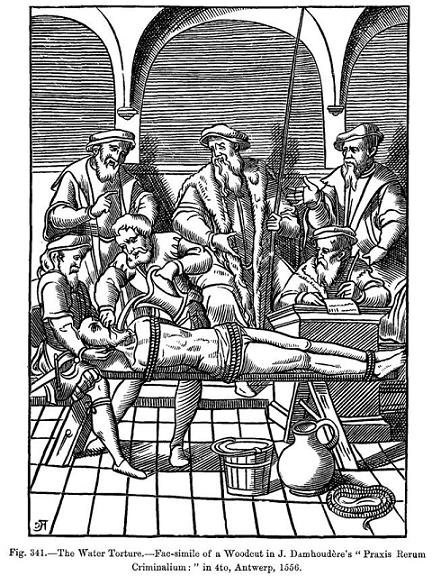
Tomorrow, we will address the morality of torture from both deontological and consequentialists viewpoints. Here I’d like to refer you to what a prominent relatively orthodox Catholic believes about the Catholic Church’s teachings regarding the morality of torture. The Catholic Church knows what of it speaks as it attempted to water-board” Jews into accepting the tenets of the Catholic faith in Spain centuries ago. Mark Shea writes this about the Catholic Church’s views on torture (I encourage you to read his whole post):

The Church’s basic teaching on torture is laid out in Veritatis Splendor 80 (followed by a discussion of what the Holy Father means by “intrinsically immoral” acts). VS cites, I believe, Lumen Gentium and Gaudium et Spes (though I could be wrong and my memory is groggy this early). The Church does not define what torture is (leaving that matter to common sense and to the specialized knowledge of those whose job it has historically been to know such as police, judges, interrogators, philosphers, and other people of good will who operate in the field where interrogation and police work must be done).

The basic guidelines the Church proposes are pretty simple

1. Don’t do evil that good may come of it. [This is about as strong an injunction against consequentialism as is possible.]
2. Some things are intrinsically evil, meaning you *can’t* do them under any circumstance.
3. Torture is one of these things.
4. If you are confused about what “torture” is, then bear in mind the Church’s *other* command, which is that we must treat prisoners humanely, not merely “not torture them”. Aim for that, and you won’t accidently torture them.
5. Seek the intelligence you need while bearing in mind the above.

Some of the basic attempts to justify the use of torture are:

Alan Dershowitz Defends Torture…”in Extraordinary Circumstances”

In a previous post, I linked to a series of articles published by the Washington Monthly, the contributors to which all were firm in their belief that torture is never justified. I mentioned in class the other day that one of the tenets of my teaching philosophy is to create a strict wall of separation between my own political beliefs and the substance and content of my teaching. Torture is the one area where I make an exception as I believe that this is not a partisan issue (a claim that is supported by the partisan views of the contributors to the Washington Monthly special report on torture–Republican, Democrats, and Independents all contributed to the report) and that torture is morally wrong and the United States government should never use it as official public policy.

In order to provide some balance to the debate, however, please find below an interview of Alan Dershowitz, who–by his own admission–supports torture only in “exceptional circumstances”, by veteran British journalist David Frost. Dershowitz, a professor at Harvard Law School, is the most erudite of those who support torture. Most of the comments of those who support the use of torture by the US government aren’t nearly as thoughtful as Dershowitz. Here are some examples from Michael Goldfarb of the Weekly Standard:

Andrew Sullivan is yet again calling the president a “war criminal.” This time in response to today’s New York Times article revealing that the Bush administration has subjected terror suspects captured abroad to ‘severe’ and ‘brutal’ interrogations.

Sullivan has a history of trotting out the charge of “war criminal,” sticking the label on George Tenet, Donald Rumsfeld, Pentagon counsel Jim Haynes, and Berkeley law prof John Yoo.

And for what? The Times indicts the Bush administration for exposing terrorists captured abroad to “head-slapping, simulated drowning and frigid temperatures.” Boo hoo. And why does the Times consider this such a dangerous policy? The reporters end the story with this quote, from former Navy lawyer John Hutson, which they must believe to be compelling:

“The problem is, once you’ve got a legal opinion that says such a technique is O.K., what happens when one of our people is captured and they do it to him? How do we protest then?” he asked.

As Jules Crittenden notes in response:

[The] article neglects to mention we are fighting an enemy that considers powerdrills into kneecaps and videotaped beheading of captives business as usual. That in fact, we have yet to face an enemy in the modern era that observes anything approaching the standards we do. Germany, Japan, North Korea, North Vietnam, Iran, Iraq. Disorientation, isolation, beatings, starvation, summary executions, torture … of the bone-breaking, organ-smashing, electrocuting, bloody-drawing variety.

That is, real torture. And it trivializes the seriousness of it to apply the word to “head-slapping, simulated drowning and frigid temperatures.” It also trivializes the seriousness of real war crimes for someone to throw around the charge so promiscuously. A quick search of Sullivan’s blog for “war criminal” turns up 34 hits, all of them referring to members of the Bush administration. No doubt hit number 35 will be Andrew’s attack on the war criminals of the Worldwide Standard.

Here is another example from Goldfarb:

I haven’t really been following this issue, mostly because I’m pretty sure that whatever the government is doing to these terrorists wouldn’t “shock my conscience.” Like my man Scalia says, sometimes you’re going to have to take these terrorists and “smack them in the face.” But, some folks are more easily shocked than I am, and they are in full moral outrage mode this morning with the release of a 2003 memo by John Yoo (now a professor at Berkeley!) approving “harsh interrogation techniques.” Oh, the humanity!

Unfortunately, in a sad twist of fate, Andrew Sullivan has taken the week off, and so there will be no calls for a new Nuremberg trial featuring the prosecution of George Bush, Dick Cheney, Donald Rumsfeld, and everyone else Andrew doesn’t agree with. But if you need your fix of self-righteous lefty demagoguery, Glenn Greenwald is a pretty good substitute with his post on “John Yoo’s War Crimes.”

Book Review: “Justice in Conflict? The ICC and Peace Processes”,

icc.jpgWe will be analyzing international law next week upon our return from spring break. The recently established International Criminal Court (ICC), an independent (i.e., it has no linkn to the United Nations, unlike the International Court of Justice–ICJ) international court located in the Hague, has in its short existence (it came into force in 2002) been the subject of heated debate between those who view it as a bold and necessary step in the fight for international justice, and those who view its powers as undermining to a dangerous degree state sovereignty.

This week’s weekly letter from the International Crisis Group (ICG) contains a book review of Nicholas Waddell and Phil Clark’s “Justice in Conflict: The ICC and Peace Processes. The author of the review, Nicholas Gronko, writes:

The International Criminal Court (ICC) is now investigating or prosecuting individuals involved in three of the most devastating conflicts in Africa – Darfur, northern Uganda and the Democratic Republic of Congo (DRC). In each case, the ICC has been forced to confront the challenges inherent in pursuing peace and justice simultaneously. What happens – and what should happen – when efforts to prosecute perpetrators of mass atrocities coincide with a peace process? What is the best approach when the price of a peace deal may be a degree of impunity for those most responsible for such abuses? One common and convenient response is to hide behind truisms and make general statements of principle to the effect that no trade-off is required because peace and justice are inextricably linked. Clearly peace and justice are complementary in that justice can deter abuses and can help make peace sustainable by addressing grievances non-violently. But good things don’t always go together, and to present peace and justice as invariably mutually reinforcing is misleading and unhelpful when the difficult reality of peacemaking often proves otherwise. We review below arguments surrounding the ICC’s impact on prospects for peace in Uganda and go on to offer some general considerations that international policymakers should heed when seeking to balance peace and justice demands.

Here is a look at the 106 (most recent count) signatories to the Statute of Rome (which established the ICC).  States in green are signatories to the statute.

iccmemberstates.png

Peace and Punishment–An Insider’s Account of the ICTY

Marko Attila Hoare, whose blog (Greater Surbiton) is a great place to read about South East European politics, has a post on the recently published book by former spokeswoman of the International Criminal Tribunal for the former Yugoslavia (ICTY), Florence Hartmann.  The book is written in French and the title is Paix et chatiment: Les guerres secretes de la politique et de la justice internationales [Peace and Punishment: Secret Politial Wars and International Justice].

Hoare has a long post about the book. Here are some snippets:

[Hartmann] has used her eyewitness’s insight into the inner workings of the ICTY to support her blistering critique of the failure of the Western alliance to support the cause of justice for the former Yugoslavia. Her book paints a portrait of Western powers, above all the US, Britain and France, stifling the ICTY and preventing the arrest of war-criminals through a combination of obstruction, manipulation, mutual rivalry and sheer inertia.

One of the best parts of the book concerns what Hartmann terms the ‘fictitious pursuit’ of the two most prominent Bosnian Serb war-criminals, Radovan Karadzic and Ratko Mladic, involving repeated failures to arrest them. Hartmann gives various reasons why the Western powers might have behaved in this manner, among them the alleged agreement in 1995 between Milosevic, Mladic and French President Jacques Chirac, that in return for the release of two French pilots shot down by the Serbs over Bosnia, Mladic would never be prosecuted by the ICTY; the similar alleged agreement between Karadzic, Mladic and the US’s Richard Holbrooke in 1996, for Karadzic to withdraw from political life in return for a guarantee that he would never be prosecuted; and the readiness in 2002 of Bosnia’s High Representative, Britain’s Paddy Ashdown, to sabotage the attempts of Bosnian intelligence chief Munir Alibabic to track down Karadzic, out of rivalry with the French intelligence services with which Alibabic was working…

Peace and Punishment, nevertheless, remains essential reading for several reasons. It reminds us that, however critical one may be of del Ponte’s performance as Chief Prosecutor, she was very far from being the only senior individual responsible for the ICTY’s failures. It gives an insight into the sort of debates and conflicts over strategy that preoccupied war-crimes investigators at the OTP. And it highlights the fact that, far from being an agent of Western imperialism, the Chief Prosecutor was acting in a frequently hostile international arena, in which she had to struggle for international cooperation, and in which the ICTY was frequently squeezed rather than supported by the Great Powers. Although, as I have indicated, I am highly critical of several aspects of this book, I would nevertheless recommend it to anyone interested in the subject of why international justice has failed the peoples of the former Yugoslavia.

Design a site like this with WordPress.com
Get started