NATO Report Cites Four Most Dangerous Threats to the West

The authors of the NATO-commissioned report I mentioned in the post below have listed what they believe are the most potentially dangerous threats to international security. If you’d like, you can choose to select one of these as your blog project for the semester.

Once more, from the Guardian:

The authors – General John Shalikashvili, the former chairman of the US joint chiefs of staff and Nato’s ex-supreme commander in Europe, General Klaus Naumann, Germany’s former top soldier and ex-chairman of Nato’s military committee, General Henk van den Breemen, a former Dutch chief of staff, Admiral Jacques Lanxade, a former French chief of staff, and Lord Inge, field marshal and ex-chief of the general staff and the defence staff in the UK – paint an alarming picture of the threats and challenges confronting the west in the post-9/11 world and deliver a withering verdict on the ability to cope.

The five commanders argue that the west’s values and way of life are under threat, but the west is struggling to summon the will to defend them. The key threats are:

  1. Political fanaticism and religious fundamentalism.
  2. The “dark side” of globalisation, meaning international terrorism, organised crime and the spread of weapons of mass destruction.
  3. Climate change and energy security, entailing a contest for resources and potential “environmental” migration on a mass scale.
  4. The weakening of the nation state as well as of organisations such as the UN, Nato and the EU.

We will address the impact of environmental change on migration later in the semester when we read the work of Thomas Homer-Dixon.
New York Times special Report on Pollution and Economic Growth in China

You can find a fascinating 10-part report on the dramatic environmental impact of China’s miraculous economic growth in the New York Times. The report, Choking on Growth, provides readers and viewers a multimedia perspective on growth and pollution. From the perspective of comparative politics, it is important to note that some scientists and other scholars in China are trying to estimate the impact of environmental destruction on the general welfare of China’s citizens. They have begun to use a new measure of well-being, “green GDP”, arguing in effect that GDP itself is not an accurate measurement of a society’s well-being. In PLSC240, we will analyze other indicators of well-being, including HDI, the Gini Index, etc, when we study Political Economy (Chapter 4). From an IR perspective, we can ask ourselves what right or responsibility those outside China (whether IGOs like the UN, or other states like Japan and the US) have to intervene and attempt to reverse the damage China is causing to its own and the planet’s fragile ecosystem. Here is a link to a compelling video and some images below from the New York Times:

[rockyou id=99737780&w=500&h=350]

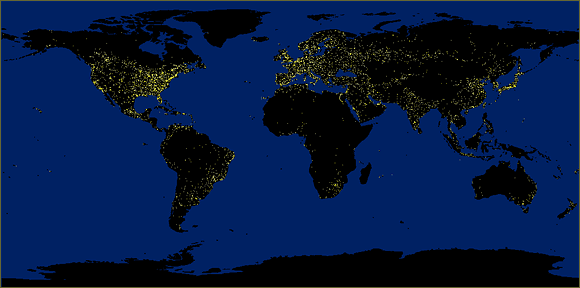
A Unique Indicator of Economic Development–Luminous Flux

Or light. Below you will find a fascinating map from the World Resources Institute, (which is a great website, featuring information on such matters as renewable fresh water resources, literacy rates, and other phenomena that are found at the “intersection of the environment and human needs.”

world_city_lights.gif

Here is a description of the map:

“The National Geophysical “city lights” database depicts stable lights and radiance calibrated lights of the world (which includes lights from cities, towns, industrial sites, gas flares, fires, and lightning illuminated clouds). A high concentration of city lights is especially found in industrialized densely populated regions such as western Europe, Japan, and the U.S.. Alternatively, few “city lights” are shown in economically poorer and sparsely populated regions (e.g. central and northern Africa and South America). Moderate “city lights” are found in several densely populated “developing countries” (e.g. India, Indonesia, eastern Brazil, and South Africa). The “city lights” data may be used a proxy for population distribution or infrastructure (e.g. in which it may be assumed that the occurrence of few city lights is correlated with the presence of institutional, political, and industrial infrastructure).”

Design a site like this with WordPress.com
Get started