
Alan Dershowitz Defends Torture…”in Extraordinary Circumstances”

In a previous post, I linked to a series of articles published by the Washington Monthly, the contributors to which all were firm in their belief that torture is never justified. I mentioned in class the other day that one of the tenets of my teaching philosophy is to create a strict wall of separation between my own political beliefs and the substance and content of my teaching. Torture is the one area where I make an exception as I believe that this is not a partisan issue (a claim that is supported by the partisan views of the contributors to the Washington Monthly special report on torture–Republican, Democrats, and Independents all contributed to the report) and that torture is morally wrong and the United States government should never use it as official public policy.

In order to provide some balance to the debate, however, please find below an interview of Alan Dershowitz, who–by his own admission–supports torture only in “exceptional circumstances”, by veteran British journalist David Frost. Dershowitz, a professor at Harvard Law School, is the most erudite of those who support torture. Most of the comments of those who support the use of torture by the US government aren’t nearly as thoughtful as Dershowitz. Here are some examples from Michael Goldfarb of the Weekly Standard:

Andrew Sullivan is yet again calling the president a “war criminal.” This time in response to today’s New York Times article revealing that the Bush administration has subjected terror suspects captured abroad to ‘severe’ and ‘brutal’ interrogations.

Sullivan has a history of trotting out the charge of “war criminal,” sticking the label on George Tenet, Donald Rumsfeld, Pentagon counsel Jim Haynes, and Berkeley law prof John Yoo.

And for what? The Times indicts the Bush administration for exposing terrorists captured abroad to “head-slapping, simulated drowning and frigid temperatures.” Boo hoo. And why does the Times consider this such a dangerous policy? The reporters end the story with this quote, from former Navy lawyer John Hutson, which they must believe to be compelling:

“The problem is, once you’ve got a legal opinion that says such a technique is O.K., what happens when one of our people is captured and they do it to him? How do we protest then?” he asked.

As Jules Crittenden notes in response:

[The] article neglects to mention we are fighting an enemy that considers powerdrills into kneecaps and videotaped beheading of captives business as usual. That in fact, we have yet to face an enemy in the modern era that observes anything approaching the standards we do. Germany, Japan, North Korea, North Vietnam, Iran, Iraq. Disorientation, isolation, beatings, starvation, summary executions, torture … of the bone-breaking, organ-smashing, electrocuting, bloody-drawing variety.

That is, real torture. And it trivializes the seriousness of it to apply the word to “head-slapping, simulated drowning and frigid temperatures.” It also trivializes the seriousness of real war crimes for someone to throw around the charge so promiscuously. A quick search of Sullivan’s blog for “war criminal” turns up 34 hits, all of them referring to members of the Bush administration. No doubt hit number 35 will be Andrew’s attack on the war criminals of the Worldwide Standard.

Here is another example from Goldfarb:

I haven’t really been following this issue, mostly because I’m pretty sure that whatever the government is doing to these terrorists wouldn’t “shock my conscience.” Like my man Scalia says, sometimes you’re going to have to take these terrorists and “smack them in the face.” But, some folks are more easily shocked than I am, and they are in full moral outrage mode this morning with the release of a 2003 memo by John Yoo (now a professor at Berkeley!) approving “harsh interrogation techniques.” Oh, the humanity!

Unfortunately, in a sad twist of fate, Andrew Sullivan has taken the week off, and so there will be no calls for a new Nuremberg trial featuring the prosecution of George Bush, Dick Cheney, Donald Rumsfeld, and everyone else Andrew doesn’t agree with. But if you need your fix of self-righteous lefty demagoguery, Glenn Greenwald is a pretty good substitute with his post on “John Yoo’s War Crimes.”

Rice Prices Surge 30% in one Day

I think I’ll start eating more quinoa.

The Financial Times reports that “fears of unrest rise across Asia as rice price surges 30% in a day.”  In a BBC interview, the director of the International Rice Research Institute (IRRI–don’t tell me you didn’t know one existed) bluntly states why this could be a major problem.

“Rice is the staple food for about half the world’s population, and over half the world’s poor.”

As the FT reports, many events has transpired to cause such a dramatic, sudden rise in the price of this extremely important food staple and the potential political effects.

Rice prices jumped 30 per cent to a record high yesterday, raising fears of fresh outbreaks of social unrest across Asia, where the grain is a staple food for more than 2.5bn people.

The increase came after Egypt, a leading exporter, imposed a formal ban on selling rice abroad to keep local prices down and the Philippines announced plans for a major purchase of the grain in the international market to boost supplies.

Global rice stocks are at their lowest since 1976. While prices of wheat, corn and other agricultural commodities have surged since late 2006, the rice prices increase started in January.

The Egyptian export ban formalises a previous poorly enforced curb and follows similar restrictions imposed by Vietnam and India, the world’s second and third-largest exporters.

Cambodia, a small seller, also announced an export ban.

These foreign sales restrictions have removed about a third of the rice traded in the international market.

Chookiat Ophaswongse, president of the Thai Rice Exporters Association, said: “I have no idea how importing countries will get rice.” He forecast prices would rise further.

Here is the BBC interview with the head of the IRRI:

Ken Roth Lecture on Human Rights and the Environment

We watched a video of a lecture given by Ken Roth (the Executive Director of the human rights NGO, Human Rights Watch) on the link between human rights and environmental degradation.  You can watch the entire lecture on youtube.  It is also embedded below.  Here is the description of the lecture:

Human Rights Watch Executive Director Ken Roth explains how environmental abuse has led to human rights violations in Darfur, Nigeria, Indonesia and Angola in the first of this season’s Joan B. Kroc Institute for Peace & Justice Distinguished Lecture Series at the University of San Diego. Series: “Joan B. Kroc Institute for Peace & Justice Distinguished Lecture Series” [10/2007]

President Bush wins European Approval for Missile Defense Shield

Yesterday in intro to IR we discussed the morality of former US President Ronald Reagan’s Strategic Defense Initiative (SDI) from a moral standpoint.  We debated the morality of replacing the theretofore existing principle of Nuclear Deterrence for a missile defense shield meant to destroy launched nuclear weapons, thereby making nuclear weapons essentially useless.  Some quarter of a century later, the New York Times reports that President Bush has won acquiescence from some European allies for his version of a missile defense shield that would cover the European continent.

bush_europe_missile_shield.jpgBUCHAREST, Romania — NATO leaders agreed Thursday to endorse a United States missile defense system based in Europe and to provide more troops for Afghanistan, but they declined, as expected, to back President Bush’s proposal to bring Ukraine and Georgia closer to NATO membership…

“There has been, over 10 years, a real debate as to whether there is a ballistic missile threat,” said Mr. Bush’s national security adviser, Stephen J. Hadley. “And I think that debate ended today.”

The Russian president, Vladimir V. Putin, has objected repeatedly to building parts of the missile defense system in former Soviet bloc states, despite Washington’s assurances that the system is a response to threats from Iran, not from Russia. Mr. Putin, saying the system would fuel a new arms race, has even threatened toaim Russian missiles at the system, while also offering the use of a substitute system in Azerbaijan.

NATO’s final statement invited Russia to cooperate with the United States and Europe on developing defenses jointly.

Konstantin Kosachev, chairman of the international affairs committee of the Russian Parliament, said that missile defense would be high on the agenda for the meeting between Mr. Putin and Mr. Bush in Sochi, a Russian resort, scheduled after the NATO conference, which Mr. Putin is to attend Friday.


Is NAFTA good or bad for US Workers and the US Economy?

With Democratic Presidential candidates Hillary Clinton and Barack Obama tussling over the relative  merits of the North American Free Trade Agreement, this Boston Globe column, in which Canadian Trade Minister David Emerson is quoted, is useful as quick background reading.  NAFTA, signed by former President Bill Clinton and ratified by the US Congress in teh mid-1990s, sought to bring down trade barriers amongst the Mexican, Canadian, and United States’ economies.  A common lament amongst those in rust-belt states and along the Mexican border is that the agreement has sent millions of jobs formerly held by Americans to Canada and Mexico.  Emerson cautions us to be wary of this claim, parsing the logic:

I strongly believe that the growth in protectionist sentiment is somewhat misplaced and irrational. It’s people who are concerned about the loss of jobs over the last 10 years which largely — analytically — has been shown to be driven by technology,” he told reporters.

“To the degree that it’s the result of liberalized trade, it’s more to do with the Asian dynamos like China and India and Vietnam, and countries like that. It’s not NAFTA that is hurting the North American worker. It’s not,” Emerson said.

“In fact, NAFTA is probably the friend of the North American worker because it enables us to achieve a level of efficiency and competitiveness that helps us take on the real competitive threats.”

Emerson said he had urged his counterparts in Canada’s 10 provinces to stress this message in dealings with the governors of U.S. states and members of the U.S. Congress.

“When you recognize that 39 out of 50 states have Canada as their number one export market, you start to realize governors and congressmen at the local level have an awful lot at stake, and we need to make sure they understand that,” Emerson said.

“Premiers and provincial ministers are very good, they have lots of contacts. The federal government cannot do it all.”

Prime Minister Stephen Harper has expressed confidence that, despite the rhetoric, the North American Free Trade Agreement will not be reopened. Emerson was not quite as confident.

“We’ve all been hearing the comments of presidential candidates, of congressmen. Protectionist forces have been gathering steam for some years and they’re showing no signs of abating,” he said.

Political Ideology/Attitudes and Happiness

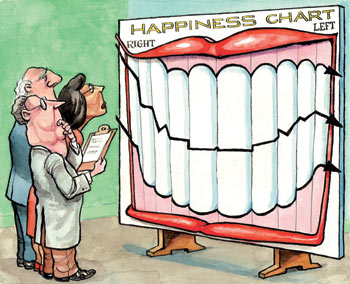
Are individuals of a certain political attitude orientation more likely to be happy than those with competing political attitudes?  The short answer, in the United States at least, may be yes; moreover, self-defined conservatives seem to be much happier (or at least claim they are) than are liberals, and extremists of either group are happier than moderates.  From the Economist:

economist_happiness.jpgIn 2004 Americans who called themselves “conservative” or “very conservative” were nearly twice as likely to tell pollsters they were “very happy” as those who considered themselves “liberal” or “very liberal” (44% versus 25%). One might think this was because liberals were made wretched by George Bush. But the data show that American conservatives have been consistently happier than liberals for at least 35 years.

This is not because they are richer; they are not. Mr Brooks thinks three factors are important. Conservatives are twice as likely as liberals to be married and twice as likely to attend church every week. Married, religious people are more likely than secular singles to be happy. They are also more likely to have children, which makes Mr Brooks confident that the next generation will be at least as happy as the current one.

When religious and political differences are combined, the results are striking. Secular liberals are as likely to say they are “not too happy” as to say they are very happy (22% to 22%). Religious conservatives are ten times more likely to report being very happy than not too happy (50% to 5%). Religious liberals are about as happy as secular conservatives.

Why should this be so? Mr Brooks proposes that whatever their respective merits, the conservative world view is more conducive to happiness than the liberal one (in the American sense of both words). American conservatives tend to believe that if you work hard and play by the rules, you can succeed. This makes them more optimistic than liberals, more likely to feel in control of their lives and therefore happier. American liberals, at their most pessimistic, stress the injustice of the economic system, the crushing impersonal forces that keep the little guy down and what David Mamet, a playwright, recently summed up as the belief that “everything is always wrong”. Emphasising victimhood was noble during the 1950s and 1960s, says Mr Brooks. By overturning Jim Crow laws, liberals gave the victims of foul injustice greater control over their lives. But in as much as the American left is now a coalition of groups that define themselves as the victims of social and economic forces, and in as much as its leaders encourage people to feel helpless and aggrieved, he thinks they make America a glummer place.

Morality and Iraq–Consequentialism and Deontology

The press seems to have a fascination with nice, round numbers.  Whereas the 3,976th, 2,349th, 342nd,  etc., deaths of US soldiers in Iraq did not merit much media coverage, last week’s 4000th death certainly did make its way onto newspapers and on television news shows.  Many critics of the war have used the milestone to ramp up their criticism of the war arguing that the price, in terms of American lives and treasure, is simply too high.  The President argues otherwise.  From the Washington Post:

As the American military death toll in Iraq reached 4,000, President Bush conferred yesterday with top U.S. officials in Washington and in Baghdad and vowed in a public statement that the outcome of the war “will merit the sacrifice.”

As we noted in class today, President Bush is arguing from a consequentialist perspective, insisting the the cost to the United States of military engagement in Iraq–in terms of deaths, injuries, and other costs–while high, will be outweighed by the benefits that continued military engagement there will produce.

Consequentialism is one of the two main moral philosophical traditions we will address this semester.  The other is deontological ethics, which is based on the Greek word deon, meaning “duty”, or “obligation.”  From this perspective, there are certain acts that are morally impermissible because they are inherently wrong and no consequential calculus can justify them from a moral perspective.  An example of such deontological reasoning is the following quote from Samuel Huntington, who claimed (about 15 or so years ago) that “it is morally unjustifiable and politically indefensible that members of the [U.S.] armed forces should be killed to prevent Somalis from killing one another.”

John McCain Argues for Continued US Military Presence in Iraq on Moral Grounds

Ross Douthat, from the Atlantic.com, has a comment on the first major policy speech by presumptive Republican Presidential candidate John McCain since he mathematically wrapped up the nomination.  The speech is appropriate for our purposes, given that McCain makes a fundamentally moral case for continued US military involvement in Iraq and we have just begin to address the role of morality and ethics in foreign policy in Intro to IR.

“To walk away from the Iraqi people and consign them to … horrendous violence, ethnic cleansing and possibly genocide,” he argued, would represent “an unconscionable act of betrayal, a stain on our character as a great nation.” 

Douthat then compres McCain’s speech on Iraq to that of Barack Obama’s major foreign policy address last week:

If Obama wants to claim the moral as well as the political high ground, he can’t just make the case that Americans will be better off if the United States withdraws from Iraq; he needs to mount a persuasive argument that Iraqis will be better off as well.

Here is an excerpt of McCain’s speech:

Unrest in Egypt due to Inflation

The Financial Times reports a rise in social unrest in Egypt, which has been attributed to inflation, rising food costs in particular. Inflation is soaring in most parts of the Middle East, from the affluent enclaves of the United Arab Emirates to the more distressed countries, such as Egypt. The main culprit is the record-level price of oil.

A wave of discontent has been sweeping through Egypt in response to mounting food prices and the return of long queues in front of bakeries selling subsidised bread – the only food item that has not recently risen in price.

Civil servants, industrial workers and even groups considered privileged such as doctors and university lecturers have been staging strikes and demanding higher pay to meet price increases of up to 50 per cent for some basic foods.

State university lecturers have gone on strike this week, bringing many classes to a halt for a day. “Faculty members in Egypt are normally a very conservative group who do not want to expose themselves to trouble,” said Hany Al Husseini, one of the strike organisers. “But now the economic situation has become so bad that people are prepared to do anything.”

Barack Obama on the Financial System, Uncertainty and Risk

In my post below, I linked to an article by Thomas Homer-Dixon in which, among other things, he argued that the problem with the contemporary financial system is that the arcane machinations and lack of transparency (Level-III assets, anyone?)  have transformed the market from one of risk–which can form the basis for a stable financial system–to uncertainty–which cannot.  So the question then, is how to create the conditions under which banks and other financial institutions, and investors can adequately assess risk.  The lack of transparency is the reason that the credit markets have currently seized up and the Federal Reserve has had to come to the rescue of Bear Stearns. (Ben Bernanke–the Chairman of the Federal Reserve–himself has argued that “banks will fail” over the next couple of years.  Indeed, a couple of small regional American banks have already failed.)

By coincidence, Democratic Presidential candidate Barack Obama gave a speech at Cooper Union in New York setting out his vision of how his policies would help the engine  of the American (and international) financial system become more transparent and a solid foundation for the US and world economy.  I encourage you to watch the speech, wherein Obama presents his view of the nature of the relationship between the market and state (government).

“It’s worth taking a moment to reflect on the role that the market has played in the development of the American story.  The great task before our founders was putting into practice the ideal that government could simultaneously serve liberty and advance the common good.  For Alexander Hamilton, the young Secretary of the Treasury, that task was bound to the vigor of the American economy.  Hamilton had a strong belief in the power of the market, but he balanced that belief with the conviction that human enterprise, ‘may be beneficially stimulated by prudent aids and encouragements on the part of the government [state]'”

Design a site like this with WordPress.com
Get started