
“Truman lost China” and the effect of “the stuff of politics” on IR

In our discussion of the international (or system) level-of-analysis in IR, we noted some of the strengths and weaknesses of focusing explanation and description at that level. While system-level explanations are helpful in that they are comprehensive and holistic, a major disadvantage of that level is that it misses, or neglects, the “stuff of politics.” What does that mean?

ping_pong_diplomacy.jpgHere’s an explanation by way of example. The image below is of Richard Nixon and Mao ZeDong engaging in “ping pong diplomacy”* with Chinese Prime Minister Zhou Enlai looking on approvingly [why is Mao using a “Western” grip?]. Those of you who know a little bit about US-China diplomatic history understand the importance of the “Nixon goes to China” moment. The most significant point, for our purposes, is that this meeting signaled the re-establishment of diplomatic relations between the United States and “Red China”, after they had been cut off due to the 1949 victory of Mao’s Communists in the Chinese Civil War. It was not surprising that it was Nixon–a Republican–who was able to make this diplomatic gesture, since it would have been politically impossible for a Democratic president to have done the same. This is because President Harry S. Truman, and the whole of the Democratic party by association, had been vilified for having “lost China” to Communism. This is the kind of “stuff of politics” that is ignored when looking at IR from only an international (or system-level) perspective. Here is a clip from a documentary analyzing Nixon’s visit to China:

*Nixon and Mao never did play ping-pong (as far as I know), but their meeting was given the name “ping-pong diplomacy” since the first post-1949 diplomatic US visitors to China were table tennis players.

Democracy in Russia

From the Chronicle of Higher Education, we learn that Russian President Vladimir Putin’s government has shut down a university that offers “politically sensitive” courses.

A Russian court has ordered a university that receives support from Western organizations and had offered courses in election monitoring to shut down immediately, in what professors said was the first time an entire university had been closed for political reasons under President Vladimir V. Putin.

The ruling, issued by a court in St. Petersburg on Friday, shut down the European University of St. Petersburg just as a new semester was about to start and after many of the 170 students who were scheduled to attend had arrived in the city.

Mr. Putin had criticized the university last fall, accusing it of meddling in Russian politics, according to news reports, and a highly placed government official raised similar concerns in late December, a professor told The Chronicle.

What a terrible offense!  Meddling in Russian politics!  The nerve! We in the West take for granted far too often the nature of the liberties we enjoy.  We in the academic world, in particular, are often unaware of the great dangers that academics in many parts of the world face in trying to perform tasks and research that to us in the West seem mundane.  To increase awareness about the lack of academic freedom in many parts of the world, a group of like-minded individuals has created the Scholars at Risk Network.

PLSC240–Next Blog Assignment

Hello student-bloggers:

Your next blog post will be due on Friday, February 15th at 6:00pm.

The prompt for your post is “The rational choice/political culture debate and [my topic].” Once again, I will emphasize that you have wide latitude to post, and anything will be acceptable as long as it is somehow related to the prompt above. In addition, please take note of the rubric I will be using to grade your blog.  Remember that I will give you a provisional grade as of the mid-term break (this grade will not be factored into your final grade; it is meant to give you an idea of what your blog grade would be at the end of the semester if the character/quality of your posts were to remain the same until the end of the semester).  You can find the rubric in the Assignments folder of Blackboard.

Best of luck,

J.

Challenges to Rational Choice Theory

The fundemental assumption regarding human behavior, upon which the whole edifice of rational choice theory (RCT) rests is that human beings are rational; specifically, it means that they act in order to maximize their self-interest by “maximizing expected utility”. The construction above takes into account our preferences (utility) and the fact that the link between our actions and outcomes are rarely certain, but that we are able to adequately estimate (beliefs) the likelihood of achieving a specific goal given an accompanying action.

In the example of Lebron James I posted earlier, he has a generally good idea of his preferences (he prefers–other things equal–to hit a 3-pointer over a field goal or a free throw) and his beliefs (he knows his stats regarding his 3-point shooting percentage, his field goal, and free throw percentages as well). Given his beliefs and preferences, Lebron can easily act–and generally does–in an instrumentally rational manner.

How valid, though, is the assumption that human beings do act in an instrumentally rational manner? In other words, do individuals always maximize their expected utility? The short answer is no. Some political scientists believe that political culture often acts to mitigate instrumentally rational behavior. [We’ll discuss this in class on Tuesday.] Whole sub-disciplines in behavioral psychology and behavioral economics can point to copious amounts of research data demonstrating the lack of rationality in human beings, often in fairly simple situations. Michael Sherman asks “why people believe weird [i.e., irrational] things about money”:

Would you rather earn $50,000 a year while other people make $25,000, or would you rather earn $100,000 a year while other people get $250,000? Assume for the moment that prices of goods and services will stay the same.

Surprisingly — stunningly, in fact — research shows that the majority of people select the first option; they would rather make twice as much as others even if that meant earning half as much as they could otherwise have. How irrational is that?

Continue reading “Challenges to Rational Choice Theory”

Blog your way to a $2000 Scholarship

Here is an opportunity that some of you may want to take a look at.  The site College Schoarships.org is giving out a series of $2000 scholarships to college students who blog about politics.  Here is some of the information; click here to find out more about the competition and about the organization.

The 2nd Annual Political Blogging Scholarship

Scholarship Amount – $2,000

Laptop.Do you maintain a political weblog and attend college? Would you like $2,000 to help pay for books, tuition, or other living costs? If so, read on.
We’re giving away $2,000 this year to a college student who blogs about politics. Our scholarship is awarded annually.

Scholarship Requirements:

  • Your blog must contain unique and interesting information about political issues, current events, opinions, etc. No spam bloggers please!!!
  • U.S. citizen;
  • 3.0 GPA;
  • Currently attending full-time in post-secondary education; and
  • If you win, you must be willing to allow us to list your name and blog on this page. We want to be able to say we knew you before you became a well educated, rich, and famous blogging legend.

Why a Political Blogging Scholarship?

When we first introduced our general Blogging Scholarship in 2006, we didn’t really know what to expect. The applicants had such varied interests and style. There were 10 finalists, all outstanding at what they did. In the end, the winner of the popular vote was a political blogger.

We then realized it’s very hard for others to compete with political bloggers when it comes to rallying votes. Instead of banning political bloggers from entering this year’s Blogging Scholarship without any compensation, we decided to create a separate scholarship just for political bloggers.

With the 2008 presidential election run already well underway, bloggers figure to play a big roll in the next elections.

Political Blog Categories

When submitting your application, please label your affiliation as one of the following:

  • Republican Party
  • Democratic Party
  • Other 3rd Party

We are accepting scholarship applications from all political bloggers, and our directors will decide on a blog from each category to become a finalist. If we do not receive an application from one of the political categories, we will leave out that particular category during the final round. In true democratic fashion, voting will be open to the public to decide the winner between the finalists.

More Trouble in East Timor–President shot in coup attempt

In a previous post, I used the current political situation in the relatively new state of East Timor as an illustration of the importance of having a strong state to facilitate political and economic development.  The situation in that country has become even more dire as we hear that East Timor’s President, Jose Ramos-Horta–a former winner of the Nobel Peace Prize–has been shot in an attempted assassination attempt.  From the BBC:

East Timor’s President Jose Ramos-Horta is in a critical condition and has been put into an induced coma, after being shot by rebel soldiers.

Mr Ramos-Horta was shot in a pre-dawn attack on his Dili home, and later airlifted to Australia for treatment.

Later Prime Minister Xanana Gusmao declared a 48-hour state of emergency, including a night-time curfew.

Mr Gusmao, who was targeted in a separate incident but was unharmed, described the events as a coup attempt.

Rebel leader Alfredo Reinado and another rebel died in the attack on Mr Ramos-Horta.

Australian PM Kevin Rudd pledged to send more peacekeepers to East Timor.

He said the “attempt to assassinate the democratically elected leadership of a close friend and neighbour of Australia’s is a deeply disturbing development”.

Here’s more from the New York Times, and according to this report from Australia’s ABC, UN police failed to help the injured President:

East Timor’s Government says United Nations forces failed to help President Jose Ramos Horta after he was shot in an assassination attempt in Dili this morning.

He was shot in the arm and stomach after fugitive rebel leader Alfredo Reinado launched a pre-dawn raid on his home.

Mr Ramos Horta is now in a serious but stable condition in Royal Darwin Hospital after being evacuated on a Careflight plane this afternoon.

He was sedated on the flight from Dili to Darwin and the hospital says he is suffering three gunshot wounds – two to the upper chest and one to the abdomen.

East Timor Prime Minister Xanana Gusmao, who was also attacked but escaped unharmed, has confirmed that Reinado was shot dead during the raid.

The country’s Foreign Ministry has issued a statement which said that UN police stayed about 300 metres away from where Mr Ramos Horta was shot.

Reading Questions on Political Culture

Here are questions for the three assigned readings. (Note that I have uploaded a video on Blackboard that explains how to interpret the numerical results from regression analysis.)

Please come to class prepared to answer the following questions:

General Questions

After having read the three required articles, what is your assessment of the concept political culture? Is there evidence that national political cultures exist? Do you have reason to believe that political culture is a concept that can be adequately defined? Can we use the concept political culture to account for cross-national patterns in various political phenomena? How does each of the
authors use the concept political culture and what is their assessment of its utility as an explanatory mechanism in comparative politics?

Inglehart, Ronald–“The Renaissance of Political Culture”

  • What is the significance of Figure 1 n p. 1206?
  • Is there a correlation between life satisfaction and level of economic development [see Figure 2]? Explain.
  • Why does Inglehart analyze the phenomena i) life satisfaction, and ii) interpersonal trust?
  • What is the logic underlying the relationship between culture and economic development as outlined in Weber’s “the Protestant Ethic?”
  • The relative growth rates of Protestant as against non-Protestant countries in the 1970s and 1980s seems to undermine Weber’s “Protestant ethnic” argument. How does Inglehart reconcile the argument with the empirical evidence?
  • What is post-materialism and what is the relationship bebetween post-materialist values and economic growth?

Continue reading “Reading Questions on Political Culture”

Do national cultures exist? Do supra-national cultures exist?

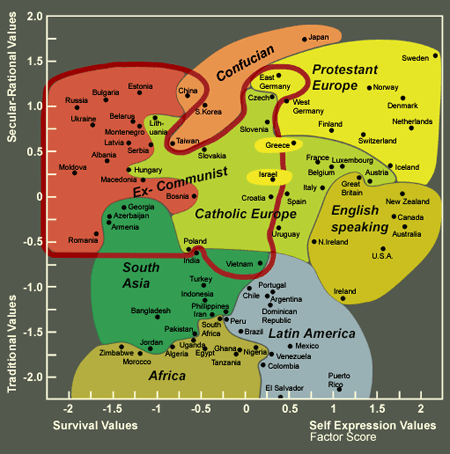
Here is a map from Ronald Inglehart’s World Values Survey organization web site. The site allows users to analyze data collected by the World Values Survey in dozens of countries around the world. We are reading Inglehart’s The Renaissance of Political Culture this week and will analyze the importance of political culture for understanding political outcomes, such as democracy and economic development. Are some cultures more compatible with democracy and economic growth than others? Is culture a more compelling framework for testing political phenomena than is rational choice?

Inglehart-Welzel Cultural Map of the World

This map reflects the fact that a large number of basic values are closely correlated; they can be depicted in just major two dimensions of cross-cultural variation

inglehart_weltzel_value_map.gif

Condoleeza Rice, International Relations Theory and the Bush Administration

In class today, I tried to convince you that understanding IR from a theoretical perspective was not simply some abstract, pedantic pursuit, but that the theoretical lens through which we view international relations does have real-world implications, many of which are dramatic.

I noted the role of Condoleeza Rice as the chief National Security Advisor to President Bush during his first term and also noted that Rice has long held a realist view of international relations. As you must know by now (I think I’ve mentioned it about 503 times since the beginning of the semester), realists view the state as the only prominent actor in international affairs. This was Rice’s view upon assuming her new position and this was manifested in the security objectives of the incoming administration, which did not believe, initially, that a non-state actor like Al Qaeda was a grave threat to the security of the United States.

Here are excerpts from Rice’s article in Foreign Affairs magazine in the midst of the 2000 presidential election campaign:

Summary: With no Soviet threat, America has found it exceedingly difficult to define its “national interest.” Foreign policy in a Republican administration should refocus the country on key priorities: building a military ready to ensure American power, coping with rogue regimes, and managing Beijing and Moscow. Above all, the next president must be comfortable with America’s special role as the world’s leader…

Continue reading “Condoleeza Rice, International Relations Theory and the Bush Administration”

Design a site like this with WordPress.com
Get started