Islam, Religious Attitudes, and Democracy

There is a lot of ink being spilled on the question of the compatibility of Islam with democracy. Here is a link to a paper by Mark Tessler, published in the journal, Comparative Politics, in 2002.

“Islam and Democracy in the Middle East: The Impact of Religious Orientations on Attitudes Toward Democracy in Four Arab Countries,” Comparative Politics, Vol. 34 (April 2002): 337-354.

If you are on campus, here is a direct link to a pdf version of the article.

From the Abstract:

Continue reading “Islam, Religious Attitudes, and Democracy”

What is Comparative Politics?

Most students (and non-students, for that matter) have only a vague idea of the content of “comparative politics.” In other sub-disciplines in political science, such as American Politics, and International Relations, the subject matter is almost self-explanatory. In a subsequent post, I’ll tell you what I think comparative politics is about. For now, I provide for you (once again, free of charge!) a sample of the titles of some recent articles published in one of the leading journals in the field of comparative politics, the aptly titled Comparative Politics.

Volume 40, Number 2, January 2007

  • John Sidel, “Social Origins of Dictatorship and Democracy Revisited: Colonial State and Chinese Immigrant in the Making of Modern Southeast Asia”
  • Frances Hagopian, “Latin American Catholicism in an Age of Religious and Political Pluralism: A Framework for Analysis”
  • Gary L Goodman and Jonathan T. Hiskey, “Exit without Leaving: Political Disengagement in High Migration Municipalities in Mexico”
  • Ozge Kemahlioglu, “Particularistic Distribution of Investment Subsidies under coalition Governments: The Case of Turkey”
  • Lianjiang Li, “Political Trust and Petitioning in the Chinese Countryside”

Volume 40, Number 1, October 2007

  • J. Samuel Valenzuela, Timothy R. Scully, and Nicolás Somma, “The Enduring Presence of Religion in Chilean Ideological Positionings and Voter Options”
  • Christina Davis and Jennifer Oh, “Repeal of the Rice Laws in Japan: The Role of International Pressure to Overcome Vested Interests”
  • Linda J. Cook, “Negotiating Welfare in Postcommunist States”
  • Wim van Oorschot and Wilfred Uunk, “Welfare Spending and the Public’s Concern for Immigrants: Multilevel Evidence for Eighteen European Countries”
  • Christian Albrekt Larsen, “How Welfare Regimes Generate and Erode Social Capital: The Impact of Underclass Phenomena”
  • Review Article: Veljko Vujačić, “Elites, Narratives, and Nationalist Mobilization in the Former Yugoslavia”

Continue reading “What is Comparative Politics?”

Ethnic Cleansing and Violence in Baghdad

The Washington Post carries a story on the front page of its Sunday edition, which describes the changing nature of residential segregation in Baghdad, from the perspective of returning refugees and displaced persons. Included is a compelling map [click the link on the left for a larger view] of Baghdad showing the dynamics of the process of ethnic cleansing (and ethnic consolidation) of Baghdad’s map_ethnic_cleansing_baghdad.gifneighborhoods between April 2006 and November 2007.
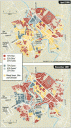
This could have something to do with the decreasing levels of violence in Baghdad over the last six months or so. (Of course, the increased US troop presence helps, but a more compelling argument comes out of work by many political scientists on the rational, or strategic, nature of inter-ethnic violence. The violence that is perpetrated by the respective sides during episodes of inter-ethnic conflict is rarely random.

In my own work in Croatia, there was a compelling strategic logic to the violence perpetrated by both sides. Territory–towns, regions, cities, etc.,–that was deemed strategically important was targeted, while territory that was not strategically important was left alone. A similar dynamic may be occurring in Baghdad. With the task of segregation of Baghdad’s neighborhoods a fait accompli, the need and desire, on the part of the sectarian militias, to use violence has diminished considerably.

My Intro to Comparative Politics Final Exam–Fall 2007

Here is my exam:

Final Exam–PLSC240–Intro to Comparative Politics

The final exam consists of three parts. Please read the instructions carefully! Please answer all questions in your blue book only!

Part I–Identification

Please define, and explain the significance of, 9 of these 11 terms in four or five sentences each.
1. Preferences & Beliefs
2. Capacity
3. Legitimacy
4. Comparative method
5. Concrete versus abstract (judicial) review
6. Export-oriented industrialization
7. Failed State
8. Hybrid regimes
9. jus sanguinus & jus soli
10. Prisoner’s Dilemma
11. Proportional Representation

Continue reading “My Intro to Comparative Politics Final Exam–Fall 2007”

Assessing the Quality of Democracy

This is the title of a Journal of Democracy-inspired book co-edited, with an introduction, by Larry Diamond and Leonardo Morlino. Following the introduction, the book is divided into two sections: a thematic chapter dealing with such issues as (author in parentheses) the rule of law (O’Donnell), accountability (Schmitter), freedom (Beetham), equality (Rueschemeyer), and responsiveness (Bingham Powell, Jr.).

The second section comprises a series of two-country comparative case studies, which include the following: Italy and Spain, Chile and Brazil, Bangladesh and India, South Korea and Taiwan, Poland and Romania, and Ghana and South Africa.

I think I will use this the next time I teach Intro to Comparative.

Political Culture and Economic Outcomes

What kind of an impact does political culture have on political and economic outcomes and are there systematic differences across countries? In this new paper, Alberto Alesina and Paola Guiliano use data culled from the World Value Survey to demonstrate an effect between the strength of family ties (which they argue are different across cultures) and economic outcomes.

Here is the abstract and a link to the paper:

We study the importance of culture, as measured by the strenght of family ties, on economic ehavior and attitudes. We define our measure of family ties using individual responses from he World Value Survey regarding the role of the family and the love and respect that children eed to have for their parents for over 70 countries. We show that strong family ties imply more reliance on the family as an economic unit which provides goods and services and less on the market and on the government for social insurance. With strong family ties home production is higher, labor force participation of women and youngsters, and geographical mobility, lower. Families are larger (higher fertility and higher family size) with strong family ties, which is consistent with the idea of the family as an important economic unit. We present evidence in cross country regressions. To assess causality we look at the behavior of second generation immigrants in the US and we employ a variable based on the grammatical rule of pronoun drop as an instrument for family ties. Our results overall indicate a significant influence of the strength of family ties on economic outcomes.

You hopefully remember the graphic of the tripartite division of society that was shown in class last week. The family, as we mentioned, is one of the fundamental institutions of civil society and the level of involvement of the family in economic decisions and economic output varies greatly across countries. As Alesian and Guiliano observe:

Stronger family ties are associated with lower labour force participation, especially that of youngsters who stay at home longer, and that of women who have traditional roles in these societies as “guardians” of the household, fostering and protecting family ties. Thus stronger family ties mean more is produced at home and less in the market. Since official statistics only take market-production into account, countries with larger home production may have a downward bias in their measure of per capita GDP. This may also suggest that it is NOT the lack of child and care facilities that make women stay at home (an argument that one always hear as a self-evident truth, for instance in Italy), but it may be – right or wrong – the result of a family choice.

Design a site like this with WordPress.com
Get started