Transparency International Corruption Perceptions Index for 2007

Economists, political scientists and practitioners have long been aware of the deleterious effects of corruption. Transparency International, an international NGO, has been playing a lead role since its inception in 1993 in the fight to highlight the problem of corruption and in creating a forceful international anti-corruption movement. What is corruption?

Corruption is the abuse of entrusted power for private gain. It hurts everyone whose life, livelihood or happiness depends on the integrity of people in a position of authority.

What are some of the effects of corruption, but obvious and hidden?

Corruption hurts everyone, and it harms the poor the most. Sometimes its devastating impact is obvious:

* A father who must do without shoes because his meagre wages are used to pay a bribe to get his child into a supposedly free school.

* The unsuspecting sick person who buys useless counterfeit drugs, putting their health in grave danger.

* A small shop owner whose weekly bribe to the local inspector cuts severely into his modest earnings.

* The family trapped for generations in poverty because a corrupt and autocratic leadership has systematically siphoned off a nation’s riches.

Other times corruption’s impact is less visible:

* The prosperous multinational corporation that secured a contract by buying an unfair advantage in a competitive market through illegal kickbacks to corrupt government officials, at the expense of the honest companies who didn’t.

* Post-disaster donations provided by compassionate people, directly or through their governments, that never reach the victims, callously diverted instead into the bank accounts of criminals.

* The faulty buildings, built to lower safety standards because a bribe passed under the table in the construction process that collapse in an earthquake or hurricane.

Corruption has dire global consequences, trapping millions in poverty and misery and breeding social, economic and political unrest.

Corruption is both a cause of poverty, and a barrier to overcoming it. It is one of the most serious obstacles to reducing poverty.

Here is a chart comparing corruption levels around the world in 2007. The higher the cpi score, the higher the level of perceived corruption.
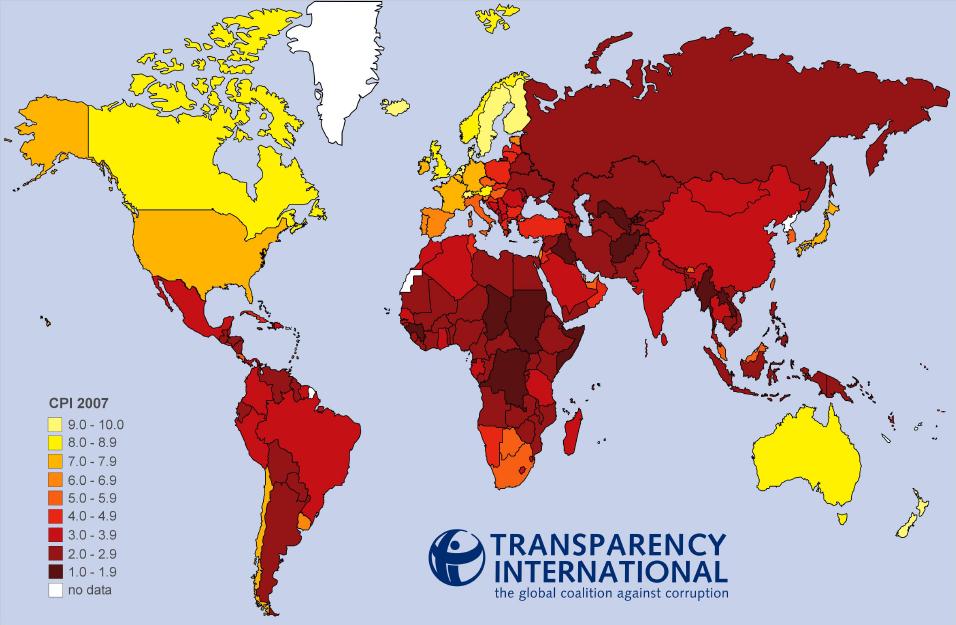
transparency_corruption_world_map_2007.jpg

Pulitzer Center on Crisis Reporting

Here is some information about an interesting new NGO dedicated to reporting on the world’s crisis spots. The World Security Institute’s Pulitzer Center on Crisis Reporting was established in 2006.   Be sure to also have a look at their “untold stories” blog page.  Here is a description of their mission, in their own words:

The World Security Institute’s Pulitzer Center on Crisis Reporting, established in 2006, intends to be a leader in sponsoring the independent reporting that media organizations are increasingly less willing to undertake on their own. The Center’s goal is to raise the standard of coverage of global affairs, and to do so in a way that engages both the broad public and government policy-makers.

The Pulitzer Center is a bold initiative, in keeping with its sponsorship by a family whose name for more than a century has been a watchword for journalistic integrity and courage. From Teapot Dome through the civil rights struggle, Vietnam and the run-up to Iraq, the Pulitzers have stood for a “drastically independent” journalism that would “never be satisfied with merely printing news.”

When the third Joseph Pulitzer became editor of the St. Louis Post-Dispatch a half century ago, he paid tribute to that legacy. “Not only will we report the day’s news,” he said, “but we will illuminate dark places and, with a deep sense of responsibility, interpret these troubled times.” The Pulitzer Center is driven by that same mission and deep sense of responsibility, in times just as troubled.

The Pulitzer Center functions as an independent division of the World Security Institute, itself a leader in the sponsorship of independent journalism and scholarship. The Center will partner with the Institute’s other divisions, especially in television production and Internet publications, both to identify potential reporting topics and to insure global distribution of the projects that result.

The Center welcomes proposals for enterprising reporting projects throughout the world, with an emphasis on issues that have gone unreported, under-reported or mis-reported in the mainstream American media. The Center’s director is Jon Sawyer.

World Economic Forum Releases Global Risks Report for 2008

The World Economic Forum, a Swiss-based NGO whose motto is “entrepreneurship in the global public interest”, has recently released its Global Risks Report for 2008.  They view four main issues as presenting the most potential global risk over the next twelve months and beyond.

The present report looks at global risks from a range of different perspectives. The first part of the report focuses on four emerging issues that are shaping the global risk landscape: systemic financial risk, food security, supply chains and the role of energy. On systemic financial risk, we put current market turmoil in the historical context and ask how the transformation of the global financial system over the last two decades may require us to rethink our expectations and understanding of systemic risk in the future. On food security, we discuss how the subject has moved from the periphery of the global risk landscape to its centre, and ask whether the world is ready to cope with the various trade-offs that the new food economy is generating. On supply chains, we investigate a potentially hidden set of vulnerabilities in the global economy to supply chain disruptions. Finally, on energy, we outline the emergence of a range of energy-related risks and ask if the world can move towards secure and sustainable energy.

World’s Top 10 (International Relations) Think Tanks by FPRI

The Foreign Policy Research Institute has compiled a list of the world’s top ten think tanks. You can find the report archived at the International Crisis Group’s website here.

Here are the top 10, according to FPRI:

Top 10 Think Tanks Globally
(Arranged Alphabetically)

Think Tank

Country

Centre for European Policy Studies

Belgium

French Institute of International Relations

France

German Institute for International Politics and Security

Germany

Institute of World Economy and International Relations

Russia

International Crisis Group

Belgium

International Institute for Strategic Studies

United Kingdom

Jaffee Center for Strategic Studies

Israel

Japan Institute of International Affairs

Japan

Royal Institute of International Affairs

United Kingdom

Shanghai Institute for International Studies

China

Transparency International Corruption Index

Here’s another excellent source of information from an NGO, Transparency International, that investigates, writes about, and collects data dealing with corruption. This NGO puts out an annual Transparency Index, listing countries around the world with respect to the level of corruption in each.

What is Transparency International?

Transparency International, the global civil society organisation leading the fight against corruption, brings people together in a powerful worldwide coalition to end the devastating impact of corruption on men, women and children around the world.
TI’s mission is to create change towards a world free of corruption.

Transparency International challenges the inevitability of corruption, and offers hope to its victims. Since its founding in 1993, TI has played a lead role in improving the lives of millions around the world by building momentum for the anti-corruption movement. TI raises awareness and diminishes apathy and tolerance of corruption, and devises and implements practical actions to address it.

Here is a link to the Corruption Perceptions Index (CPI), and Bribe Payers Index (BPI), among others. There is a wealth of information on this site related to corruption.

Design a site like this with WordPress.com
Get started