Individuals Having an Impact on IR

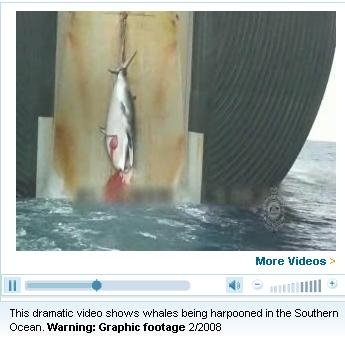
In a previous post, I asked you to consider not how international relations affects you, but how the way in which you behave, and the actions that you take have an effect on IR. Here’s a story about how changing individual attitudes in Japan may be having a greater impact on the whaling industry than the combined efforts of states and NGOs over the last couple of decades. You can see a graphically disturbing video of whales being killed at the link above.

JAPAN’s whalers are going broke and have been forced to slash prices because no one wants to eat their growing mountain of whale meat.

whale_slaughter.jpgThe farcical truth of Japan’s whaling industry was exposed yesterday by Japanese media reports that the Institute for Cetacean Research is struggling to repay $37 million in government subsidies.

The report came as Japanese embassy officials made a stern protest in Canberra over the Federal Government’s release of shocking whaling photographs.

The ICR, responsible for Japan’s lethal “research operation”, is flooding Japan with cheap whale meat that it cannot sell, according to the reports in respected newspaper Asahi Shimbun.

Meat and other parts of whales killed during ICR “scientific research” in the Southern Ocean is sold to a private fisheries company Kyodo Senpaku, which manages the sale of whale meat in the Japanese market. But while ICR has consistently increased the number of whales it kills – by 30 per cent between 2005 and 2006 – there has been no rise in domestic demand for whale meat or products.

Greenpeace Australia Pacific whales campaign director Rob Nicholl said the losses were further proof that there was no market for whale meat in Japan.
“It’s standard economics. There is an oversupply. They’ve had to reduce the price but they still can’t get rid of the stuff,” he said.
Do you think that this story can shed any light on a potential solution to the drug and human trafficking industries? How specifically?
Thanks in part to Hillary and “Obama-san”, fresh image of U.S. Abroad

In Chapter 5, Mingst discusses two main categories of the power of states–tangible and intangible. Amongst the intangible sources of power are national image, public (whether domestic or international) support, and leadership. Based on this article in the Christian Science Monitor, the Democratic primary seems to have increased the level of tangible U.S. power.

Regardless of which Democrat pulls ahead as the candidates race toward Nevada and South Carolina, the rapid political rise of a Harvard-educated Illinois senator with a Kenyan father is bringing ripples and some tides of excitement in the near and far corners of a weary world.

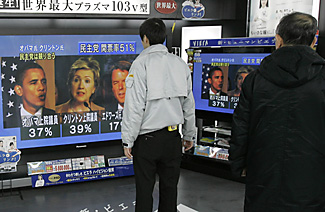
Who’s The One? Japanese watched the results of the New Hampshire Democratic primary in Tokyo Wednesday. Shizuo Kambayashi/APIt’s clear that the buzz around America’s first realistic black candidate has fed the imagination of many non-US observers, who see the controversial superpower as offering something different…

…”[Barack Obama is] what the rest of the world dreams America can be,” says JacquesMistral, a transatlantic specialist and director of economic studies at the French Institute for International Relations in Paris. “He looks like a Kennedy type, and that he’s black is very new. In Europe, the idea that a woman can win is accepted. But for a black person to win would represent a radical change – for the US, and the world.”

It is too early to say that “Obama-mania” is sweeping the planet, particularly after the junior senator’s second place showing in New Hampshire. The public in Europe and Asia have only recently focused on Mr. Obama, though in Africa he’s been news for some time.

But in a world where nearly every poll shows America’s image seriously dragging after the Iraq war onset, and scant interest in Republicans, Obama has made a significant splash, especially among the young…

…In Japan, where US elections are sometimes taken more seriously than the election of the Japanese prime minister, the rise of Obama is as intriguing a subject as the romance between French President Nicolas Sarkozy and the Italian singer Carla Bruni.

“Obama-san is great,” says Azusa Shiraishi, a sophomore at Seinan Gakuin University in Fukuoka. She compares Obama with the Rev. Martin Luther King Jr. and thinks “he could bring different perspectives of the US to us as well as American people. That would be great.”

Australia and Japan in Whaling row

The Financial Times reports that the Australian Prime Minister has vowed to try to put an end to commercial whaling, which puts him at odds with a Pacific ally, Japan. You can find the whole story here, but here’s an important snippet:

Kevin Rudd, Australia’s new Labor prime minister, on Thursday said his government would pursue all means to end commercial whaling by Japan and other countries, dismissing claims that Japanese hunting is for scientific purposes.

Mr Rudd’s comments, which mark a significant shift in Australian foreign policy, came amid a tense stand-off that has soured relations between Japan and Australia.

The previous conservative government of John Howard, defeated by Labor in last November’s election, had avoided antagonising Japan, one of Australia’s closest allies and most important trading partners, over the issue.

We’ll look at this issue later in the semester when we analyze the state or domestic level. There is an important theory in IR that argues that there is a single, unitary national interest that is fairly consistent over time, regardless of which party or leader is in charge. What is this theory and what are the implications for that theory of the whaling row between the Japanese and Australians?

Design a site like this with WordPress.com
Get started