“Truman lost China” and the effect of “the stuff of politics” on IR

In our discussion of the international (or system) level-of-analysis in IR, we noted some of the strengths and weaknesses of focusing explanation and description at that level. While system-level explanations are helpful in that they are comprehensive and holistic, a major disadvantage of that level is that it misses, or neglects, the “stuff of politics.” What does that mean?

ping_pong_diplomacy.jpgHere’s an explanation by way of example. The image below is of Richard Nixon and Mao ZeDong engaging in “ping pong diplomacy”* with Chinese Prime Minister Zhou Enlai looking on approvingly [why is Mao using a “Western” grip?]. Those of you who know a little bit about US-China diplomatic history understand the importance of the “Nixon goes to China” moment. The most significant point, for our purposes, is that this meeting signaled the re-establishment of diplomatic relations between the United States and “Red China”, after they had been cut off due to the 1949 victory of Mao’s Communists in the Chinese Civil War. It was not surprising that it was Nixon–a Republican–who was able to make this diplomatic gesture, since it would have been politically impossible for a Democratic president to have done the same. This is because President Harry S. Truman, and the whole of the Democratic party by association, had been vilified for having “lost China” to Communism. This is the kind of “stuff of politics” that is ignored when looking at IR from only an international (or system-level) perspective. Here is a clip from a documentary analyzing Nixon’s visit to China:

*Nixon and Mao never did play ping-pong (as far as I know), but their meeting was given the name “ping-pong diplomacy” since the first post-1949 diplomatic US visitors to China were table tennis players.

The Federal Budget and Military Defense Spending

When we address Chapter 5 of Mingst, we’ll learn about the various sources of power. One of the most important, obviously, is military power. Given President Bush’s latest $3.1 trillion budget proposal, I began to wonder how much of that is apportioned to spending on the military and defense? Fred Kaplan from Slate.com has done the research and has concluded the following:

As usual, it’s about $200 billion more than most news stories are reporting. For the proposed fiscal year 2009 budget, which President Bush released today, the real size is not, as many news stories have reported, $515.4 billion—itself a staggering sum—but, rather, $713.1 billion.

Is that a lot? Is it “staggering”, as Kaplan suggests? Should we be concerned with how much we spend militarily? I think the answer is yes, but in the manner of a discriminating consumer. In other words, what is our “rate of return” on that spending? Is the spending efficient and non-wasteful? Could we be just as safe and powerful if we spent 75%, or 50% of that total? A couple of data points suggest that US military spending does not give us a good rate of return and if national defense were a private industry, we’d be looking for a different supplier. First, how does US military spending compare to how much China, Russia (two potential rivals) or the European Union, or Canada, are spending on defending their states? Here’s an estimate, from the Washington-based think tank GlobalSecurity. org (which has a lot of great data related to security issues):

World Wide Military Expenditures

Country

Military expenditures (US$)

Budget Period

World

$1100 billion

2004 est. [see Note 4]

Rest-of-World [all but USA]

$500 billion

2004 est. [see Note 4]

United States

$623 billion

FY08 budget [see Note 6]

China

$65.0 billion

2004 [see Note 1]

Russia

$50.0 billion

[see Note 5]

France

$45.0 billion

2005

United Kingdom

$42.8 billion

2005 est.

Japan

$41.75 billion

2007

Germany

$35.1 billion

2003

Italy

$28.2 billion

2003

South Korea

$21.1 billion

2003 est.

India

$19.0 billion

2005 est.

Saudi Arabia

$18.0 billion

2005 est.

Australia

$16.9 billion

2006

Turkey

$12.2 billion

2003

Brazil

$9.9 billion

2005 est.

Spain

$9.9 billion

2003

Canada

$9.8 billion

2003

Israel

$9.4 billion

FY06 [see Note 7]

Kaplan observes something even more interesting than the relative amount that the United States is spending–the apportionment of that spending amongst the different military services:

The “Overview” section of the Pentagon’s budget document contains a section called “Program Terminations.” It reads, in its entirety: “The FY 2009 budget does not propose any major program terminations.”

Is it remotely conceivable that the Defense Department is the one federal bureaucracy that has not designed, developed, or produced a single expendable program? The question answers itself.

There is another way to probe this question. Look at the budget share distributed to each of the three branches of the armed services. The Army gets 33 percent, the Air Force gets 33 percent, and the Navy gets 34 percent.

As I have noted before (and, I’m sure, will again), the budget has been divvied up this way, plus or minus 2 percent, each and every year since the 1960s [author’s emphasis]. Is it remotely conceivable that our national-security needs coincide so precisely—and so consistently over the span of nearly a half-century—with the bureaucratic imperatives of giving the Army, Air Force, and Navy an even share of the money? Again, the question answers itself. As the Army’s budget goes up to meet the demands of Iraq and Afghanistan, the Air Force’s and Navy’s budgets have to go up by roughly the same share, as well. It would be a miracle if this didn’t sire a lot of waste and extravagance.

Congress exposes this budget to virtually no scrutiny, fearing that any major cuts—any serious questions—will incite charges of being “soft on terror” and “soft on defense.” But $536 billion of this budget—the Pentagon’s base line plus the discretionary items for the Department of Energy and other agencies—has nothing to do with the war on terror. And it’s safe to assume that a fair amount has little to do with defense. How much it does and doesn’t is a matter of debate. Right now, nobody’s even debating.

defense_budget_2008_2009.jpg

Source for chart: Department of Defense

American Conservatives Against John McCain’s Foreign Policy

A few sessions from now we’ll analyze international relations from a state-level perspective.  The great debate in IR, with respect to the state level, is whether state level characteristics such as economic system, political regime, etc., are determinative in explaining and predicting state behavior at the international level.  As we have already discussed, the neorealists have a ready answer: the only state-level characteristic that matters in foreign affairs is power.  The liberals, of course, have a different viewpoint, as do radicals and constructivists.   Notice one word that was absent from the preceding two sentences–conservative.  What are the elements of a conservative foreign policy?  [There is, of course, a neoconservative approach (or theory) in IR, but what about conservative, with the neo prefix?  Moreover, does the ideological viewpoint of the U.S. President matter in the way that foreign policy decisions in the White House are made?

To help answer the second question, I would like to introduce you to a group of self-professed American conservatives, who banded together in 2002 and created The American Conservative magazine.  How do those in charge of the magazine define conservatism and what are their views of the upcoming presidential election?

We believe conservatism to be the most natural political tendency, rooted in man’s taste for the familiar, for family, for faith in God. We believe that true conservatism has a predisposition for the institutions and mores that exist. So much of what passes for contemporary conservatism is wedded to a kind of radicalism—fantasies of global hegemony, the hubristic notion of America as a universal nation for all the world’s peoples, a hyperglobal economy. In combination with an increasingly unveiled contempt for America’s long-standing allies, this is more a recipe for disaster.

Against it, we take our stand.

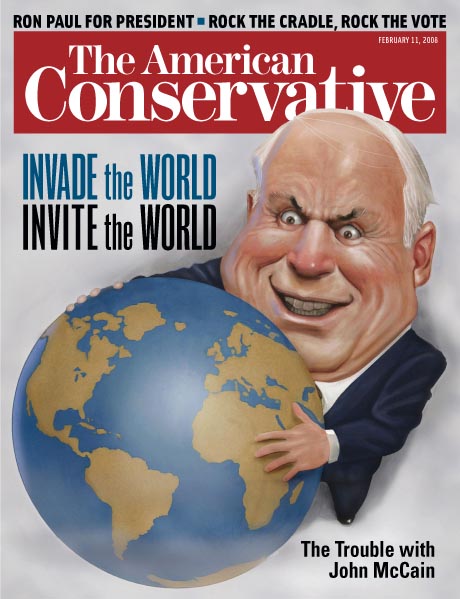
Consistent with their view of conservatism, they are worried (terrified?) with the prospect of a McCain presidency.  Rather than excerpt from a recent article in the magazine that assesses what a President McCain means for the future of American foreign policy, I’ll provide a link to the article and give you the title and a shot of the cover:

“The Madness of John McCain–A militarist suffering from acute narcissism and armed with the Bush Doctrine is not fit to be commander in chief.”

mccain_american_conservative_magazine.jpg

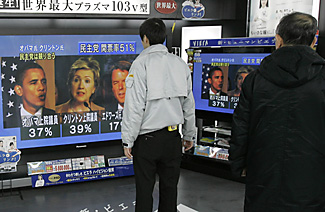
Thanks in part to Hillary and “Obama-san”, fresh image of U.S. Abroad

In Chapter 5, Mingst discusses two main categories of the power of states–tangible and intangible. Amongst the intangible sources of power are national image, public (whether domestic or international) support, and leadership. Based on this article in the Christian Science Monitor, the Democratic primary seems to have increased the level of tangible U.S. power.

Regardless of which Democrat pulls ahead as the candidates race toward Nevada and South Carolina, the rapid political rise of a Harvard-educated Illinois senator with a Kenyan father is bringing ripples and some tides of excitement in the near and far corners of a weary world.

Who’s The One? Japanese watched the results of the New Hampshire Democratic primary in Tokyo Wednesday. Shizuo Kambayashi/APIt’s clear that the buzz around America’s first realistic black candidate has fed the imagination of many non-US observers, who see the controversial superpower as offering something different…

…”[Barack Obama is] what the rest of the world dreams America can be,” says JacquesMistral, a transatlantic specialist and director of economic studies at the French Institute for International Relations in Paris. “He looks like a Kennedy type, and that he’s black is very new. In Europe, the idea that a woman can win is accepted. But for a black person to win would represent a radical change – for the US, and the world.”

It is too early to say that “Obama-mania” is sweeping the planet, particularly after the junior senator’s second place showing in New Hampshire. The public in Europe and Asia have only recently focused on Mr. Obama, though in Africa he’s been news for some time.

But in a world where nearly every poll shows America’s image seriously dragging after the Iraq war onset, and scant interest in Republicans, Obama has made a significant splash, especially among the young…

…In Japan, where US elections are sometimes taken more seriously than the election of the Japanese prime minister, the rise of Obama is as intriguing a subject as the romance between French President Nicolas Sarkozy and the Italian singer Carla Bruni.

“Obama-san is great,” says Azusa Shiraishi, a sophomore at Seinan Gakuin University in Fukuoka. She compares Obama with the Rev. Martin Luther King Jr. and thinks “he could bring different perspectives of the US to us as well as American people. That would be great.”

The USA’s Place in the World in 2016?

I posted earlier some excerpts from Daniel Drezner’s article envisioning what a post-Bush administration American foreign policy may look like, In a similar vein, here are some snippets from a piece in the New York Times Magazine written by Parag Khanna* that try to predict the nature of US power and authority at the end of 2016. The article is entitled “Waving Goodbye to Hegemony.” Do you think that the United States will lose its hegemonic status by 2016? What about the challenges from an integrated Europe and a rising China? I encourage you to read the whole article. If we have time, we will read this at the end of the semester.

But the distribution of power in the world has fundamentally altered over the two presidential terms of George W. Bush, both because of his policies and, more significant, despite them. Maybe the best way to understand how quickly history happens is to look just a bit ahead.

It is 2016, and the Hillary Clinton or John McCain or Barack Obama administration is nearing the end of its second term. America has pulled out of Iraq but has about 20,000 troops in the independent state of Kurdistan, as well as warships anchored at Bahrain and an Air Force presence in Qatar. Afghanistan is stable; Iran is nuclear. China has absorbed Taiwan and is steadily increasing its naval presence around the Pacific Rim and, from the Pakistani port of Gwadar, on the Arabian Sea. The European Union has expanded to well over 30 members and has secure oil and gas flows from 27world3-450.jpgNorth Africa, Russia and the Caspian Sea, as well as substantial nuclear energy. America’s standing in the world remains in steady decline.

Why? Weren’t we supposed to reconnect with the United Nations and reaffirm to the world that America can, and should, lead it to collective security and prosperity? Indeed, improvements to America’s image may or may not occur, but either way, they mean little. Condoleezza Rice has said America has no “permanent enemies,” but it has no permanent friends either. Many saw the invasions of Afghanistan and Iraq as the symbols of a global American imperialism; in fact, they were signs of imperial overstretch. Every expenditure has weakened America’s armed forces, and each assertion of power has awakened resistance in the form of terrorist networks, insurgent groups and “asymmetric” weapons like suicide bombers. America’s unipolar moment has inspired diplomatic and financial countermovements to block American bullying and construct an alternate world order. That new global order has arrived, and there is precious little Clinton or McCain or Obama could do to resist its growth.

Remember that when I post snippets from articles, that in no way suggests that I agree with what the author is saying. I alert you to them mostly because they introduce or mention concepts, theories and ideas that we discuss in class and also to show you get you to think critically about claims and assertions made by the author(s). To which theory of international relations do you think the author is an adherent? Why? What evidence in this article can you find to support your assertion?

*Parag Khanna is a senior research fellow in the American Strategy Program of the New America Foundation. This essay is adapted from his book, “The Second World: Empires and Influence in the New Global Order,” to be published by Random House in March.

Design a site like this with WordPress.com
Get started