Rising Food Prices Have Global Political Implications

The issue of rising food prices globally has come under increasing scrutiny lately and has political leaders concerned. The annual meetings of the World Bank and IMF gave prominence to the problem and newspapers and magazines are weighing in with their opinion on the potential short- and long-term implications of the dramatic spike in world food prices. Will this last? Are we finally facing a neo-Malthusian future or will we be able to find a feasible and politically palatable solution to this crisis?

The Economist has a new article on the potentially devastating impact that the rise in food prices. In an article called “The silent tsunami” the editors (who generally espouse a free-market oriented, classically liberal view of the relation between markets and the state) argue that what is needed to avert disaster are “radical solutions.”

PICTURES of hunger usually show passive eyes and swollen bellies. The harvest fails because of war or strife; the onset of crisis is sudden and localised. Its burden falls on those already at the margin.

Today’s pictures are different. “This is a silent tsunami,” says Josette Sheeran of the World Food Programme, a United Nations agency. A wave of food-price inflation is moving through the world, leaving riots and shaken governments in its wake. For the first time in 30 years, food protests are erupting in many places at once. Bangladesh is in turmoil (see article); even China is worried (see article). Elsewhere, the food crisis of 2008 will test the assertion of Amartya Sen, an Indian economist, that famines do not happen in democracies.

Famine traditionally means mass starvation. The measures of today’s crisis are misery and malnutrition. The middle classes in poor countries are giving up health care and cutting out meat so they can eat three meals a day. The middling poor, those on $2 a day, are pulling children from school and cutting back on vegetables so they can still afford rice. Those on $1 a day are cutting back on meat, vegetables and one or two meals, so they can afford one bowl. The desperate—those on 50 cents a day—face disaster.

Roughly a billion people live on $1 a day. If, on a conservative estimate, the cost of their food rises 20% (and in some places, it has risen a lot more), 100m people could be forced back to this level, the common measure of absolute poverty. In some countries, that would undo all the gains in poverty reduction they have made during the past decade of growth. Because food markets are in turmoil, civil strife is growing; and because trade and openness itself could be undermined, the food crisis of 2008 may become a challenge to globalisation.
After arguing that the first step in any proposed solution is for states to adequately fund the World Food Program, the editorial argues for a free-market solution to the underlying problems:

In general, governments ought to liberalise markets, not intervene in them further. Food is riddled with state intervention at every turn, from subsidies to millers for cheap bread to bribes for farmers to leave land fallow. The upshot of such quotas, subsidies and controls is to dump all the imbalances that in another business might be smoothed out through small adjustments onto the one unregulated part of the food chain: the international market.

For decades, this produced low world prices and disincentives to poor farmers. Now, the opposite is happening. As a result of yet another government distortion—this time subsidies to biofuels in the rich world—prices have gone through the roof. Governments have further exaggerated the problem by imposing export quotas and trade restrictions, raising prices again. In the past, the main argument for liberalising farming was that it would raise food prices and boost returns to farmers. Now that prices have massively overshot, the argument stands for the opposite reason: liberalisation would reduce prices, while leaving farmers with a decent living.

Here is a world hunger map from the UN Food Program. What do you think the various colors represent?
Pope Benedict XVI a Foreign Policy Radical

The Pope delivered a speech last week to the United Nations in which he argued–as have many radicals over the last few decades–that the will of the international community to act in order to solve important global problems is being undermined because a few states have accrued too much power.  The Associated Press has more:

NEW YORK – Pope Benedict XVI warned diplomats at the United Nations on Friday that international cooperation needed to solve urgent problems is “in crisis” because decisions rest in the hands of a few powerful nations.

In a major speech on his U.S. trip, Benedict also said that respect for human rights, not violence, was the key to solving many of the world’s problems.

While he didn’t identify the countries that have a stranglehold on global power, the German pope — just the third pontiff to address the U.N. General Assembly — addressed long-standing Vatican concerns about the struggle to achieve world peace and the development of the poorest regions.

On the one hand, he said, collective action by the international community is needed to solve the planet’s greatest challenges.

On the other, “we experience the obvious paradox of a multilateral consensus that continues to be in crisis because it is still subordinated to the decisions of a few.”

The pope made no mention of the United States in his speech, though the Vatican did not support the U.S.-led invasion of Iraq in 2003, which occurred despite the Bush administration’s failure to gain Security Council approval for it. At other moments on his trip, Benedict has been overtly critical of the U.S., noting how opportunity and hope have not always been available to minorities.

The pope said questions of security, development and protection of the environment require international leaders to work together in good faith, particularly when dealing with Africa and other underdeveloped areas vulnerable to “the negative effects of globalization.”

Flu Viruses’ Global Pathways Largely Predictable

We’ll be addressing globalizing issues in intro to IR on Monday and this interesting story in the Washington Post from a couple of days ago illustrates some of the important concepts raised in Chapter 10 of Mingst.

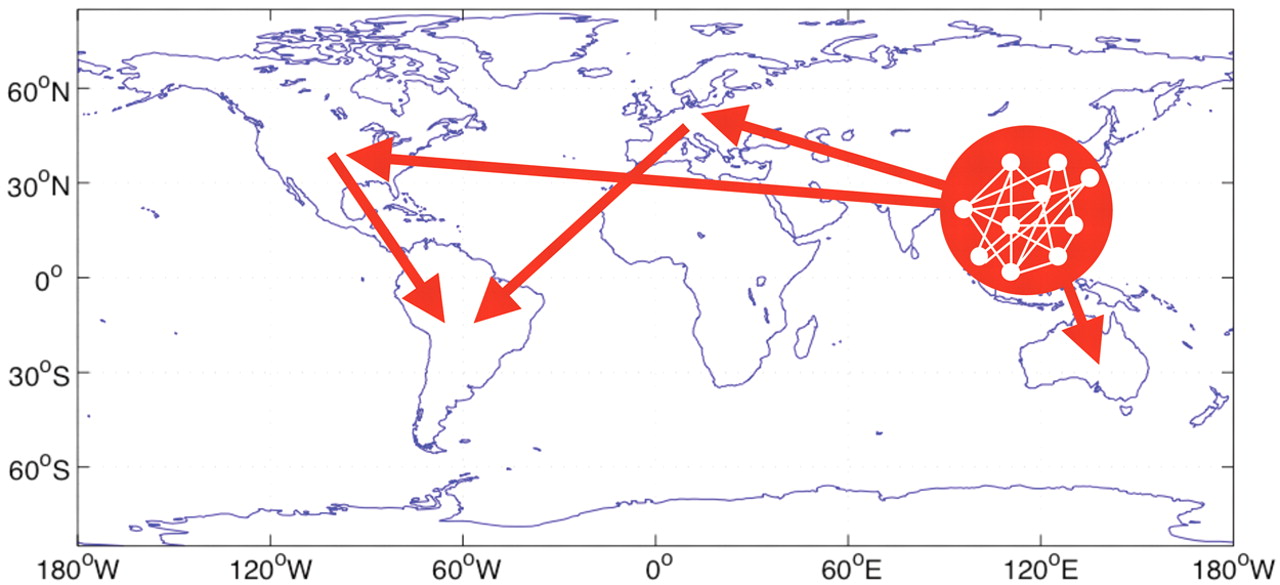
New strains of seasonal influenza virus all arise in East or Southeast Asia and take a largely predictable route around the world before dying out for good in South America, the global glue-trap for the pathogen.

That is the conclusion reported yesterday by a large team of researchers who analyzed the genetic ancestry of about 13,000 virus samples collected from six continents over a five-year period to answer long-standing questions about the flu’s life cycle.

The findings help explain the biological mechanisms that underlie two long-held observations about flu: New strains tend to appear first somewhere near China, and Australia’s flu season is a preview of what will happen in North America six months later. They also help explain why one winter’s flu is always at least a little bit different from the previous winter’s, even though the virus disappears over the summer…

But why is East-Southeast Asia always the starting point? The researchers believe it’s because of the unusual concentration of different climates there. The region has both tropical environments, where flu flourishes during the rainy season, and temperate zones. There are places that are relatively close — Russell cited Bangkok and Kuala Lumpur, Malaysia, 700 miles apart — that have totally different flu seasons.

This effectively allows new strains to be passed around the region like a baton in a relay race, even though in each climate zone the virus completely dies out once a year.

The reason new variants don’t cause epidemics if they are carried back to East Asia from elsewhere is because people already have immunity to them. They’re old news. At least that’s the theory.

Here, from Science magaizine (subscription only) is a chart demonstrating the global spread of flu viruses.

Poor Countries, Agriculture, and IMF Policies

There has been a rapid increase in food prices over the last couple of years, seen most dramatically in the recent 30% one-day rise in the price of rice worldwide.  This is putting tremendous pressure on the poor and is leading to instability in countries around the world.  There have been violent demonstrations–and equally violent government responses–to food rioting in Egypt and Haiti in the last couple of weeks.  They may be but a harbinger of the economic and political instability to come.  Here is a report from the BBC, in which an expert argues that IMF policies have contributed to the rise in food prices:

“Poor countries need to invest heavily in agriculture to feed their people.  There’s been a dearth of investment in agriculture in poor countries, mainly because of IMF and World Bank policies…”

Rice Prices Surge 30% in one Day

I think I’ll start eating more quinoa.

The Financial Times reports that “fears of unrest rise across Asia as rice price surges 30% in a day.”  In a BBC interview, the director of the International Rice Research Institute (IRRI–don’t tell me you didn’t know one existed) bluntly states why this could be a major problem.

“Rice is the staple food for about half the world’s population, and over half the world’s poor.”

As the FT reports, many events has transpired to cause such a dramatic, sudden rise in the price of this extremely important food staple and the potential political effects.

Rice prices jumped 30 per cent to a record high yesterday, raising fears of fresh outbreaks of social unrest across Asia, where the grain is a staple food for more than 2.5bn people.

The increase came after Egypt, a leading exporter, imposed a formal ban on selling rice abroad to keep local prices down and the Philippines announced plans for a major purchase of the grain in the international market to boost supplies.

Global rice stocks are at their lowest since 1976. While prices of wheat, corn and other agricultural commodities have surged since late 2006, the rice prices increase started in January.

The Egyptian export ban formalises a previous poorly enforced curb and follows similar restrictions imposed by Vietnam and India, the world’s second and third-largest exporters.

Cambodia, a small seller, also announced an export ban.

These foreign sales restrictions have removed about a third of the rice traded in the international market.

Chookiat Ophaswongse, president of the Thai Rice Exporters Association, said: “I have no idea how importing countries will get rice.” He forecast prices would rise further.

Here is the BBC interview with the head of the IRRI:

Design a site like this with WordPress.com
Get started